
Surgical instruments and prototypes (HQ)
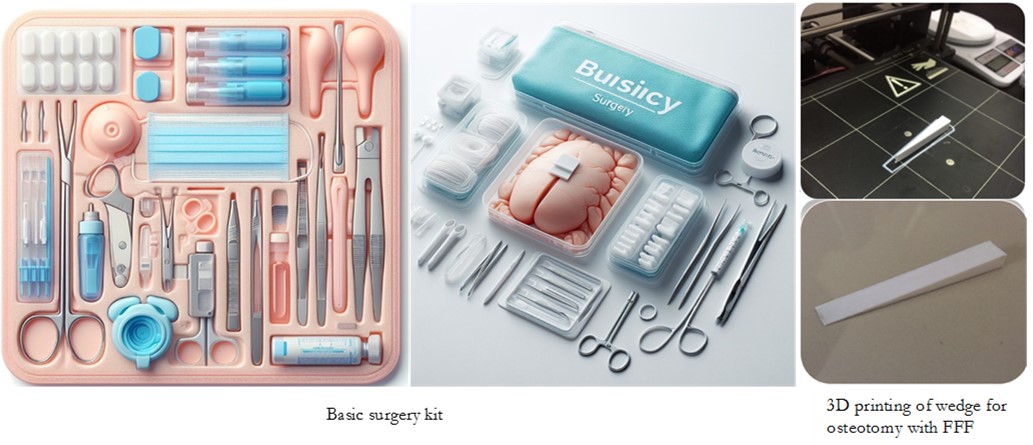
Next, there are some guidelines for medical and individualized cases with their coding, obtained after analyzing the respective references, and grouped by case study and common trends, highlighting in bold the competitive advantages that can become innovations.
HQ-01. Use imaging to subtract information, dimension the guidewire, and enter the information into a previously designed software tool containing previously parameterized models to generate an individualized design. Use 3D printing of the models to corroborate the effectiveness of the adjustments prior to their use in surgery [1]–[4].
HQ-02. Recommended materials include PLA, PC, and ABSi-Ag, and should be paired with appropriate sterilization methods. Examples:
- PC can be sterilized using an autoclave at 110-130°C for 3-10 minutes, or hydrogen peroxide plasma at 45°C for 45-80 minutes [1].
- Glutaraldehyde at room temperature has been used for PLA sterilization, although microbial bodies persist. Sterilization of PLA instruments can be achieved at a printing temperature of 240°C.
- ABSi-Ag can be sterilized at 300-311°C in a temperature-controlled environment at 77°C [2]–[5].
Printed instruments are cost-effective compared to conventional ones.
HQ-03. Among frequent applications: conventional surgical instruments for tents, surgical guides and templates for screws [1]–[5].
HQ-04. Screw templates contain a part that matches the patient’s body obtained by reverse engineering and imaging (CT or MRI), after a part that traces a drill path for screw insertion [2]–[4]
HQ-05. In the case of surgical instruments, these use a combination of standardized elements such as blades and 3D-printed material for the body or handles. The base geometry starts from conventional commercial stainless-steel instruments but is modified to overcome identified deficiencies in weight, balance, stiffness, and tactile control [5].
HQ-06. Regarding mechanical strength, the guides and jigs have no major demands on their strength. On the other hand, the surgical instrument kit, such as retractors, scalpel, and forceps, among others, must withstand more demanding loads: a tangential load of 11.3+/-0.57 kg, up to deformation 13.6+/-0.68kg, up to rupture at 15.9+0.8kg. The above applies regardless of the type of sterilization [1], [2], [5]
HQ-07. Regarding legal aspects, the reference standards that must be complied with are the following: standard for materials 5832-4 of 2011; nationally, Resolution 2183 of 2004 of the Ministry of Health and Social Protection; internationally, Laboratory Biosafety Manual, the Sterilization Manual for Health Centers [1].
HQ-08. Consider the benefits and highlight them so that the instruments gain notoriety in the market. In terms of benefits, the cost is one-tenth of the stainless-steel instrument and a manufacturing time of less than 90 minutes; an average decrease of approximately 17 minutes in intraoperative time, and one-fifth of the cost with titanium guides if polymers are used; total reduction of waste due to the use of titanium [2].
Please refer to the original bibliographic references or consult the References database or Medical database for more details.
References
[1] M. SAIN, P. RAFAEL, and L. LOPEZ, “IMPLEMENTACIÓN DE CUÑA Y DESARROLLO DE HERRAMIENTA INFORMÁTICA APLICADA A PROCESOS DE OSTEOTOMÍA UTILIZANDO TECNOLOGÍA FDM (MODELADO DE DEPOSICIÓN FUNDIDA): UN CASO CLÍNICO.,” UNIVERSIDAD DEL ATLÁNTICO, Puerto Colombia, Colombia, 2018.
[2] T. M. Rankin, N. A. Giovinco, D. J. Cucher, G. Watts, B. Hurwitz, and D. G. Armstrong, “Three-dimensional printing surgical instruments: are we there yet?,” J. Surg. Res., vol. 189, no. 2, pp. 193–197, Jun. 2014.
[3] H. H. Malik et al., “Three-dimensional printing in surgery: a review of current surgical applications,” J. Surg. Res., vol. 199, no. 2, pp. 512–522, 2015.
[4] Y. Tong, D. J. Kaplan, J. M. Spivak, and J. A. Bendo, “Three-dimensional printing in spine surgery: a review of current applications,” Spine J., vol. 20, no. 6, pp. 833–846, Jun. 2020.
[5] S. Kondor et al., “On Demand Additive Manufacturing of a Basic Surgical Kit,” J. Med. Device., vol. 7, no. 3, Jul. 2013.