
Static Failure Theory
The following is a summary of codified guidelines for failure theory (TEFA) based on the analysis of the accuracy and requirements of models used to predict the failure of materials manufactured by FFF or FDM, highlighting in bold the accuracy of the models as a measure of the degree of reliability of the products.
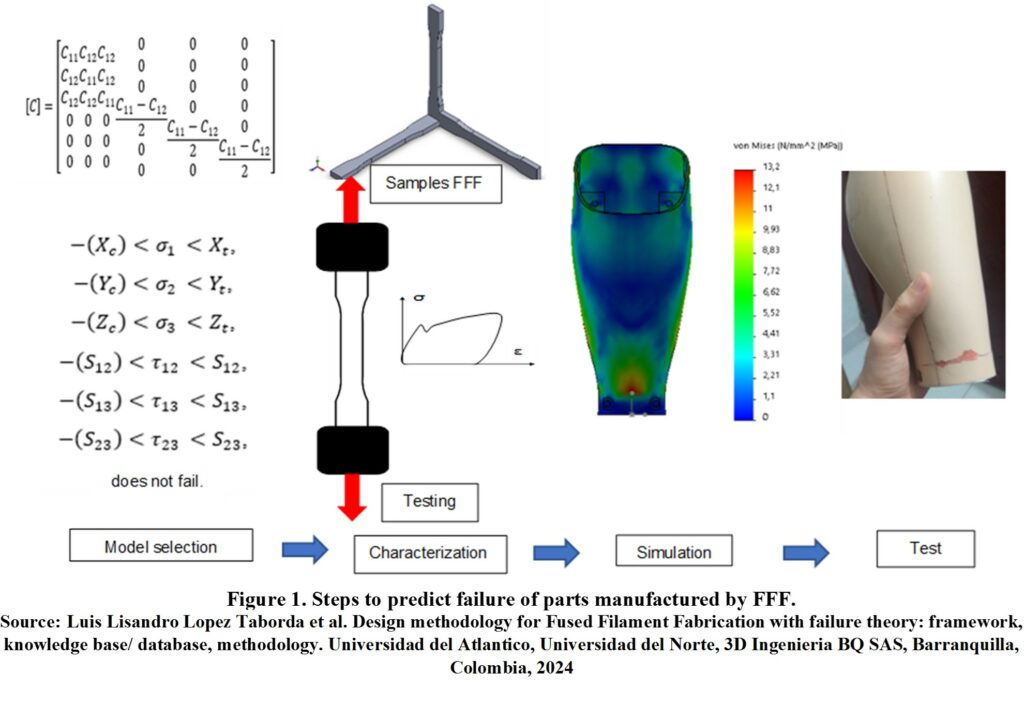
TEFA-01. The Tsai-Hill failure theory is suitable for predicting failure in plane stress cases in in-plane walls but not for combined stress cases with complex geometries.
It yields variable failure predictions in plane stress cases, with error rates of 13% to 17% depending on factors like build orientation, layer height, and raster width [1], [2]. In the case of thin-walled supports under plane strain, the prediction error was 15% [3]. However, the theory does not align with actual outcomes in studies involving parts with complex geometries and combined load states [4].
TEFA-02. The Tsai-Hill theory predicts failure in three-dimensional stress states near stress concentrators but is not suitable for single stress states.
It has prediction errors of approximately 9.4% for yield strength in three-dimensional stress near stress concentrators. However, the theory’s predictions do not align with reality when applied to elements subjected to a simple bending stress state [5]
TEFA-03. Utilize Tsai-Wu theory to optimize tension-loaded parts, not for compression optimization.
It yielded improvements of 63.2% to 67.5% when compared to the Von Mises theory in topologically optimizing three-dimensional structures under tensile loads. Both criteria were equally effective for optimizing the compressive stress state [6].
TEFA-04. To predict failure in parts subjected to combined loads and three-dimensional stresses, use the Osswald and Osswald model with caution due to the complexity in cost and time of the prior characterization.
The Osswald and Osswald theory achieves errors of 13.3% in the prediction of plane stress failure [7], [8].
TEFA-05. Use simple resistances to predict failure under simple loading conditions. Examples of investigations with good fits to experimental results:
- elements subjected to tension [9],
- bending [5]
- compression [4], [3].
TEFA-06. Use maximum stress theory to select materials and geometries in phases requiring little precision, such as conceptual or basic design.
The use of maximum stress theory is effective in the prediction of failure in three-dimensional stresses near stress concentrators, with similar accuracy but less accurate than Tsai-Hill model (11.7%) [5]
TEFA-07. Use isotropic models to predict the deflection or deformation of parts.
Deflection prediction is effective whether using an isotropic or transversely isotropic (orthotropic) model with errors around 10% and dependent on the build orientation [10], [11], [10], [11], [5].
TEFA-08. Select the appropriate failure model based on the specific situation and conduct mechanical characterization accordingly for effective utilization (see Figure 1). Each failure model necessitates its specific mechanical characterization before employing the corresponding failure theory. The number of tests increases depending on the type of stress:
- For plane stresses, characterization in two fabrication directions, including a 45° orientation, is required [4], [6], [3].
- For three-dimensional stresses, characterization in all three directions and 45° characterization in three different planes is needed [10], [11].
- The Tsai-Wu model requires compression characterization [6], [3].
- The Osswald and Osswald model necessitates testing under combined loads to accurately characterize the material [7], [8].
TEFA-09. It can be simplified by assuming transversely isotropic behavior and reducing the number of characterizations [10], [11] or taking advantage of simple loading and stress state to characterize with that type of simple loading [9], [12], [13], [4], [3], [5]
References
[1] T. Yao, Z. Deng, K. Zhang, and S. Li, “A method to predict the ultimate tensile strength of 3D printing polylactic acid (PLA) materials with different printing orientations,” Compos. Part B Eng., vol. 163, pp. 393–402, 2019.
[2] G. Alaimo, S. Marconi, L. Costato, and F. Auricchio, “Influence of meso-structure and chemical composition on {FDM} 3D-printed parts,” Compos. Part B Eng., vol. 113, pp. 371–380, Mar. 2017.
[3] R. Chen, A. Ramachandran, C. Liu, F.-K. Chang, and D. Senesky, “Tsai-Wu Analysis of a Thin-Walled 3D-Printed Polylactic Acid ({PLA}) Structural Bracket,” in 58th {AIAA}/{ASCE}/{AHS}/{ASC} Structures, Structural Dynamics, and Materials Conference, 2017.
[4] S. B. Bishwonath Adhikari, “Strength and failure mechanisms in 3D printed parts,” Master of Science in Technology, Aalto University School of Engineering Department of Mechanics of Material, 2016.
[5] R. J. Algarín Roncallo, L. L. Lopez Taborda, and D. Guillen, “Experimental characterization , theoretical modeling and failure analysis of the mechanical behavior of acrylonitrile butadiene styrene parts by fused fi lament fabrication,” no. June, 2023.
[6] A. M. Mirzendehdel, B. Rankouhi, and K. Suresh, “Strength-based topology optimization for anisotropic parts,” Addit. Manuf., vol. 19, pp. 104–113, 2018.
[7] G. A. M. Capote, A. Redmann, and T. A. Osswald, “Validating a Failure Surface Developed for {ABS} Fused Filament Fabrication Parts through Complex Loading Experiments,” J. Compos. Sci., vol. 3, no. 2, p. 49, May 2019.
[8] G. A. Mazzei Capote, N. M. Rudolph, P. V Osswald, and T. A. Osswald, “Failure surface development for ABS fused filament fabrication parts,” Addit. Manuf., vol. 28, pp. 169–175, 2019.
[9] J. Wikström, “Modeling the strength of 3D printed parts,” Aalto University, School of Engineering, Mechanical Engineering, 2015.
[10] M. Domingo-Espin, J. M. Puigoriol-Forcada, A.-A. Garcia-Granada, J. Lluma, S. Borros, and G. Reyes, “Mechanical property characterization and simulation of fused deposition modeling Polycarbonate parts,” Mater. Des., vol. 83, pp. 670–677, 2015.
[11] S. Ravindrababu, Y. Govdeli, Z. W. Wong, and E. Kayacan, “Evaluation of the influence of build and print orientations of unmanned aerial vehicle parts fabricated using fused deposition modeling process,” J. Manuf. Process., vol. 34, pp. 659–666, 2018.
[12] R. Algarín, L. López, and D. Guillen, “Experimental characterization and theoretical modelling of the mechanical behaviour of ABS in the 3D printing process,” Barranquilla, Colombia, 2023.
[13] R. Algarín, J. Vargas, and L. Lopez, “Elementos protésicos de fácil acceso para personas con amputación de miembro inferior.” BARRANQUILLA, COLOMBIA, 2019.