
Prostheses and orthoses (P&O)
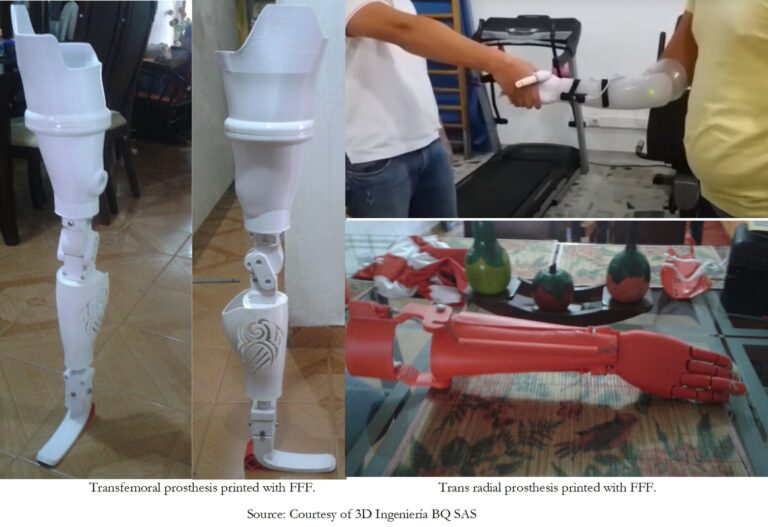
Next, there are some guidelines for medical and individualized cases with their coding, obtained after analyzing the respective references, and grouped by case study and common trends, highlighting in bold the competitive advantages that can become innovations.
P&O-01. Customizing the design of sockets, splints, or orthoses involves 3D scanning the patient’s residual limb or limb.
Specialized software is efficient for modifying size, adding features like valves and support flaps, and managing the model’s surface. It enables remote fabrication and modeling, allowing scanning and design locations to be separate [1]–[7].
The digital process reduces steps, waste, modeling time, visits, and delivery times.
P&O-02. To correct the interlaminar weakness of printed materials, use them with other stronger materials or fabricate them indirectly with FFF. Examples:
- Coating the printed prosthetic socket with epoxy resin-impregnated socks [8].
- Molding carbon fiber fabric pre-impregnated with epoxy resin using a printed mold [9].
- Using FFF printed molds to mold silicone prosthetic feet [10].
- Combining FFF printed prosthetic feet with standardized elements made from conventional materials [11].
P&O-03. Materials to be used for prosthesis and orthosis applications are ABS, Poly Lactic Acid (PLA), PA, Polycarbonate (PC). But also, less frequently, the following can be used: Polyethylene Terephthalate Glycol (PETG), TPU, High Impact Polystyrene (HIPS) [1]–[7].
P&O-04. Orient orthoses and prostheses in a direction that reduces the support material but maintains mechanical strength by avoiding aligning the layer with the load it will bear during service. At the same time, choose or optimize the fabrication paths of the support material [3].
P&O-05. Strength and durability for lower limb prostheses and orthoses are critical and regulated by specific standards. The ISO 10328:2006 standard should be used for lower limb prostheses or for foot orthoses, the ISO 22523 standard [11], [4]
P&O-06. Patient comfort can be achieved by multi-material or internal multi-pattern impressions, achieving rigid and soft zones depending on the patient’s sensitivity and the areas in contact. Polishing of the part is recommended to reduce friction on contact with the patient while improving the physical appearance of the part [11], [1], [2].
P&O-07. Prostheses and orthoses can be combined with open or accessible designs (permanent openings or gates) that allow multiple functionalities. In summary, they facilitate cleaning or grooming of the patient’s limb, combine with electrotherapy for physiotherapy or pain treatment, review the progression of recovery, and apply heat or cold and massage for physiotherapy, among other things [5], [6], [7].
P&O-08. Upper prostheses or orthoses are less demanding concerning mechanical strength but require varying degrees of freedom or movement. Digital libraries are available online, containing free mechanical and electrical prosthesis designs. These designs can be scaled to fit the size of patients or users. Also, further accessories can be incorporated to improve function, e.g., gloves to improve grip during fine grasping [12], [13].
P&O-09. Commercialization requires compliance with local standards involving quality management systems, marching laboratories, and good manufacturing practices and manuals. The infrastructure and management systems increase sales costs, from manufacturing costs ranging from US$250 to US$1000 depending on the item [13].
P&O-10. In case the prosthesis or orthosis exceeds the size of the printer, the model can be divided, incorporate screwed or adhesive joints, and consolidated after fabrication [11].
P&O-11. Biomechanical variables and comfort must be considered to ensure efficient use by the patient, for instance, variables such as:
- The contact pressure and shear stresses at the stump/socket interface during the stance phase of walking, which should be as low as possible to prevent damage to soft tissues. The pressure and stress can be quantified during the design stage through finite element simulation and measured during the walking stage by incorporating sensors for this purpose [14], [15].
- The change in volume of the stump and the piston effect or relative vertical movement of the socket with respect to the stump can be reduced with the appropriate selection of liner, pin, and/or vacuum system (suspension system). Additionally, measuring misalignment during walking is possible by incorporating sensors for this purpose [16].
- The performance, that is, the metabolic rate or energy consumption of the patient during walking, should be low to prevent premature exhaustion of the patient. Performance is optimized by also considering cost, weight, stiffness, and durability through multi-objective optimization methods and finite element simulation [14]. Moreover, including topological optimization allows for the reduction of the weight of orthotics and prosthetics while ensuring mechanical strength [15].
- Excess heat and sweating can damage the patient’s skin, and can be corrected by the appropriate selection of liner or by incorporating gel channels and openings for heat evacuation in the design of the prosthetic and orthotic, but ensuring that the pressure and shear stress is not high near the openings to avoid damage to these tissues [14], [16].
- Other aspects such as walking performance, which includes gait deviation, angular alignment or position of the socket, knee, pillar, and foot, leg length discrepancy, and selection of height. These influence energy consumption during walking and balance, and affect in terms of mechanical injuries, impaired balance, knee or back pain, and the mental health of the patient [16]. In this regard, a motion analysis should be conducted to complement the design of the prosthetic and orthotic ensuring its functionality [15].
P&O-12. Liners can be customized using similar procedures for prosthetics and orthotics, starting from the 3D scanning of the patient’s limb, surface modification through Computer-Aided Design, and optimization to achieve not excessive but also not insufficient pressure [17].
Finally, the liner is manufactured by thermomolding processes, injection molding, cryogenic CNC machining, or direct 3D printing of granular gel. The main materials used are Polyurethane (TPU), Silicone, and TPE [17].
P&O-13. Irritation and cytotoxicity tests should be considered according to ISO 10993 for prosthetic and orthotic elements that come into direct contact with the patient’s skin. Moreover, the materials should not cause allergic reactions [16].
P&O-14. Topologically optimize the material structure to reduce its stiffness at high temperatures to decrease surface tension on the patient’s limb and increase comfort, and at low temperatures, the material should recover its stiffness (shape memory). This way, excessive heat is used to enhance the patient’s comfort [16].
P&O-15. Consider the intrinsic limitations of printed materials to select suitable users to maximize the cost/benefit ratio, for example, for:
- Lower limb prostheses. They are more demanding in terms of mechanical strength because they must support the patient’s weight during walking and repeatedly (fatigue and impact), and due to the interlaminar weakness of printed materials, infants and pets can be potential users who demand less from the materials [18].
- Upper limb prostheses. Although not as mechanically demanding as the lower ones, growing infants require more changes of prostheses due to limb size changes, which implies high costs for part replacement. The low cost and rapid production of printed prostheses offset the extra costs due to changes [19]. Something similar could be concluded with lower limb prostheses for people in growth.
P&O-16. Consider statistics related to recurrent practices when designing and manufacturing 3D printed prosthetics and orthotics related to materials used, manufacturing techniques, configurations, sensors, and action control. For example:
- Upper Prostheses.
- Technology: FDM 72%, SLS 8%, SLA 4%, Others 16% [20].
- Material: PLA and ABS [19].
- Part: Hand 36% (9/25), forearm 48% (12/25), arm 16% (4/25) [20].
- Type of control: Electromyography 50% (12/24), finger 4.17% (1/24), wrist 20.8% (5/24), elbow 25% (6/24) [20].
- Energy: Body 54.2% (13/24), External 45.8% (11/24) [20].
- Flexion: Cable 87.5% (21/24), mechanical links/joints 8.3% (2/24), elastic cable 4.17% (1/24) [20].
- Extension: Cable 66.7% (16/24), mechanical links/joints 4.17% (1/24), elastic cable 16.7% (4/24), flexible cable 4.17% (1/24), flexible link 8.3% (2/24) [20].
- Orthotics and prosthetics with AM [21].
- Cases and costs: Foot orthosis 66% of cases and 20.9% of costs, Lumbosacral orthosis 3.5% and 20.8%, Knee orthosis 3.9% and 12.6%, Ankle-foot orthosis 4.3% and 10.4%.
- Foot orthosis with AM [21].
- Technology: SLS 61.5% (8/13), FDM 15.4% (2/13), FDM and SLS 15.4% (2/13), Polyjet 7.7% (1/13)
- Material: Nylon 12 70% (7/10), ABS 20% (2/10), ABS & Nylon 12 10% (1/10)
- Ankle-foot orthosis with AM [21].
- Technology: SLS 66.7% (6/9), FDM 22.2% (2/9), SLA 11.1% (1/9)
- Material: Nylon 11 or 12 or others 75% (6/8), PC 12.5% (1/8), PC-ABS & ULTEM 12.5% (1/8)
- Prosthetic sockets with AM [21].
- Technology: SLS 43.5% (10/23), FDM 34.7% (8/23), SLA 8.7% (2/23), Others 13% (3/23)
- Material: Nylon 11 or 12 or others 39.1% (9/23), PC 17.4% (4/23), PP 17.4% (4/23), Others 26% (6/23) (includes combination with resins that coat PE, PC)
P&O-17. Using topological optimization combined with 3D scanning of the patient’s geometry reduces the number of steps in the design and manufacturing process of orthotics and prosthetics, as well as the materials and weight of the product, which improves the patient’s metabolic performance. Additionally, it reduces labor and waste associated with the manual molding process [15], [21].
Please refer to the original bibliographic references or consult the References database or Medical database for more details.
References
[1] E. S. Jaimes, G. C. P. Bot\’\ia, P. H. Rodrigues, G. Reis, J. C. C. Rubio, and M. R. V. Lana, “Comparison of a transtibial socket design obtained by additive manufacturing and reverse engineering and a traditional model,” J. Phys. Conf. Ser., vol. 1126, p. 12016, Nov. 2018.
[2] Y. Jin, J. Plott, R. Chen, J. Wensman, and A. Shih, “Additive Manufacturing of Custom Orthoses and Prostheses: A Review,” Procedia {CIRP}, vol. 36, pp. 199–204, 2015.
[3] Y. Jin, Y. He, and A. Shih, “Process Planning for the Fuse Deposition Modeling of Ankle-Foot-Othoses,” Procedia {CIRP}, vol. 42, pp. 760–765, 2016.
[4] A. Shih, D. W. Park, Y.-Y. (Dory) Yang, R. Chisena, and D. Wu, “Cloud-based Design and Additive Manufacturing of Custom Orthoses,” Procedia {CIRP}, vol. 63, pp. 156–160, 2017.
[5] F. B. Haro, P. S. Pedro, A. B. S. Pedro, J. Lopez-Silva, J. A. Juanes, and R. D\textquotesingleAmato, “Design and prototyping by additive manufacturing of a functional splint for rehabilitation of Achilles tendon intrasubstance rupture,” in Proceedings of the Sixth International Conference on Technological Ecosystems for Enhancing Multiculturality – {TEEM}{\textquotesingle}18, 2018.
[6] F. Blaya, P. S. Pedro, J. L. Silva, R. D’Amato, E. S. Heras, and J. A. Juanes, “Design of an Orthopedic Product by Using Additive Manufacturing Technology: The Arm Splint,” J. Med. Syst., vol. 42, no. 3, Feb. 2018.
[7] I. Molnár and L. Morovič, “Design and manufacture of orthopedic corset using 3D digitization and additive manufacturing,” {IOP} Conf. Ser. Mater. Sci. Eng., vol. 448, p. 12058, Nov. 2018.
[8] L. H. Hsu, G. F. Huang, C. T. Lu, D. Y. Hong, and S. H. Liu, “The development of a rapid prototyping prosthetic socket coated with a resin layer for transtibial amputees,” Prosthet. Orthot. Int., vol. 34, no. 1, pp. 37–45, 2010.
[9] D.-A. Türk, H. Einarsson, C. Lecomte, and M. Meboldt, “Design and manufacturing of high-performance prostheses with additive manufacturing and fiber-reinforced polymers,” Prod. Eng., vol. 12, no. 2, pp. 203–213, Feb. 2018.
[10] O. Abdelaal, S. Darwish, K. A. Elmougoud, and S. Aldahash, “A new methodology for design and manufacturing of a customized silicone partial foot prosthesis using indirect additive manufacturing,” Int. J. Artif. Organs, vol. 42, no. 11, pp. 645–657, 2019.
[11] R. Algarín, J. Vargas, and L. Lopez, “Easily accessible prosthetic elements for lower limb amputees.” Barranquilla, Colombia, 2019.
[12] R. R. Roberto Algarín, Javier Vargas, Luis López, Guadalupe Avelar Milena Mendoza, “Diseño y Construcción de Prótesis de Miembros Superiores e Inferiores mediante Impresión 3D para Personas Discapacitadas de Bajos Recursos.” BARRANQUILLA, COLOMBIA, 2015.
[13] D. S. B. Roberto Algarín, Javier Vargas, Luis López, Guadalupe Avelar, “Prótesis electromecánicas de miembro inferior y superior para personas amputadas de bajos recursos.” BARRANQUILLA, COLOMBIA, 2017.
[14] Y. Wang, Q. Tan, F. Pu, D. Boone, and M. Zhang, “A Review of the Application of Additive Manufacturing in Prosthetic and Orthotic Clinics from a Biomechanical Perspective,” Engineering, vol. 6, no. 11, pp. 1258–1266, 2020.
[15] A. Kumar and D. Chhabra, “Adopting additive manufacturing as a cleaner fabrication framework for topologically optimized orthotic devices: Implications over sustainable rehabilitation,” Clean. Eng. Technol., vol. 10, no. May 2021, p. 100559, 2022.
[16] S. D. Varsavas, F. Riemelmoser, F. Arbeiter, and L. M. Faller, “A review of parameters affecting success of lower-limb prosthetic socket and liners and implementation of 3D printing technologies,” Mater. Today Proc., vol. 70, pp. 425–430, 2022.
[17] X. Yang et al., “Material, design, and fabrication of custom prosthetic liners for lower-extremity amputees: A review,” Med. Nov. Technol. Devices, vol. 17, no. December 2022, p. 100197, 2023.
[18] R. Mendaza-DeCal, S. Peso-Fernandez, and J. Rodriguez-Quiros, “Orthotics and prosthetics by 3D-printing: Accelerating its fabrication flow,” Res. Vet. Sci., vol. 162, no. May, p. 104960, 2023.
[19] S. Y. Uraga Morimoto et al., “Upper limbs orthesis and prostheses printed in 3D: An integrative review,” Brazilian J. Occup. Ther., vol. 29, pp. 1–14, 2021.
[20] M. Kumar, Krishnanand, A. Varshney, and M. Taufik, “Hand prosthetics fabrication using additive manufacturing,” Mater. Today Proc., no. xxxx, 2023.
[21] R. K. Chen, Y. an Jin, J. Wensman, and A. Shih, “Additive manufacturing of custom orthoses and prostheses-A review,” Addit. Manuf., vol. 12, pp. 77–89, 2016.