
Material selection considering biocompatibility and sterilization.
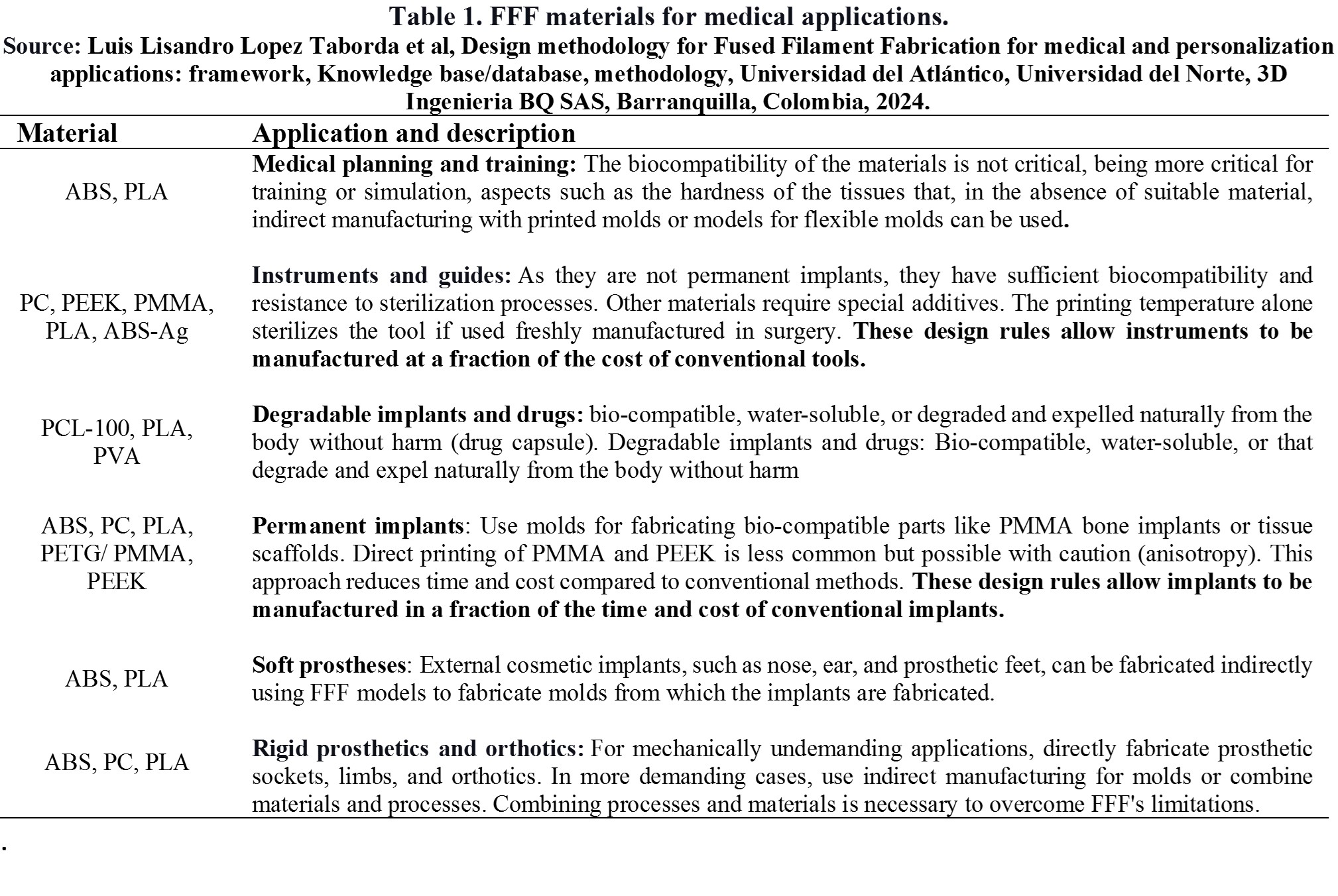
Here are the summarized general rules (RG) of design, categorized by common topics. The competitive and innovative advantages are highlighted in bold, and their application is illustrated with Figures or Tables.
RG-ME-04. The material selection considering biocompatibility and sterilization is fought according to the specific application type. Table 1 summarizes several possibilities, and the main competitive and innovative advantages are highlighted in bold.
On the other hand, more recent studies have considered different sterilization methods [1], the development of new biocompatible materials [2], [3], and reviews of the state of the art that consider the biocompatibility of FFF thermoplastic materials [4]–[7]. Careful reading is recommended to complement the above recommendations for the appropriate selection of materials, manufacturing processes, and sterilization methods.
References
[1] R. Told et al., “A state-of-the-art guide to the sterilization of thermoplastic polymers and resin materials used in the additive manufacturing of medical devices,” Mater. Des., vol. 223, p. 111119, 2022.
[2] P. Karimipour-Fard, M. P. Jeffrey, H. JonesTaggart, R. Pop-Iliev, and G. Rizvi, “Development, processing and characterization of Polycaprolactone/Nano-Hydroxyapatite/Chitin-Nano-Whisker nanocomposite filaments for additive manufacturing of bone tissue scaffolds,” J. Mech. Behav. Biomed. Mater., vol. 120, no. March, p. 104583, 2021.
[3] A. Dey, M. M. Rahman, N. Yodo, and D. Grewell, “Development of biocomposite filament for fused filament fabrication from soy hulls and soy protein isolate,” Mater. Today Commun., vol. 34, no. July 2022, p. 105316, 2023.
[4] M. J. Mirzaali, V. Moosabeiki, S. M. Rajaai, J. Zhou, and A. A. Zadpoor, “Additive Manufacturing of Biomaterials—Design Principles and Their Implementation,” Materials (Basel)., vol. 15, no. 15, 2022.
[5] S. Talib, S. Gupta, V. Chaudhary, P. Gupta, and M. A. Wahid, “Additive manufacturing: Materials, techniques and biomedical applications,” Mater. Today Proc., vol. 46, pp. 6847–6851, 2021.
[6] B. J. Singh, R. Sehgal, and R. P. Singh, “Additive manufacturing in biomedical and healthcare sector: an umbrella review,” Int. J. Interact. Des. Manuf., 2023.
[7] T. Tom et al., “Additive manufacturing in the biomedical field-recent research developments,” Results Eng., vol. 16, no. September, p. 100661, 2022.
[8] Luis Lisandro Lopez Taborda et al, Design methodology for Fused Filament Fabrication for medical and personalization applications: framework, Knowledge base/database, methodology, Universidad del Atlántico, Universidad del Norte, 3D Ingenieria BQ SAS, Barranquilla, Colombia, 2024.