Life & durability: Expected product life.
This refers to the number of load application cycles expected before the product designed and manufactured with FFF or FDM fails, or alternatively, the number of years of life depending on the recommendations and use or application of the product.
- Expected life of 1 to 7 years [1], non-functional or load cycling surfaces (but up to 10 to 100 load cycles does not rule out the process, and between 100 to over 1000 cycles, or over 1000 cycles at least consider other processes) [2].
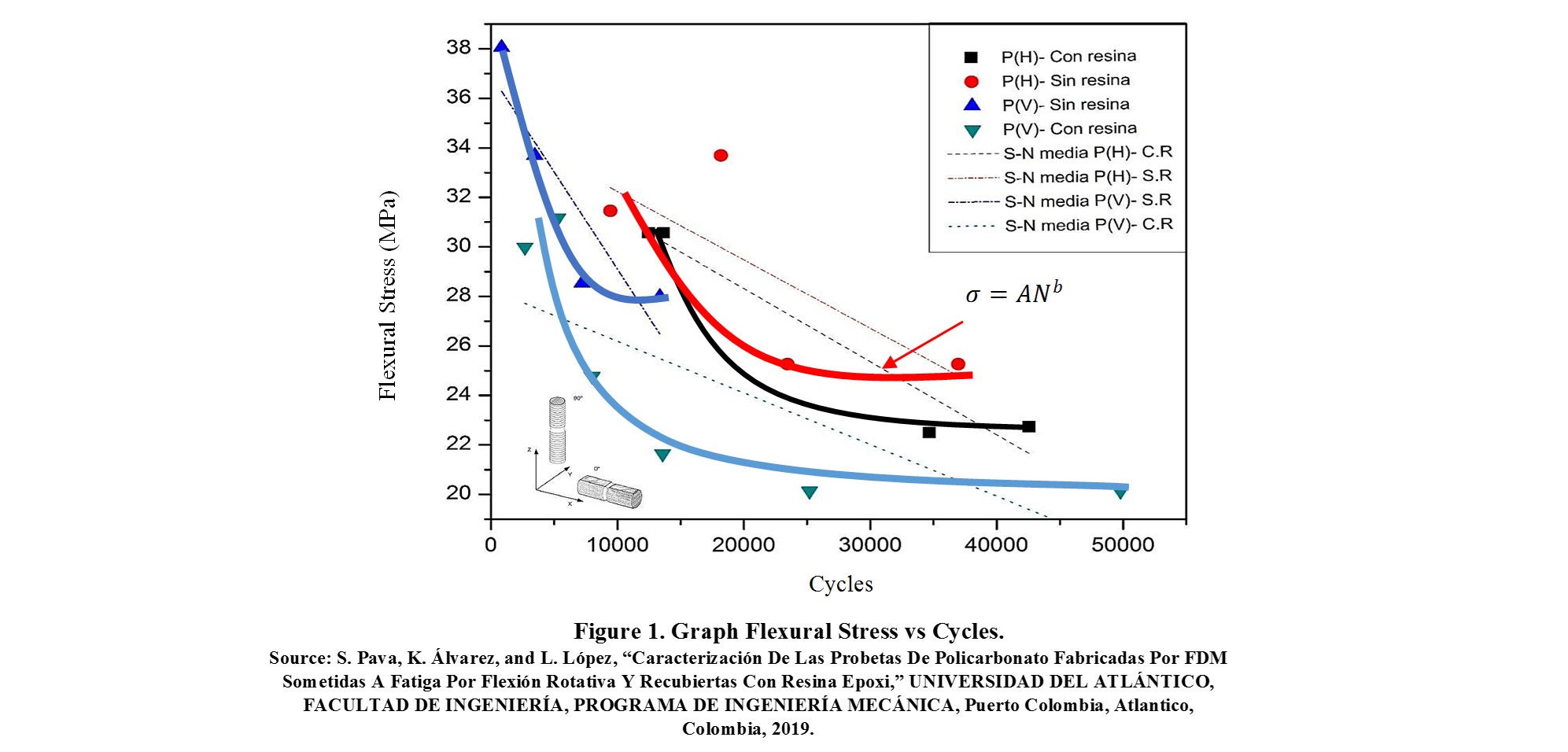
- Tests of epoxy coated specimens (PC, Polycarbonate), subjected to rotational fatigue exhibit life of approximately 50000 load cycles at 20Mpa stress [3].
- 20000-30000 cycles at 6MPa to 18Mpa stresses (PC fabricated parts) [4].
- 0 to 10MPa achieves 1Million cycle life (PLA specimens) [5].
- Using ABS-M30 to manufacture tooling for hydroforming, over 100 cycles is a reasonable expectation and over 400 is possible with sheet materials such as Aluminum 2024-0 [6].
- Using FDM/FFF to prototype injection molding tooling, hundreds to thousands can be used for injection molding [7] and low to moderate (over 5. 000) [8].
- FDM use in reverse casting is best in low volume applications (quantity in inverse proportion to part size), typically less than 100 parts [9].
In general, experience proves that parts subjected to dynamic tension loads have greater strength and lifespan if they are preferably manufactured horizontally rather than vertically oriented [3]-[4]. To overcome these limitations, it is recommended to consult the Failure Theory and Process Chain pages.
References
[1] J. Munguia, C. Riba, and J. Lloveras, “In the search of design for rapid manufacturing strategies to solve functional and geometrical issues for small series production,” in International Conference on Engineering Design ICED, 2007, vol. 7.
[2] J. W. Booth, J. Alperovich, P. Chawla, J. Ma, T. N. Reid, and K. Ramani, “The Design for Additive Manufacturing Worksheet,” J. Mech. Des., vol. 139, no. 10, p. 100904, 2017.
[3] S. Pava, K. Álvarez, and L. López, “Caracterización De Las Probetas De Policarbonato Fabricadas Por FDM Sometidas A Fatiga Por Flexión Rotativa Y Recubiertas Con Resina Epoxi,” UNIVERSIDAD DEL ATLÁNTICO, FACULTAD DE INGENIERÍA, PROGRAMA DE INGENIERÍA MECÁNICA, Puerto Colombia, Atlantico, Colombia, 2019.
[4] J. M. Puigoriol-Forcada, A. Alsina, A. G. Salazar-Mart\’\in, G. Gomez-Gras, and M. A. Pérez, “Flexural fatigue properties of polycarbonate fused-deposition modelling specimens,” Mater. Des., vol. 155, pp. 414–421, Oct. 2018.
[5] T. Letcher and M. Waytashek, “Material Property Testing of 3D-Printed Specimen in {PLA} on an Entry-Level 3D Printer,” in Volume 2A: Advanced Manufacturing, 2014.
[6] Stratasys, “TECHNICAL APPLICATION GUIDE FDM Tooling for Sheet Metal Forming: Hydroforming and Rubber Pad Press.” 2015.
[7] Stratasys, “APPLICATION GUIDE: Injection Blow Molding with FDM.” 2015.
[8] Stratasys, “TECHNICAL APPLICATION GUIDE: FDM FOR SAND CASTING.” 2013.
[9] Stratasys, “TECHNICAL APPLICATION GUIDE: Investment Casting with FDM Patterns.” 2015.