
Implants (IMP)
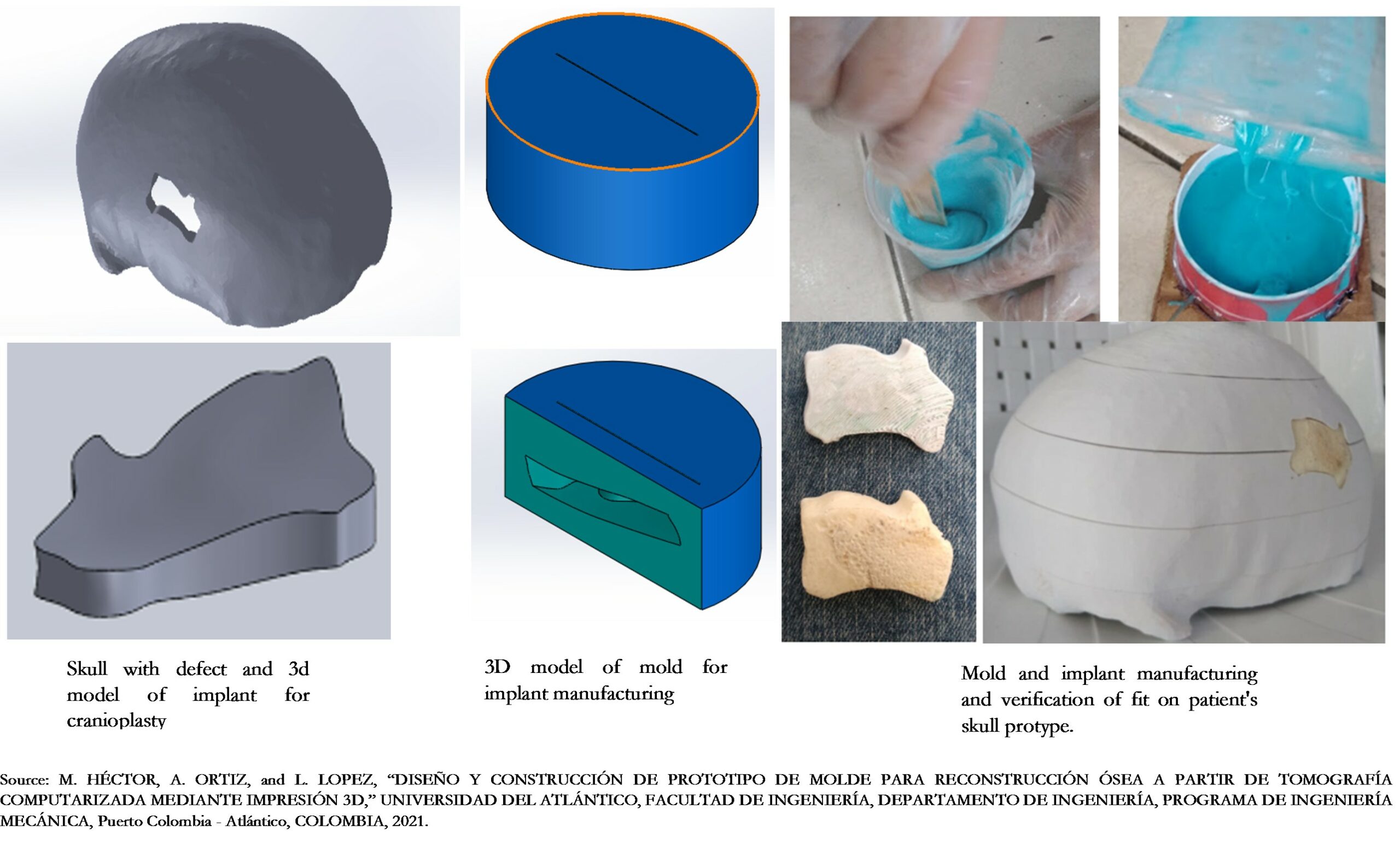
Next, there are some guidelines for medical and individualized cases with their coding, obtained after analyzing the respective references, and grouped by case study and common trends, highlighting in bold the competitive advantages that can become innovations.
IMP-01. Implants are typically manufactured indirectly, using PC or ABS molds to mold PMMA resin, or PLA models to create silicone molds for PMMA resin molding. Material compatibility with the sterilization method should be considered. Alternatively, implants can be directly fabricated using PMMA melted filament, although there are limited case studies on real patients [1], [2]
Printed implants offer significantly reduced manufacturing times and costs compared to conventional methods.
IMP-02. Customization involves reverse engineering files obtained through 3D scanning, computed tomography (CT), or magnetic resonance imaging (MRI), depending on the specific case. 3D scanning is suitable for external implants, while CT or MRI is recommended for internal implants [2]–[7].
IMP-03. It is necessary to develop special materials for specific applications; among the commercial materials developed for AM process with UV photosensitive resins and others, the cases of NextDent Denture 3D for denture bases, 3D E-Guard from EnvisionTEC for dental aligners are presented (https://envisiontec.com/3d-printing-industries/medical/dental/) [6], [7].
IMP-04. Materials for various applications include:
- Titanium for bone implants.
- Poly (L-lactide) (PLLA) for bioabsorbable implants, breaking down into body-absorbable lactic acid over time.
- Copolyester polymer for bioabsorbable implants.
- In development: polyglycolic acid, tyrosine, polycaprolactone, salicylic acid, or polycarbonate for endoprostheses and skin implants.
- For dental implants (braces): thermoplastic elastomer (TPE), thermoplastic elastomer vulcanized (TPV), polyurethane elastomer, block copolymer elastomer, polyolefin blend elastomer, and thermoplastic copolyester elastomer.
- Grafts made from polydimethylsiloxane (PDMS), flexible poly lactic acid (PLA), and PCL materials, followed by uniform filling with a hydrogel composed of fibrin and collagen.
- PCL for throat implants.
These materials offer a wide range of options for diverse medical applications [6], [7].
IMP-05. Customization is achieved by reverse engineering the files obtained by 3D scanning, computed tomography or MRI depending on the specific case [1]–[7]
IMP-06. Consider and highlight the benefits so the implant gains notoriety in the market. Reductions of more than 50% of waiting time and cost reduction in the case of bone implants [2].
Please refer to the original bibliographic references or consult the References database or Medical database for more details.
References
[1] M. HÉCTOR, A. ORTIZ, and L. LOPEZ, “DISEÑO Y CONSTRUCCIÓN DE PROTOTIPO DE MOLDE PARA RECONSTRUCCIÓN ÓSEA A PARTIR DE TOMOGRAFÍA COMPUTARIZADA MEDIANTE IMPRESIÓN 3D,” UNIVERSIDAD DEL ATLÁNTICO, FACULTAD DE INGENIERÍA, DEPARTAMENTO DE INGENIERÍA, PROGRAMA DE INGENIERÍA MECÁNICA, Puerto Colombia – Atlántico, COLOMBIA, 2021.
[2] L. Ruiz-Huerta, Y. C. Almanza-Arjona, A. Caballero-Ruiz, H. A. Castro-Espinosa, C. M. D\’\iaz-Aguirre, and E. E. y Pérez, “{CAD} and {AM}-fabricated moulds for fast cranio-maxillofacial implants manufacture,” Rapid Prototyp. J., vol. 22, no. 1, pp. 31–39, 2016.
[3] C. Lin, Ed., Biomedicine. InTech, 2012.
[4] V. Petrovic, J. Vicente, J. Ramn, and L. Portols, “Additive Manufacturing Solutions for Improved Medical Implants,” in Biomedicine, InTech, 2012.
[5] D. Espalin, K. Arcaute, D. Rodriguez, F. Medina, M. Posner, and R. Wicker, “Fused deposition modeling of patient-specific polymethylmethacrylate implants,” Rapid Prototyp. J., vol. 16, no. 3, pp. 164–173, 2010.
[6] D. M. Devine, Ed., Polymer-Based Additive Manufacturing. Springer International Publishing, 2019.
[7] A. Foerster, L. R. Cantu, R. Wildman, and C. Tuck, “Current Market for Biomedical Implants,” in Polymer-Based Additive Manufacturing, Springer International Publishing, 2019, pp. 97–119.