
Database for Mechanical Characterization for FFF
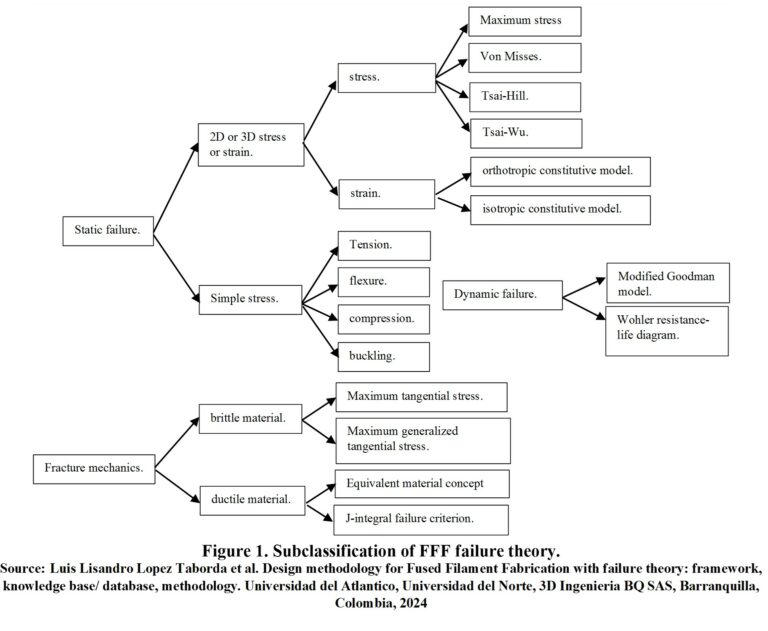
Figure 1 summarizes the subclass of models that predict the failure of materials manufactured by FFF/FDM [1].
Figure 2 summarizes the main headings of the database.
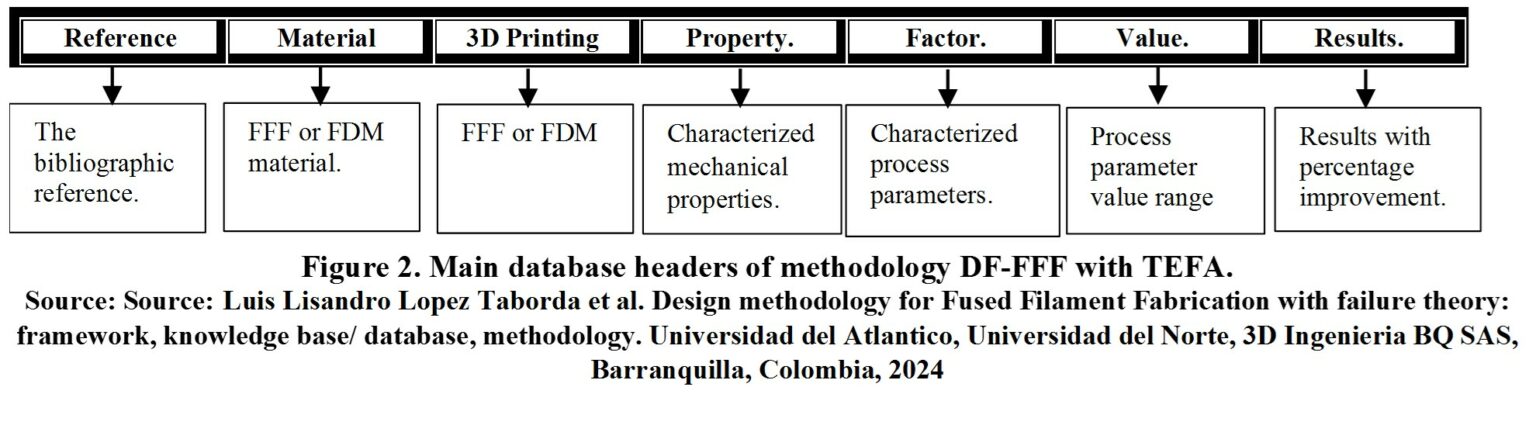
Below is a detailed explanation of each heading in Figure 2.
- Reference: Contains the bibliographic reference analyzed to generate specific and general guidelines.
- Material:The characterized material is specified.
- 3D printing: Specifies whether the printer used for manufacturing is an industrial (FDM) or desktop (FFF) grade printer.
- Property: Describes the characterized mechanical properties (experimental outputs).
- Factor: Describes the process parameters (experimental inputs).
- Value: Specifies the value ranges of the process parameters.
- Results: summarizes the value and percentage changes in properties as a function of process parameters. From these, specific and general guidelines are defined to improve the mechanical properties of a part.
Under each heading or column is the respective information, and each row contains information related to a specific case or reference. The purpose is to search according to the desired case to apply the guidelines of other cases to one’s case. In case of detailed information, the reference can be consulted directly.
Mechanical Characterization
| Ref. | Material | Printer | Property | Manufacturing Parameter / Experimental Factor | Experimental Factor Before and after | Observations and Suggestions |
|---|---|---|---|---|---|---|
| M134 | ABS, PLA PEEK, TPU, PA, PP, PE | FFF | Tensil strength (Sut), Degree of Anisotropy (Da) | Printing Orientation (OI), Infill Orientation (OT), Material, Others. | HI: Horizontal, on edge, vertical OT: 0° to 90° | Degree of anisotropy by print orientation ABS: 22-67%, Avg. 51.8%; PLA: 5.3-77%, Avg. 39.4%; PEEK: 88% Degree of anisotropy by layer orientation ABS: 6-86%, Avg. 39.8%; PLA: 4-89%, Avg. 38.45%; PEEK: 10-26%, Avg. 16%; TPU: 24-39%, Avg. 31.5%; PA: 9.8-11%, Avg. 10.2%; PP: 4-18%, Avg. 11.6%; PE: 0-1.5 The change in print orientation changes the print times and the support material. |
| 386 | PLA, Filled PLA, PETG, PMMA, ASA, Carbon Fiber, PC, Flexible TPU, and PC-PBT, nylon, ABS, ASA, PETG, Carbon, Wood, Nylon, PVA, and HIPS, PLA, PET/PETG, ABS, ASA, Flexible, Carbon, Wood, Metal, PA/Nylon, Stone, Organic, Glow, PVA, PC, HIPS, DURABIO, PP, PVC, PVB, Castable, PC-ABS, and ESD | FFF | Shear Strength, Tensil strength , strength Bending, Fatigue Behavior, Compression strength, Impact strength, Impact Absorption, Dynamic Mechanical strength, Stiffness, Compress Deformation, Poisson's Ratio, Wear Resistance, Fracture Toughness, Dimensional Accuracy, Surface Roughness, Cost and Production Time, Thermal Expansion Coefficient, Volumetric Precision Module, Anisotropy | Fill density (%), airgap, layer height (t),infill orientation (OT), print orientation (OI). | %: 0-100 Airgap: >0.1mm t: >0.1mm OT: 0-90°, +-45° OI: 0-90° | %, OI, OT, t, air gap, influence most resistances and static and dynamic properties, as well as deformations. t, influences fracture toughness, wear resistance, and tensile and flexural strength. Air gap, OI, OT affect roughness and dimensional accuracy. %, OT, affect manufacturing times and costs. |
| M54 | ABS, PLA, PEEK, PC, PEI | FDM: 1600, 1650,2000, 3000, Fortus, Dimension, Vantage UPrint FFF: Prusa Makerbot, Ultimaker, Lulzbot, Mendel, Witbox | Tensile strength, Compressive strength, Flexural strength, Impact resistance. | % filling density (%), airgap, layer height (t), infill orientation (OT), print orientation (OI), color (C), perimeter layers (p), infill width (b), print temperature (T), bed temperature (Tc), ambient temperature (Ta), print speed (V), infill type (TT) | %: 0-100, 20 levels Airgap: 3 levels t: 7 levels OT: 0-90°, 45/-45°, 0/90, 30/-60, 15/-75° OI: 0-90°, 6 levels TT: 3 levels C: 5 levels V: 8 levels T: 3 levels Tc: 3 levels Ta: 3 levels p: 3 levels | Generals. The most important parameters in the FDM/FFF process for mechanical properties: airgap (it is recommended to set it to a negative value), print orientation, infill orientation, layer thickness (a lower layer thickness increases strength), and infill percentage. Temperature is important. The interactions of these parameters are important. Perimeter layers affect strength and stiffness, as well as infill percentage and airgap. Print orientation has more influence on mechanical properties than infill angle. (ABS M30; ABS, Makerbot replicator 2x; Pc, Fortus 400mc; Ultem, fortus 400mc) Layer width and height should be as small as possible (ABS, Fortus 400mc; PLA, Makerbot z18; ABS P400; PEEK, rep rap). The results of these specific studies should be used with caution. It is not known for certain what results are obtained when transferred to other 3D printers. Tension To achieve the highest tensile strength, the infill should be aligned along the longest dimension. 0° orientation ensures the best tensile strength (ABS, Makerbot replicator 2x, ABS, PLA, Lulzbot taz, prusa, rep rap) Bending The final strength value is higher for the 0° fiber orientation, followed by the +45°/-45° and 90° orientations (ABS, Vantage) Other experiments showed that the 45°/-45° orientation provides better bending strength than the 0°/90° orientation (ABS, Dimension) Bending strength was higher than tensile strength (ABS P400, Dimension) Impact Impact force is maximum for 100% infill (ABS, Replicator 2x) The value of impact force is higher for the cross orientation 45°/-45° (ABS, Dimension) Compression Horizontal and vertical specimens with 0°/90° infill orientations have higher strength compared to those with 45°/-45° infill angles (Ultem 9085, fortus 400mc) Others. Color has no influence on mechanical properties (ABS, FDM1600; ninja flex, semi flex, Hips, T-Glass, Nylon, ABS, PC, Lulzbot tax 3.1 and 4) Color affects crystallinity and therefore strength (PLA, lulzbot taz) Environmental temperature has no influence on mechanical properties (ABS, fdm1600) Environmental temperature and convection conditions of the build space influence filament bonding, and therefore part strength (ABS p400, fdm1600 and 2000) To achieve the highest tensile strength, platform temperature should be high (PEEK, rep rap). |
| TF18 | ABS, PLA, PC, PA, PP, FRP | FDM: Fortus 400mc, Fortus 250mc FFF: Makerbot Replicator, Felix Pro I Lulzbot taz | Tenacity Fracture toughness (K, KIC, KIIC, KI/KII) J integral Tensile strength Flexural strength. | % fill density (%), airgap, infill orientation (WO), print orientation (PO), print temperature (T), print speed (V), infill type (WT), microstructure | OT: 0-90°, 45/-45°, 0/90, OI: XYZ a ZXY T: 210-240°c | Optimizing the printing path can increase failure load by 20% (ABS, Makerbot replicator). Path optimization requires time in programming. A 54% increase in fracture resistance was obtained with filament layers perpendicular to the crack plane (ABS plus P400, Fortus 250mc). Apparent fracture resistance (Jcr,a) significantly increased with printing temperature, by 186% per 30°C change (ABS, Felix Pro I). Annealing and rapid cooling achieve a 105% increase in fracture resistance (J). Post-processing involves longer production times and additional costs (PLA, lulzbot taz). The geometric pattern and infill angle affect fracture toughness (ABS, FDM). Reducing airgap/fill percentage reduces voids, increasing fracture toughness (ABS, FDM). Reinforcements affect fracture resistance (PLA, FDM). Microstructure improves fracture toughness (PA, FDM). Build orientation and layer orientation affect fracture behavior (PC, FDM). Annealing is recommended to reduce voids (PLA, FDM). Influence of filling speed and density on fracture (PLA, FDM). |
| M159 | PC, Epc | FFF: Lulzbot taz 4 y 5, Prusa i3mk2s, Prusa Tayrona XL | tensil strenght, Young's modulus, Yield strength, Impact resistance, Flexural strength. | Cover height (t), print orientation (OI), print temperature (T), print speed (V), printer and bed/clamp type, material supplier. | t:0.06-0.3mm OI: XYZ to ZXY T:250-270°C V:30-50mm/s Printer: Lulzbot taz 4 and 5, Prusa i3mk2s, Prusa Tayrona XL Bed type: metal coated with pei, glass. Adhesion: glue with blue masking tape, fixative-Laca | Flexion (OI: Horizontal) Increase of 30-90% with an average of 60%, by reducing from 0.3 to 0.1mm. Flexural strength increases with increasing printing temperature. Increase of 37-149% with an average of 93%, by increasing from 250 to 270°C. Flexural strength increases with reducing printing speed. Increase of 10-70% with an average of 40%, by reducing from 50 to 30mm/s. Flexural strength varies with the material supplier. Material is a respect a re-packaged material presents differences between -0.5%-140% with an average of 72.3%. Tension The mechanical property in horizontal and edge printing orientations are similar, with increases due to parameter changes between 17-35% from the lowest to the highest value, depending on the orientation, specific property, and parameters, on average increases of 26%. The mechanical properties in the vertical orientation are lower than in the other two orientations, with property increases due to parameter changes ranging from 42-84% depending on the property and parameters, on average 47%. The observed anisotropy percentage considering the average tensile strength, between horizontal and edge is 9%, and between horizontal and vertical is 57.5%. Impact Impact strength in the horizontal direction can increase from the lowest to the highest value by 110% with parameter changes. Impact strength in the vertical and edge directions show maximum increases of 60.8% and 114.3% respectively. The specimen with horizontal printing orientation has the highest impact strength, on average 6.4 J/mm^2, followed by vertical specimens with 5.3 J/mm^2, and lastly edge specimens with 3.9 J/mm^2. Based on the average strength values, the anisotropy percentage between horizontal and edge specimens is 39.1%, horizontal and vertical 17.2%. Others Reducing the layer height can double and triple printing times. Flexural strength is higher than tensile strength, comparing horizontal OI, averages of 93.4MPa and 40MPa respectively (133.5%). Tensile mechanical properties for horizontally, edge, and vertically manufactured specimens are a function of the interaction of temperature, speed, and layer height factors. Mechanical properties increase with increasing interaction of temperature and layer height, and with increasing temperature and printing speed, and decrease with increasing interaction of all three factors. Impact strength is a function of the interaction of printing parameters, and its specific relationship also depends on the manufacturing orientation. Increasing temperature increases energy consumption. Reducing speed increases printing times. When comparing tensile strengths for horizontal and edge orientations for certain specific parameters, there are no statistical differences. When comparing flexural strengths of specimens manufactured on different desktop printers, no statistical differences are detected, as well as with the table attachment method. |
| M160 | PETG | FFF: Prusa i3mk2s, Prusa i3mk3s | tensil strength, Young's modulus, Yield strength, Bending strength. | Cover height (t), print orientation (OI), print temperature (T), print speed (V), printer, material supplier, storage time. | t:0.1-0.4mm OI: XYZ and ZXY T:230-260°C V:30-50mm/s Printer: Prusa i3mk2s, Prusa i3mk3s, Time Storage | Bending (OI: Horizontal) Bending resistance is a function of layer height, temperature, print speed, and multiple interactions of the three factors. Bending resistance can increase from its lowest value to its highest value by 532% by changing parameters. Tension Tensile strength in horizontal, edge, and vertical manufacturing orientations is specific functions of layer height, speed, print temperature, and interactions. Tensile strength can increase by changing parameters, from its lowest value to its highest value by 32%, 23.5%, and 173.5% for horizontal, edge, and vertical print orientations respectively. The elastic modulus can increase by changing parameters, from its lowest value to its highest value by 25.2%, 69%, and for edge and vertical print orientations respectively. The degree of anisotropy between horizontal and edge print orientations based on their average strengths is 3.7%, and with respect to the vertical orientation is 37.7%. The degree of anisotropy between edge and vertical print orientations based on their average modulus is 11.4%. Tensile strength in all print orientations increases with decreasing speed and layer height, and increases with increasing temperature. The elastic modulus increases with increasing layer height, temperature, and speed for the edge orientation. For the vertical orientation, the modulus increases with decreasing height and speed, and increases with increasing temperature. The relationships with parameters and average strengths can change with changes in material supplier and storage conditions, and the strength can decrease by 65.1%. |
| M161 | TPU | FFF: Prusa i3mk2s, Prusa i3mk3s | tensil strength, Young's modulus, Yield strength. | layer height (t), print orientation (OI), print temperature (T), print speed (V), fill percentage (%) | t:0.1-0.3mm OI: XYZ a ZXY T:210-240°c V:30-50mm/s Impresora: Prusa i3mk2s, Prusa i3mk3s. %: 50-100 Please note that the translation is not provided as you did not specify the target language. | The mechanical properties are mainly a function of the fill percentage and printing orientation, and are similarly affected by these. Layer height, temperature, and printing speed affect the mechanical properties depending on the specific property and printing orientation. The mechanical properties increase with increasing fill percentage. Furthermore, the tensile strength in the horizontal orientation increases with increasing temperature, layer height, and the interaction of speed with other factors. The yield strength in the horizontal orientation increases with decreasing speed, increasing the interaction of temperature and speed, and the property is insensitive to layer height. The elastic modulus is a function of all parameters and increases with increasing all, also increasing with decreasing speed and temperature interaction. The increase in properties based on parameters from the lowest value to the highest is 39% for the modulus, 155% for the yield strength, and 90% for the tensile strength in the horizontal orientation. The tensile strength and yield strength in the combined vertical and edge orientation are a function of orientation (0°, 45°, and 90°), fill percentage, and the interaction of temperature, layer height, and speed factors. The elastic modulus is a function of the interactions of fill percentage with layer height, and the interaction of orientation with temperature. The increase in properties based on parameters from the lowest value to the highest is 365% for the modulus, and 450% for the tensile strength in the combined edge and vertical orientation. The degree of anisotropy between the horizontal and edge orientation considering the average tensile strength is 9.1%, and between the horizontal and vertical orientation is 71%. The degree of anisotropy between the horizontal and edge orientation considering the average modulus is 12.7%, and between the horizontal and vertical orientation is 70.2%, with the vertical orientation being stiffer. |
| FA23 | PC | FFF: Prusa i3mk2s, Prusa i3mk3s | Rotational bending fatigue, life cycles. | Printing orientation (OI), Epoxy resin type, Resin layer thickness (h), Flexural load (F). | OI: Horizontal and vertical Resin type: XTC-3D®, generic rigid. h: 0.15 mm, 0.2 mm, 0.25mm, 0.3mm, 0.5mm, 0.55mm and 1.00mm F: 3kg and 4 kg (at 300 rpm or 5hz) | The percentage of anisotropy between the horizontal and vertical printing orientation comparing the average life cycles without considering the resin ranges from 65.9-84.4%, and with resin ranges from 2.9-69.5%, equalizing in some cases the life of vertically manufactured specimens with the horizontal ones (isotropy). The maximum number of cycles reached is 42000 cycles with a stress of 22MPa for the horizontal orientation and for the vertical orientation with resin 50000 cycles with a stress of 20MPa. The manual application process of the resin hinders proper control of the thickness, producing scattered data of the life cycles. It is recommended to improve control over the final resin thickness. For certain lower layer values, no significant differences are observed in the studied properties. |
| ME77, ME78 | ABS, PLA, PETG, PA+CF, PC, PLA+ bronce, PA, TPU-Armadillo, PLA+ | FFF: Prusa i3mk2s, Prusa i3mk3s, Cr10 | Tensile strength, Young's modulus, Yield strength. | Print orientation (OI), Halftone orientation (OT), specimen type, filling percentage, tensile test speed, Supplier and brand. | OI: Horizontal, vertical, corner at 0°, 60°, 75° OT: 0°, 90°, 45/-45, 30/60 %: 33%, 66%, 75%, 100% Type of specimen I and IV according to ASTM D638 standard, Test speed: 1mm/min and 500mm/min. Supplier and brand: esun, make-R. | The percentage of filler affects the mechanical properties following the logic of the blending law, therefore, the properties are directly proportional to the percentage of filler and affected by a factor equal to the percentage of filler. The actual tensile strengths differ from those reported by suppliers (usually lower): PLA + 50.2%, PC 26.6%, Pa+CF 88.2%, Pa 54.4-61.1%. TPU-Armadillo 43.9%, PETG 29%, ABS 27.7% (higher), PLA 63.7%. The tensile strengths differ between suppliers: ABS 20% The strengths differ with different types of specimens and test speeds: PA 15% At a filler percentage of 100%, the properties are independent of the frame orientation, for the same horizontal printing orientation. For a filler percentage of 33%, the frame orientation is significant in the mechanical properties. The degree of anisotropy with orientation (0° vs 90°, or horizontal vs vertical) of printing changes by material: PC 43.4%, PA+CF 26.4%, PLA+bronze 86%, Pa 20.8-40%, TPU-Armadilo 99.5%, PLA+ 37.8%. For printing orientations of 60°, 75°, and 90°, the tensile strength and yield strength do not show significant differences. To model elastic deformations in an ABS prosthetic foot according to standard prosthetic element loads, the use of a transversely isotropic linear elastic model is appropriate (assuming equal properties in the edge and horizontal orientation) with maximum errors of 31%. In finite element simulation, different failure theories are used, the maximum stress theory, Hill, and Tsai Hill with error percentages that do not exceed 30% for the ABS prosthetic knee at 75% filler in predicting the load that causes failure, and the failure zone. The failure models, maximum stress theory, Hill, and Tsai Hill, do not predict the experimental results in the ABS prosthetic foot (130-205% error), which are more in line with the reported flexural strength values. |
| M129 | ABS, PLA | FFF: Flashforge con programa makerbot | Yield strength, Bending strength, Elastic modulus | Internal filling type | Square, polygonal, rhomboid, diagonal, circular. | It was determined that in ABS, the best configuration for traction was the square mesh, which is formed by squares of 9mm2 of void and 1mm thick (solid), with a 12.6% lower yield strength than the solid material and 9.6% lighter. For bending ABS, the best configuration turned out to be the circular mesh, which is formed by concentric circles, with 6.3% lower bending strength and 11.6% lighter compared to the solid. For PLA, both for traction and bending, the most suitable configuration was the diagonal mesh, which has a diagonal distribution in the form of fibers of the same material, with a 17.6% and 6.1% lower value in yield strength and bending strength, respectively, with a weight reduction of 9.6% and 2.3%. |
| M116 | ABS-M30 | FDM: Dimension SST 768, Fortus 450 FFF: Rep Rap | Tensile strength, Bending strength, Tensile modulus, Flexural modulus. | Printer, print orientation (OI). | OI: 0°, 45° and 90°. Printer: Rep Rap, Fortus, Dimension. | The tensile strength in the horizontal direction (0°) of specimens manufactured with Rep Rap is 17.2% lower than that of the Fortus 450, 25.8% higher than that of the Dimension, and 27.1% lower than that of injection-molded specimens. Similar trends are observed in other orientations. The elastic modulus in the horizontal direction of specimens manufactured with Rep Rap is 22% lower than that of the Fortus, similar to the Dimension with differences of only 1.3%, and 30.1% lower than that of injection-molded specimens. Similar trends are observed in other orientations. The flexural strength in the horizontal direction (0°) of specimens manufactured with Rep Rap is 30.9% lower than that of the Fortus 450, similar to the Dimension with differences of only 4.4%, and 34.6% lower than that of injection-molded specimens. Similar trends are observed in other orientations. The flexural modulus in the horizontal direction of specimens manufactured with Rep Rap is 30.8% lower than that of the Fortus, similar to the Dimension with differences of only 6.5%, and 64.9% lower than that of injection-molded specimens. Similar trends are observed in other orientations. The degree of anisotropy of tensile strength between edge and horizontal orientations is 15.9% for Rep Rap and 6.7% for the Fortus. The elastic modulus for specimens manufactured with Rep Rap shows anisotropy of 12.2%, while for the Fortus it is 6.8%. The degree of anisotropy for flexural strength is 20% for Rep Rap and 4.3% for the Fortus. The data dispersion is lower for the Fortus. In terms of strengths, the maximum observed value is +/-0.8MPa for flexural strength and +/-0.3MPa for tensile strength in the Fortus, while it is +/-1.7MPa for flexural strength and +/-6.7MPa for tensile strength in the Rep Rap. The data dispersion is lower for the Fortus. In terms of moduli, the maximum observed value is +/-28MPa for flexural modulus and +/-26MPa for tensile modulus in the Fortus, while it is +/-70MPa for flexural modulus and +/-385MPa for tensile modulus in the Rep Rap. |
| TF2 | Z-ABS | FFF: Zortrax M200 | Elastic limit to tension, Tensile strength, Elastic modulus to tension, Elastic limit to compression, Compressive strength, Elastic modulus to compression | Layer height (t), Print orientation (PO), Print angle (PA). | t:0.09, 0.19, 0.39mm OI: Horizontal, canto, vertical AI: 0, 45, 90° | Tension Samples with a layer thickness of 0.09 mm and edge at 0° show the highest Young's modulus of 1524 MPa among all 3D printed tensile samples. The injection molded part is the stiffest of all, with a stiffness 1.22 times that of the stiffest printed sample. The orientation in the printing plane has an insignificant effect when the layer thickness is 0.19 mm or more. The 0° edge models with a layer thickness of 0.09 mm show the highest yield strength of 39 MPa among all printed samples. While the injection molded part has the highest yield strength, the ductility of the printed samples is 1.45 times higher than that of the injection molded part. The 90° edge with a layer thickness of 0.19 mm has the highest fracture strength of 30 MPa, which is twice that of the injection molded part. In addition, the printed samples exhibit greater plastic deformation or elongation before reaching failure or failure criteria. The degree of anisotropy observed at different angles within the same orientation depends on the orientation and layer height. For example, for tensile yield strength, anisotropy percentages of 20-35% (horizontal, edge, and vertical) are observed for a layer height of 0.39 mm, but for 0.09 mm, the percentage is 8-50% (horizontal, edge, and vertical). Similar behavior is observed for other tensile properties. The degree of anisotropy as a function of orientation shows similar values for horizontal and edge orientations. For example, for yield strength, it is 26% for 0.09 mm, and disparate for these orientations compared to the vertical, which is 55-68% for 0.09 mm. The influence of layer height on the degree of anisotropy is also observed. For example, for yield strength with a layer height of 0.39 mm, the anisotropy between horizontal and edge orientations is 33%, and with respect to the vertical, it is 25-50%. Similar trends are observed for other properties. The differences in properties based on layer height are significant. For example, for yield strength in the edge orientation, the largest observed reduction is 57% by changing the layer height from 0.09 mm to 0.39 mm at 0°. For horizontal orientations, the largest observed reduction is 67% at 90°, and for the vertical orientation, the largest observed reduction is 44% at 90°. Similar behaviors are observed for other properties. Compression Compression tests show that horizontal at 0° and horizontal at 45° have the highest stiffness and highest yield strength of all. On the other hand, horizontal at 0°, horizontal at 90°, and vertical show comparable fracture strength, indicating that the orientation of the printing plane has an insignificant effect on compression properties. The degree of anisotropy observed, for example, for compression strength (failure strength), shows anisotropy percentages of 25% for horizontal orientation (0° vs 45° because 0 and 90 are similar) and a layer height of 0.09 mm. For 0.39 mm, the percentage is 30% (same printing angles in the same horizontal plane). The degree of anisotropy as a function of orientation shows similar values for horizontal and vertical orientations. For example, for yield strength, it is 25% for 0.09 mm when comparing vertical to horizontal, or for a layer height of 0.39 mm, it is 13% when comparing horizontal to vertical. For compression strength, anisotropy values of 6% for 0.09 mm and 13% for 0.39 mm are observed. The differences in properties based on layer height are significant. For compression strength in the horizontal orientation, the largest observed reduction is 73% by changing the layer height from 0.09 mm to 0.39 mm at 45°. A 70% reduction is observed at 90°, and for the vertical orientation, the largest observed reduction is 77%. Similar behaviors are observed for other properties. |
| TF3 | ABS | FFF: FlashForge Dreamer | Elastic modulus under compression, printing time, Compression strength | Percentage of fill (%), type of fill, weft orientation (OT), print orientation (OI) | %: 0, 20, 30, 40, 100 Fill type: Rectangular, honeycomb. OT: 0/90, 45/-45 OI: Horizontal, edge and Vertical. | The properties of compression and printing time are directly proportional to the filling percentage, regardless of the printing orientation or type of filling. Even for a filling percentage of 0%, the materials exhibit compression strength. For filling percentages of 100%, the compression strengths for rectangular filled specimens at 45/-45 orientations are similar (4.2% difference) for both vertical and horizontal printing orientations, thus isotropic. For equal or lower percentages than 40%, significant differences between orientations or anisotropy are observed. For example, at 40% filling, the difference between vertical and horizontal orientation is 31.7%, at 30% filling the difference is 34.2%, and at 20% filling the difference is 25%. The same trends are observed for honeycomb filling. Honeycomb filling exhibits higher strength/density values than rectangular filling. For example, at a filling percentage of 20% and vertical printing orientation, the difference in strength compared to the same oriented rectangular pattern at 100% filling is 14.6%. However, printing times favor rectangular patterns. For a filling percentage of 40%, the honeycomb time is 1.64 times the time of rectangular patterns. In the particular case of 20% filling for honeycomb vs rectangular at 100% filling, the time ratio is inverted to 1.49, favoring honeycomb. For a filling percentage of 20%, the factor is 1.23, favoring rectangular patterns. Similar trends are observed for the elastic modulus under compression. |
| M34 | PLA | FFF: Witbox | Tensile strength, Elastic modulus under tension, Bending strength, Elastic modulus under bending, Printing time. | Layer height (t), Print orientation (OI), print speed (VI) | t:0.06, 0.12, 0.18, 0.24mm OI: Horizontal, de canto, vertical VI: 20, 50, 80mm/s | The orientations and printing speed, and the layer height are significant in the mechanical properties of bending and tension. Also, the interaction has significance in the responses. The degree of anisotropy for edge and horizontal orientation is relatively low, up to 16.04% for tensile strength, up to 8% for tensile elastic modulus, up to 28% for flexural strength, up to 33.9% for flexural modulus. The degree of anisotropy for vertical and horizontal orientations is relatively high, up to 77.3% for tensile strength, up to 74.5% for flexural strength. The exception is the modules that are similar in vertical and horizontal orientation, up to 26% for tensile modulus and 17.4% for flexural modulus. The values change depending on the speed and layer height. The most noticeable changes in strength depending on the speed and layer height occur in the vertical orientation. For example, up to 56.5% reduction in tensile strength with a reduction in layer height at a speed, or a 31% reduction in tensile strength when increasing the speed, or a 52.2% reduction in flexural strength by reducing the layer height, or a 31% reduction in flexural strength when increasing the speed. In other orientations, the increase or reduction in strength does not exceed 20% with speed or layer height and does not necessarily follow the same behavior as in the vertical orientation. Ductility decreases as the layer thickness and feed rate increase. The mechanical properties increase with increasing layer thickness and decrease with increasing feed rate for the vertical orientation. The printing time changes more drastically for the layer height. For example, for the vertical orientation, changing from 0.06mm to 0.24mm layer height and a constant speed of 20mm/s produces a 75% reduction in time, for the horizontal orientation, a 74.6% reduction is observed, similar values are observed at other speeds. As for the speed, a change from 20mm/s to 80mm/s for vertical orientation with a layer height of 0.06mm shows a 29.7% reduction in time, for the horizontal orientation, it is reduced by 68.5%, for a layer height of 0.24mm and the same orientations, reductions of 28.6% for vertical and 62.4% are observed. As for the orientation, keeping the speed and layer height fixed, there are increases and reductions in the number of layers, which affect the printing times. For small layer heights and small speeds, the difference between vertical and horizontal is 7.5%, for large layer heights, it is 6.6%, but when increasing the speed, these differences or reductions are 58.5% for small layer height and 50.7% for large layer height. |
| M9 | ABS-M30 | FDM: Dimension | Tensile strength, Deformation, Elastic modulus, layer printing time | Number of copies (NC), print orientation (OI). | NC: 1, 2, 3, 5, 10 OI: horizontal and vertical | When increasing from 1 to 10 copies, the layer printing times increase by 1161%, reducing tensile strength by 35.1%, the modulus is reduced by only 4.5% but its dispersion increases by 1200%, and deformation is reduced by 28.9%. The number of copies influences the layer printing time and the mechanical properties in the vertical orientation. No statistical differences are observed in the horizontal orientation, but there are differences in the dispersion of deformation data mainly. |
| M162 | PA+CF, PETG, PC | FFF: Prusa i3 mk2s | Impact energy, Impact resistance | Type of resin, print orientation (OI). | Type of resin: XTC-3D, Generic. OI: Horizontal, edge, vertical. | The resin and print orientation are significant in energy and impact resistance. There is also covariability with resin thickness and an interrelation with resin type and orientation, as well as different results per material. The most favorable results are observed in PETG, with a degree of anisotropy of horizontal orientation compared to edge or vertical orientation of 69.2%. After the application of resin, the degree of anisotropy is reduced to 12.5% for edge compared to vertical, or 6.7% for horizontal compared to vertical orientation. The increases in strength in the vertical orientation are 75% and 100% for edge, with a reduction in strength in the horizontal orientation of 42.3%. As for the effective changes in fracture energy for vertical and edge orientation, they are 169% and 188% respectively, with a reduction in fracture energy in the horizontal direction of 14.6%, and the anisotropy of energy changes from 68.3% to a maximum of 6.7%. For PC, the results are more moderate, with anisotropy of 66.7% changing to 50%, and the largest change is in fracture energy, with 100% and 75% in energy and strength in the vertical orientation. For Pa+CF, no significant changes are observed, with anisotropy of 75% between edge and vertical orientation for both fracture energy and strength, and 25% for energy comparing edge orientation with horizontal, and 16.7% for strength. Of the three materials, the highest energy and strength values are for PA+CF, doubling the values of PETG and PC. |
| M76 | ABS, PC, ABS-PC, ULTEM 9085 | FDM: Fortus 400mc FFF: Makerbot replicator 2X | Break energy on impact, Specific impact resistance, impact resistance. | Print orientation (OI), Print angle (AI), process type, printer | HI: horizontal, corner, vertical. AI: 0°, 45° Type of process: Printing, machining. Printer: | The most resistant orientation is horizontal, followed by edge and vertical. The degree of anisotropy by material considering the horizontal orientation compared to the edge orientation: ABS 39.4-32.5%, PC 2.6-22.1%, ABS-PC 36.8-42%, ULTEM 9085 3.2-21.6%. The degree of anisotropy by material considering the horizontal orientations compared to the vertical orientation: ABS 56.4-62%, PC 20.1%, ABS-PC 77.9-79.7%, ULTEM 9085 29.5-42.9%. The differences in strength depending on the FFF or machining printing process range from 5-10% (statistically not significant), although an increase in data dispersion is observed with machining. The degree of anisotropy for ABS FFF considering the angle is 30% for 45° compared to 0° in the edge orientation. Comparing the strength of FFF vs FDM, we observe that FDM is inferior to FFF in horizontal and edge orientations by 36.6% and 57% respectively. On the other hand, FFF is inferior to FDM in the 45° edge and vertical orientations by 10.7% and 35.2% respectively. |
| M24 | ABS-P400 | FDM: Dimension SST 768 | Tensile strength, Elastic modulus, deformation, water absorption | Printing orientation (OI), Printing angle (AI), Process type, temperature and humid environment. | OI: Horizontal, vertical. AI: 0, 45° Process type: FDM, injection. Temp: 20, 40, 60°C Amb: Dry, bath with distilled water for 200 hours | The high temperatures accelerated the diffusion rate, although the maximum water absorption rate was not affected. The rate is a function of orientation: 8% for vertical, 6% for horizontal at 45°, 5% for horizontal, and less than 0.5% for injected. At high temperatures, these absorption rates are reached more quickly. The tensile strength of FDM parts in dry, ambient conditions was approximately 26% (relative to the printed horizontal) to 56% (relative to the printed vertical) of injection molded parts. A reduction in strength is observed with high temperatures, ranging from 25% to 33% depending on the orientation. The increase in temperature and water absorption had a more significant effect on FDM parts than on injection molded parts. Tensile strength decreased by 67-71% in hot and humid environments compared to dry, ambient conditions. |
| FA22 | PC | FDM: Fortus 400 mc | Fatigue resistance to bending at R-1, Fatigue resistance to bending at R-0.5, life cycles. | Print orientation (OI) | Horizontal, on edge, vertical. (at 300rpm or 5 Hz) | The printing orientation, halftone angle, layer height, nozzle diameter, infill percentage, and printing speed have been studied in the past for ABS, ABS plus, PLA, PEI. The life cycle ratio based on orientation shows that the horizontal and edge orientations are very similar to R-1 (minimum to maximum stress ratio): at 80% of tensile strength (Sut), the ratio is 1.051, at 60% of Sut it is 1.054, at 40% of Sut it is 0.902, and at 20% of Sut it is 0.772, meaning the difference ranges from 5.1 to 22.8%. The edge orientation is more favorable for high cycles (around 3000 to 20,000 cycles) with a difference of 10-22.8%, and for low cycles (around 600 to 1500 cycles) the horizontal orientation is favorable with a difference of 5.1-5.4%. For R-0.5: at 80% Sut the difference is 25%, at 60% Sut the difference is 17%, at 40% Sut the difference is 35.1%, and at 20% of Sut the difference is 21.3%, with the edge orientation predominating. The life cycle ratio based on orientation shows that the edge and vertical orientations differ significantly for R-0.5: at 80% of tensile strength (Sut), the ratio is 7.07, at 60% of Sut it is 4.18, at 40% of Sut it is 2.99, and at 20% of Sut it is 2.50, meaning the reduction in cycles ranges from 60.1% to 85.86%. For R-1: at 80% Sut the reduction is 81.4%, at 60% Sut the reduction is 84%, at 40% Sut the reduction is 41.9%, and at 20% Sut the reduction is 63.2%, with the reduction ranging from 41.9% to 84%. |
| FA16 | PLA | FFF: Makerbot replicator 2x | Tensile strength, modulus of elasticity, strain, Bending strength, Modulus of bending, bending strain, Fatigue strength, Life cycles. | Frame orientation (OT), tension test speed. | OT: 0, 45, 90°. Test speed: 5, 50, 200, 500mm/min (at 2, 5, and 20 Hz depending on the number of cycles) | Tension At 45°, the sample became stronger with a final tensile strength of 64 MPa. The 0° and 90° orientations were not much weaker, with 58 MPa and 54 MPa (anisotropy of 9.4 to 15.6%). The deformation differs between 90° OT as the most ductile with a deformation of 4% compared to the most fragile at 0° with a deformation of 2% and the 45° orientation with a deformation of 2.5% similar to 0° (the first differs by 50% and the second differs by 20%), but essentially PLA is very rigid and brittle. The modulus differs by a maximum of 7.5%. PLA using bollard-type clamps showed that the PLA filament had similar mechanical properties to specimens at 500mm/min, with a strength of 58.9 MPa, which differs from the 0° specimen by 1.5%, but the ductility is much higher at 9%. As the test speed increases, ductility or deformation decreases, but strength increases. A change from 5 to 500mm/min or 9900% increases the strength by 22.2%, reduces ductility by 42.5%, and increases the modulus by 35.82%. Bending For bending in this type of test, the 0° orientation produced the strongest parts, with a maximum bending stress of 102 MPa. The 45° and 90° orientations obtained similar results, with 90 MPa and 86 MPa (anisotropy of 11.8-15.7%). The anisotropy for the modulus did not exceed 6.3%, while at 0° it exhibited the highest deformation values of 0.106, which differs from 90° by 57.5% and from 45° by 26.4%, but essentially PLA is very rigid and brittle. Fatigue For fatigue tests, the 90° orientation clearly had a lower fatigue life than either of the other two orientations. The other two orientations, 0° and 45°, were very similar. For one million cycles, the observed anisotropy comparing fatigue strengths is 90% comparing 45° vs 90° (10 MPa vs 1 MPa), and comparing 45° vs 0° the difference does not exceed 40%. |
| FA20, FA21 | PLA | FFF: Rep-Rap | Fatigue resistance to rotational bending, life cycles | Layer height (t), nozzle diameter (d), fill percentage (%), print speed (VI), fill type | t: 0.1, 0.2, 0.3mm d:0.3, 0.4, 0.5mm %: 25, 50, 75 VI: 25, 30, 35 mm/s Fill type: rectilinear, honeycomb (at 2800 rpm or 46.6 Hz) | For the honeycomb pattern, the filling density (200% increase in the lifespan cycles when changing from 25 to 75% filling), nozzle diameter (150% increase in cycles with a change from 0.3 to 0.5mm), and layer height (80% increase in cycles with a change from 0.1 to 0.3mm) are, from highest to lowest, the parameters that significantly affect the fatigue behavior of PLA manufactured parts. Print speed is not significant for the lifespan cycles. For the rectilinear pattern, the filling density (267% increase in lifespan cycles when changing from 25 to 75% filling) and layer height (100% increase in cycles with a change from 0.1 to 0.3mm) are, from highest to lowest, the parameters that significantly affect the fatigue behavior of PLA manufactured parts. Nozzle diameter and speed are not significant. The maximum increases observed between lifespan cycles of the rectilinear pattern by changing to the honeycomb pattern are 75% in the range of 2000 to 4000 cycles, 18% in the range of 3000 to 4000, and less than 10% in the range of 5000 to 6000. Parameters and their levels that generate extruded threads of larger dimensions are beneficial for the fatigue life of the part. In fact, a too high discrepancy between layer height and nozzle diameter leads to a detrimental effect on fatigue life. The nozzle diameter should be at least 1.5 times the value of the layer height to ensure proper cohesion between filaments for greater part integrity. An approximation to the fatigue limit of PLA parts manufactured with a honeycomb infill with 75% density, 0.5mm nozzle diameter, and 0.3mm layer height is around 45 MPa with 10000 cycles. |
| TF13 | PLA | FFF: Hage 3DpA2 | Fracture toughness (KI), Integral J | Frame orientation (OT) | OT: 0, 90, 0/90° | For monotonous loading conditions, the compact tension (CT) and notched edge bending (SENB) tests yielded fairly similar results for specimens produced with a cord orientation of 0°, 0°/90°, and 90°. Surprisingly, the 90° orientation, where the 90° cord interface, where the filament interface is directly loaded, even outperformed the 0° orientation in some cases. The parameters chosen based on another reference were aimed at achieving the best possible inter and intralaminar cohesion: printing temperature of 250°C, bed temperature of 70°C, nozzle diameter of 0.5mm, layer thickness of 0.25mm, printing speed of 30/80 (first layer/default), flow rate of 7.43 mm^3/s, and distance between grid centers of 0.8mm. This is most likely explained by very good diffusion due to processing at relatively high temperatures and spatial deviation of material properties, such as crystallinity degree, size and number of spherulites, due to processing, which can influence fracture resistance. |
| TF14 | ABS | FFF: Makerbot Replicator | Fracture toughness, fracture load. | Frame orientation (OT) | OT: 45°, optimized slicer algorithm | The translated value is: The mechanical characterization in fracture shows that the optimized C-T samples are reinforced up to 20% compared to the classical samples. |
| TF15 | ABS plus P430 | FDM: Not specified (NE) | Fracture toughness | Print orientation (OI), Halftone orientation (OT) | HI: Horizontal (XYZ, crack in YX), edge (XZY, crack in ZX), vertical (ZXY, crack in XZ) TO: 45/-45, 0/90° | When the alignment of the layers of extruded filaments changed from being parallel to perpendicular to the plane of the crack, a 54% increase in fracture resistance was observed (comparing the strongest to the weakest). However, the pattern of the infill only had a significant effect in one of the printing orientations. The highest fracture toughness is for the vertical orientation at 45/-45, followed by the same orientation and a infill of 0/90 with a 11.2% lower resistance than 45/-45 (or a 12.6% increase), followed by the horizontal orientation with a 0/90 infill which is 14.2% lower than the vertical 45/-45° (or a 16.6% increase). When comparing the differences in resistance for the horizontal orientation with a 0/90 infill (the strongest) compared to 45/-45, there is only a 4.1% difference which is lower than the standard deviation. Next in terms of weakness is the edge orientation at 0/90° which is 29.4.2% lower than the vertical 45/-45° (or a 41.7% increase), and within the same edge orientation, the difference between infills is 7.9% (comparing the strong 0/90 infill to the weak 45/-45 infill). Fracture resistance decreased by 11% when a 0/90◦ pattern was used instead of a +45/-45◦ pattern in layers oriented perpendicular to the plane of the crack. |
| M107 | PC | FDM: Fortus 400mc | Tensile strength, elastic modulus, yield strength, Deformation vs time diagram (creep test) | Number of contours (p), Print orientation (OI), effort (S), airgap | P: 1, 5, 10; OI: Horizontal, canto, vertical; S: 4,8, 12, 16 Mpa; Airgap: 0, 0.25, 0.5mm | It is observed that the creep deformation increases when the number of contours decreases (up to 10 in this study) or the airgap (up to 0.5 mm). In general, the optimal conditions for the edge piece construction orientation, a 0.0mm airgap, and the maximum number of contours are achieved. By reducing the airgap from 0.5 to 0.0 mm, the strength increases by 271.5%. For a change in contours from 1 to 10 contours, the tensile strength for a 0.0 airgap increases by 10.6%, with a 0.25 airgap it increases by 205.4%, and with a 0.5 airgap it increases by 251.8%. Similar trends are observed in the elastic modulus. By increasing the number of contours, the creep is reduced or improved by 11 to 82% depending on the specific airgap and stress level. By reducing the airgap, the reduction or improvement ranges from 7.7-79.6% at least for an airgap of 0.5 to 0.0 and different load levels and number of contours. The deformation under a stress of 16MPa for 300 min behaves anisotropically depending on the orientation: 7.3% vertically compared to the horizontal orientation, and 4.5% between vertical and edge (there is more creep in the horizontal orientation followed by vertical and edge). Arrange the deposited filaments in the same direction as the sample is pulled. |
| M37 | PC-ABS | FDM: Fortus | Creep flow rate (creep test) | Layer height (t), Airgap (AG), Print angle (AI), Pattern orientation (OT), pattern width (b), number of contours (p) | t: 0.127, 0.2540, 0.3302mm; p: 1, 5, 10; b: 0.4572, 0.5177, 0.5782mm; AG: 0.0, 0.25, 0.50mm; AI: 0, 45, 90° (horizontal); OT: 0, 45, 90° | The most effective parameters for the flow rate are layer height, number of contours, pattern orientation, and part orientation, while frame width and airgap have a low impact on the flow rate of the FDM processed part. The percentage of improvement (reduction in flow rate) when changing the parameters from their limit values: reducing layer height by 31.6%, frame angle by 11.1%, printing angle (horizontal) by 11.5%, and increasing the number of contours from 5 to 10 by 14.7%. The flow index decreases with increasing pattern orientation and part orientation. It was also found that the flow rate initially increases with increasing number of contours up to the central level and then starts to decrease with further increase in the number of contours. The optimal combination of process parameters to minimize flow-induced deformation was obtained as a layer thickness of 0.127 mm, zero airgap, 90° frame angle, 90° construction orientation, 0.4572 m road width, and 10 contours. Confirmation experiments have been carried out with the optimal process adjustment, and the observed flow index is 52.419%, which matches the empirically predicted flow index value. |
| M145 | Ultimaker 2: nylon 618, nylon 645, alloy 910; Markforged X7: Onyx, and Markforged nylon. | FFF: Ultimaker 2, Markforged X7 | Life cycles, wear (mm), wear rate (mm/60s) | Material, Momento | Moment: 5, 7, 10, 12, 15 Nm (at 1000 rpm or 16.6 Hz) | Only Nylon 66 injected and Nylon 618 materials withstood the loads to achieve considerable cycles for the study. For loads of 15Nm, they supported 80,000 cycles and 1,200 cycles respectively. At a load of 5Nm, they support 2.4 million cycles. Nylon 618 provided better results when applied with low to medium torsion compared to injection molded gears. Under a load of 10Nm, Nylon 66 supported 1.5 million cycles, while injected Nylon 66 achieved 1 million cycles. Under a load of 12Nm, they supported 780,000 cycles and 504,000 cycles respectively. Nylon 645, Alloy 910, and Onyx supported 14,000 cycles, 7,800 cycles, and 2.4 million cycles respectively under a load of 5Nm. Onyx supported 0.96 million cycles under a load of 7Nm, and 6,000 cycles under a load of 10Nm. The wear for Nylon 618 is a function of the load and cycles. For 5Nm, the wear was 0.3mm at 2.4 million cycles, while at 12Nm it was 1mm at 800,000 cycles, an increase of 233%. The deformation for those load values was 2mm and 8 to 12mm respectively at 20 minutes and 190 minutes. The wear rate remained constant until a torque of 9Nm, below 0.025mm/60s, but for higher torques like 12Nm, it increased to 0.225mm/60s, an 800% increase. The superior friction and wear performance of Nylon 618 (compared to other printed materials) is mainly dependent on the thermal behavior and the level of sintering effect between each layer. |
| M136 | ABS | FFF: Katana | Hardness, friction coefficient | Layer height (t), Print orientation (OI) | t: 0.1, 0.15, 0.2mm; OI: Horizontal, edge (load of 100N at 1.2m/s at 1000mm distance, data for 800s) | In horizontally oriented samples, the layer thickness does not have a significant effect on hardness, while in vertically oriented samples, a change in hardness values was observed. Hardness can be increased by 16.6% by changing from vertical orientation and small layer height to horizontal orientation with any layer height (or reduced by 14% vice versa). It was found that the average COF value for all layer thicknesses and orientations is around 0.4, except in small layer samples with vertical orientation, which is around 0.45 or an increase of 12.5%, and the COF of 3D printed samples was lower than that of injection molded ABS samples, ranging from 0.3 to 0.35, i.e. it is lower by 18.75%. |
| M138 | ABS, PLA+CF (20%) | FFF: Ender 3D PRO | Wear rate, Specific wear rate, friction coefficient. | Layer height (t), Fill percentage (%), Fill type | t: 0.075, 0.1, 0.125mm; %: 60, 70, 80; Filling type: Rectilinear, triangular, GRID (load of 10N at 2m/s at 130mm distance for 20min) | The thickness of the layer contributes to wear in a direct proportion, as a thicker layer would last longer and reach the substrate due to its size. The infill pattern is inversely proportional to the wear rate. Comparing extreme patterns of large layer height (0.125mm) and small infill percentage (60% Triangular) that produce high wear, against small layer (0.075mm) and large infill (80% Grid) that produce low wear, differences (increase/reduction) in wear rate and friction coefficient of 150%/60% and 71%/41.6 for ABS, for PLA+CF the values of increase/reduction are 182%/64.5% and 31.2%/23.8%. The friction coefficients and wear rate of ABS are larger than PLA+CF, 3.75 and 1.3 times respectively. Differences of around 20% are observed between infill types. |
| M89 | ABS, PLA, ABS+PLA | FFF: Doble extrusor | Tensile strength | Material, Fill percentage (%), Printing angle (AI), Material ratio (pm), Material arrangement (am) | %: 50, 100; AI: 0, 45°; Pm (ABS/PLA): 0, 20, 40, 60, 80, 100; Am: 3, 4, 6, 8 lines | The materials at 0° orientation with 100% filling rates using PLA showed the best mechanical properties. The strength at 0° orientation is higher than at 45° by 3.1MPa or 11.1%, the strength of PLA is higher than that of ABS by 6.4MPa or 24.6%, and the 100% specimens have a higher strength than the 45% ones by 11.7MPa or 50.2% (in a factor equal to the filling percentage). The simple addition of vertical lines to the product may still be ineffective. However, by adding an additional horizontal layer, better results were obtained in terms of mechanical properties. The results showed that the design of the structural arrangement of multiple materials in FDM can affect the mechanical properties. No combination achieves superior properties to the individual PLA material. |
| M93 | ABS | FDM/FFF: NE | tensil strength, Deformation. | Layer height (t), Print pattern, fill percentage (%), Print angle (AI) | t: 0.07, 0.2, 0.3mm; Pattern: Straight, diamond (Grid), honeycomb; %: hole, intermediate, solid; AI: 0, 45, 90° | The importance of factors according to their influence on the mechanical properties of the specimens is ordered as follows: Layer thickness, Fill percentage, Printing pattern, Angle. The increments achieved by changing parameters are as follows: 75% layer height (reduce), 44% fill percentage (increase), 20% pattern type, 9% angle. The optimal combination of manufacturing parameters that resulted in the specimen with the highest tensile strength was as follows: Layer thickness 70μm, Solid, Honeycomb, 45°. All specimens showed a small amount of plasticity (up to 8%). |
| M96 | PLA | FFF: Kossel Delta | Support material, printing time, bending strength, bending modulus, bending deformation, roughness | Support type | Linear, straight, Zig-zag | According to the results, the parts manufactured using the Zigzag support method have the highest flexural modulus and can withstand the highest load of all. The inline support strategy requires the least support material and printing time, making it the most sustainable support method of all. The best finish is obtained with zig-zag (0.25mm) and the worst with line (0.29mm), an improvement or reduction of 13.8%. The least amount of support is obtained with line support (2.93 gr) and the worst with zig-zag (4.79gr), an improvement or reduction of 38.8%. The maximum load supported is for zig-zag (176.71N) and the minimum for rectilinear (110.11N), an increase or improvement of 60.5%. As for the modulus, zigzag remains the best option and line the worst, with a difference or improvement of 31%. The printing time is shorter for linear, and the worst time is for rectilinear, a difference of 7.1%. The rules for choosing the best support method should depend on the requirements of the final part (what properties the final part needs). The balance between different properties should be considered. |
| M98 | PA 12, ABS | FFF: NE | Viscosity, shear rate, tensile strength, yield strength, fracture strain. | Frame orientation (FO), printing temperature (T) | OT: 0, 90, 0/90, 45/-45; T: 220, 225, 230, 235, 240, 245, 250, 255, 260, 265°C | The nozzle temperature in the range of about 250°C was determined to be applicable conditions for FDM processing of PA12. The viscosity of the molten mass is identified as an important factor to ensure good bonding between filaments and between layers and to minimize trapped microbubbles of air, which are considered the main reason for the decrease in strength of FDM parts, in addition to the strength of individual filaments. It was found that the viscosity of the molten mass of PA12 is lower than that of ABS at lower shear rates. Consequently, the quality of the bonding of PA12 FDM parts is much higher than that of the popular FDM ABS raw material, and PA12 FDM parts are almost fully dense. The tensile strength of PA12 manufactured at 250°C is higher than that of ABS by 83.3%. The tensile strength of PA12 increases with temperature, for example, from 225°C to 250°C it increases from 25MPa to 55MPa, which is a 120% increase. The strength of ABS remains stable around 30MPa. Different orientations of PA12 FDM parts and samples with a 100% fill rate and a 45°/45° pattern have a tensile strength of 58.88 MPa, which represents only a 4% reduction compared to injection-molded PA12. With a change in pattern orientation, the maximum observed change is between 0° and 90°, with an increase/reduction of 11%/9.9% (anisotropy). |
| M99 | ABS (FFF), PC (FDM) | FDM: Fortus 360mc; FFF: Ultimaker 2 | Poisson's ratio, Young's modulus, yield strength, tensile strength, elongation at break, ultimate tensile strength, strain energy density, shear modulus, displacement yield strength, shear yield strength. | Frame orientation (FO), Print orientation (PO) | OT: 45/45, 30/60, 15/75, 0/90; OI: Horizontal, on edge, vertical | Tension The results indicated that the warp and weft orientations had insignificant effects on the Young's modulus or Poisson's ratio in the ABS tensile samples. The tensile strengths of ABS in different orientations change little with the warp orientation. The anisotropy of the tensile strength with warp orientation (all from 45/-45 to 0/90°) by print orientation is as follows: 2.1% horizontal, 3.8% edge, 2.9% vertical. The anisotropy with print orientation is: Vertical vs Horizontal 10.5%, Horizontal vs Edge 8.3%. The tensile strengths of PC in different orientations change with the warp orientation. The anisotropy of the warp orientation by print orientation is as follows: 26.7% horizontal from 45/45 (strong) to 30/-60° (weak), 5.2% edge from 45/-45 to 0/90°, 4.2% vertical from 45/-45 to 0/90°. The anisotropy with print orientation is: Vertical vs Horizontal 21.7%, Horizontal vs Edge 7.4%. The warp orientation in flat construction samples reveals an anisotropic behavior in the PC samples, as the modulus and strengths varied by up to 20%. Shear The shear modulus and shear yield strength varied by up to 33% in the ABS samples. The tensile strengths and modulus for PC varied by up to 20%. Similar variations were observed in the shear of PC. The change in orientation of the PC samples appears to reveal a similar magnitude of variation in material properties. |
| M100 | PLA | FFF: Makerbot Replicator 2 | Bending strength, flexural strength, printing time. | Layer height (t), Print angle (AI), Fill percentage (%), Print speed (VI), Print temperature (T) | t: 0.1, 0.2, 0.3 mm; AI: 0, 30, 60°; %: 10, 20, 30; VI: 40, 50, 60mm/s; T: 229, 232, 235°c | The optimization procedure showed that the minimum level of deposition angle, the maximum levels of extrusion and fill speed, and the level close to half of the layer thickness produce the maximum bending force. The proposed model is quadratic in nature, most factors are significant, but not all are significant on their own. Some factors, such as speed and layer height, are significant along with interaction with fill percentage for both cases, or significant with the square of the layer. Temperature is not included in the regression model. According to the model, the strength or load increases with: increasing fill percentage, decreasing angle, decreasing square of the layer, increasing interaction between layer and fill percentage, increasing interaction between fill percentage and speed. The force and resistance can be increased by modifying parameters by 33.3%. The printing times between the lowest and highest load can be increased by 50%, and by 237.5% between the set of parameters with the lowest and highest time. |
| M144 | PA+CF (20%) | FFF: Ultimaker 2 + Ruby Nozzle | Tensile strength, modulus of elasticity, flexural strength, modulus of flexure, impact resistance (without notch), hardness. | Layer height (t), Fill percentage (%), Nozzle diameter (d), Fill pattern | t: 0.1, 0.2, 0.4mm; %: 60, 100; d: 0.25, 0.8mm; Infill type: 45/-45°, concentric | The most significant parameter is density. Tension Higher tensile strength of 46.26MPa for a 0.2mm layer, concentric pattern, 0.8mm nozzle, 100% infill, resistance reduction by changing to a 45/45 pattern is 18%, resistance reduction by increasing layer height is 10.1%-12.9%, resistance increase by reducing nozzle size is 4.4%, resistance reduction by infill is 47.1%. Higher modulus of tensile strength of 5074.74MPa for a 0.2mm layer, concentric pattern, 0.8mm nozzle, 100% infill, resistance reduction by changing to a 45/45 pattern is 24.3%, resistance reduction by increasing layer height is 11.1%-20.6%, resistance increase by reducing nozzle size is 6.9%, resistance reduction by infill is 36.6%. Flexion In the flexion test, ambient temperature influences the degree of crystallinity of the samples. Layer height plays an important role in flexion tests. The results are better for a value of 0.2mm compared to 0.4mm. Higher flexural strength of 77.41MPa for a 0.1mm layer, 45/45 pattern, 0.25mm nozzle, 100% infill, resistance reduction by changing to a concentric pattern is 9.6-51%, resistance reduction by increasing layer height is 35.8%-71.6%, resistance reduction by infill is 43.8-45.6%. Higher modulus of flexural strength of 4520.42MPa for a 0.1mm layer, concentric pattern, 0.25mm nozzle, 100% infill, resistance reduction by changing to a 45/45 pattern is 12.6-30.6%, resistance reduction by increasing layer height is 47.2%-72.6%, resistance reduction by infill is 34.8-38.3%. Impact A height of 0.4mm showed better performance in the impact test with a value of 47.59KJ/m^2, using a concentric pattern, 0.8mm nozzle, 100% infill, resistance reduction by changing to a 45/45 pattern is 21.41%, resistance reduction by reducing layer height to 0.2mm is 12.6%, resistance reduction by infill is 34.1-54.2%. Hardness For a 100% infill percentage, the maximum variation due to parameter changes is a 9.3% increase from the lowest to the highest value. The lowest hardness of 68.6Shore D among solid samples is for a layer height of 0.4mm, 45/45 pattern, and 0.8mm nozzle, the rest range between 71.8-75 shore D (not exceeding a 4.4% increase). The hardness change due to a 60% infill is a reduction of 14-20%. |
| M143 | ABS, ASA | FFF: FlashForge Creator Pro dual head | Tensile strength, Tensile modulus, Yield strength, Maximum bending load, Bending stress | Thermal aging (heated and held at 60°C for 5 hours and cooled and held at 20°C for 5 hours, repeated 3 times), type of filler. | Filling: Triangular, honeycomb; Aging: without, with. | The samples of ASA with honeycomb core showed the highest stability under flexural load after thermal aging. Tension: For ABS, the change from triangular to honeycomb produces a 19.5% increase in strength. For ASA, the increase is 2.3%. For ABS, the change from honeycomb to triangular produces a 31.2% increase in strength. For ASA, the increase is 17.6%. On average, the tensile strength of ASA is 10.4% higher than ABS, and the moduli show no differences. Flexion: With aging, the flexural load increases by 4.3% for triangular ABS and 16.6% for honeycomb ABS. For ASA, the increases are 28.9% and 58.7% respectively. The largest load for the aged arrangement is 1294N for honeycomb ASA, while for aged honeycomb ABS it is 794N, which is a 63% increase. For aged triangular arrangements, the values are 508N for ASA and 288N for ABS, representing a 76.38% increase. Others: A model is used for predicting the maximum load with predictions ranging from 1-20% error. |
| M141 | PETG | FFF: WOL 3D ENDER 3 | Tensile strength, Roughness | Fill type, fill percentage (%), layer height (t) | Type of filling: Triangular, rectilinear (cubic), Grid (diamond); %: 60, 70, 80; t: 0.1, 0.15, 0.2mm | In general, it is recommended to use GRID type infill with a density of 80% and a low layer height of 0.1mm, both to achieve maximum strength and minimum roughness. Tension The resistance per infill pattern varies: 12.3-18.1MPa Triangular, 22.98-28.12 MPa Grid (diamond), and 22.21-26.01MPa Rectilinear (Cubic). It is observed that tensile strength decreases with increasing layer thickness. For Grid infill, reductions of 8.5-11.7% are observed when changing from 0.1 to 0.2mm, for Triangular infill, reductions of 20.5-33.1% are observed, and for Rectilinear (Cubic) infill, the reduction does not exceed 10%. Tensile strength increases with increasing infill density. For Grid infill, resistance increases by 10-12% when changing from 60% to 80% infill, for Triangular infill, an increase of 12-17% is observed, and for Rectilinear (Cubic) infill, the increase does not exceed 10%. The infill pattern combined with the construction orientation produces variations in tensile strength. Roughness The roughness per infill pattern varies: 4.21-5.21um Triangular, 3.09-4.59um Grid (diamond), and 3.97-4.67um Rectilinear (Cubic). The surface roughness value decreases with increasing infill density. For Grid pattern, reductions of 4.7-6.7% are observed, for Rectilinear (Cubic) pattern, reductions of 3.4-4.3% are observed, and for Triangular pattern, reductions of 3.6-8.6% are observed. With the reduction of layer height, the improvement values per infill type (at maximum infill percentage) are: 11.5% for Triangular, 29.3% for Grid (diamond), and 12% for Cubic. |
| M130 | PLA, TPU95A | FFF: Ultimaker 3, | Tensile strength, Tensile modulus, Tensile strain, Compressive yield strength, Compressive modulus | Percentage of fill (%), ISO/probe type/size | %: 20, 60, 100; Voltage size: 1A, 1B, 2 (TPU); Compression size: D10, D5. (horizontally manufactured tension test specimen, and vertically manufactured compression test specimen) | The results suggest that the compression and tensile properties of 3D printed parts can vary significantly depending on the infill percentage and dimensions. While the infill percentage settings may remain constant, the properties of the resulting material can vary depending on the sample size. The resolution limitations of 3D printers and the relationship between the contour wall thickness and the cross-sectional area of the part can significantly affect the resulting properties. Tension The variation in tensile strength due to size is 3% between 1A and 1B for 20% infill, the increase of 65.1% occurs when changing from 1A to 2 for a 20% infill percentage. For a 60% infill percentage and the same size change, the increase in strength is 0.6% for 1A and 1B. For a 100% infill percentage and the same size change, the increase in strength is 2% for 1A and 1B. The variation in modulus of elasticity due to size is 4% for 20% infill between 1A and 1B, 92.9% for the change from 1A to 2. For 60% infill and size change 1A and 1B, the difference is 9.3%. For 100% infill and size change 1A and 1B, the difference is 13.7%. The maximum increase observed from 20% to 100% infill is 56.7% in tensile strength for 1A, and 24.17% in modulus for 1A. For 1B, the tensile strength changes by 49.1% and the modulus by 46.8%. Compression: The variation in compressive yield strength of PLA due to size is a 103.6% increase for 20% infill and a size change from 10 to 5mm. For a 60% infill percentage and the same size change, the increase in strength is 25.7%. The variation in modulus of compression of PLA due to size is a 15% increase for 20% infill and a size change from 10 to 5mm. For a 60% infill percentage and the same size change, the reduction in strength is 14.6%. The maximum increase observed from 20% to 100% infill is 97.30% in yield strength and 126% in modulus, but from 20% to 60%, the percentages for yield and modulus are 61.1% and 37%. |
| M31 | PA | FFF: Pramaan mini | Tensile strength, dimensional accuracy or tolerance, manufacturing time. | Layer height (t), Print angle (AI)/Print orientation (OI), wall thickness or perimeter (tp) | t: 0.1, 0.2, 0.3 mm; AI/OI: 0, 15, 30°/de canto; tp:0.4, 0.8, 1.2mm | The thickness of the layer is the process parameter that most affects the response characteristics. Because a thinner layer thickness provides greater adhesion strength and good axial load capacity. When the orientation angle changes, the adhesion force between the layers varies with the layer thickness. Tension The set of process parameters that yield optimal results are: For final tensile strength, a layer thickness of 0.1 mm, an orientation angle of 300, and a shell thickness of 1.2 mm. The printing angle and wall thickness were not significant in tensile strength, only the layer height. Therefore, the improvement percentages with changes in these two factors are not significant, unlike with the layer. The maximum change observed due to parameter changes is 230.4% in tensile strength, from 7.71 MPa to 25.48 MPa. Tolerances For dimensional accuracy, a layer thickness of 0.1 mm, an orientation angle of 300, and a shell thickness of 0.8 mm. As for manufacturing time, the layer thickness is 0.3 mm, the orientation angle is 0 degrees, and the shell thickness is 0.4 mm. None of the factors were significant in accuracy, so the improvement percentages with changes in these factors are not significant. The maximum change observed due to parameter changes is 98.2% in accuracy, from 0.3% to 16.7%. Time In printing time, the layer height and printing angle are significant. The maximum change observed due to parameter changes is 304% in printing time, from 25 minutes to 101 minutes. |
| M3 | PLA | FFF: Mendel Max 2 open source | Maximum impact force, Specific impact energy | Fill type, fill percentage (%), layer height (t) | Type of filling: concentric, octagonal, rectilinear; %: 25, 50, 100 | By reducing the percentage of filler, increases in specific impact energy of 125% are achieved. By increasing the percentage of filler, increases in maximum impact load of 200% are achieved. By reducing the layer height, the maximum impact load can be increased. A strong dependence of bulk density was observed in the impact absorption capacity, both in terms of mitigation and energy dissipation, while the effect of layer height was less pronounced and the effect of filler pattern was insignificant. |
| M36 | PLA | FFF: Makerbot Replicator 2_ | Impact resistance | Layer height (t), bed temperature (Tc), process | t: 0.2, 0.4 mm; Tc: 30, 160°C; Process: FFF, Injection | The impact resistance of injection molded PLA components is 17.3% and 20.1% higher than the components of the 0.2 and 0.4 mm groups at 30°C. The impact resistance of the PLA components of the 0.2 and 0.4 mm groups at 160°C was 113.9% and 69.6% higher than that of the injection molded components. Regarding the original groups printed at 30°C, the increase by heating the bed to 160°C was approximately 131.2% and 89.6%. |
| M71 | ABS | FDM/FFF: NE | Tensile strength, Bending strength, Impact resistance | infill orientation (OT), Airgap (AG), process | OT: 0/90, 30/-60, 45/-45, 75/-15; AG: -0.05, 0.05mm; Process: FFF/FDM, injection | In this case, the negative gap of the frame proved to be the most significant for improving mechanical behavior. tension The tensile strength for negative Airgap values ranged from 33-34.4MPa, and positive values ranged from 28-31.6MPa, which is an average increase of around 10% by changing from positive to negative Airgap. The changes in tensile strength due to frame orientation for negative Airgap were greater for 45/-45 than for the others, being above 3-4.2% (statistically not significant). For positive Airgap from 0/90 to 30/-60, the strength increases by 8.6%, and from 30/-60 to 45/-45, it increases by 4%. The tensile strength at 75/-15 is similar to 30/-60. The tensile strength of injected samples was 9.3% higher for 45/-45 with negative Airgap (the strongest). flexion The flexural strength for negative Airgap values ranged from 61-64MPa, and positive values ranged from 32-50MPa, which is an average increase of around 47.61% by changing from positive to negative Airgap. The changes in flexural strength due to frame orientation for negative Airgap were greater for 0/90 than for the others, being above 3.2% compared to 45/-45 and 5-7% with the rest (statistically not significant). For positive Airgap from 75/-15 to 45/-45, the strength increases by 56.25%, from 30/-60 to 45/-45, it increases by 13.6%, and from 0/90 to 45/-45, it increases by 19%. The flexural strength of injected samples was 12.5% higher for 0/90 with negative Airgap (the strongest). impact The impact strength for negative Airgap values ranged from 34-42 KJ/m^2, and positive values ranged from 18-38 KJ/m^2, which is an average increase of around 35.7% by changing from positive to negative Airgap. The changes in impact strength due to frame orientation for negative Airgap were greater for 45/-45 than for the others, being above 23.5% compared to 75/-15, 5% compared to 90, and 11% compared to 30/-60. For positive Airgap from 75/-15 to 45/-45, the strength increases by 111%, from 30/-60 to 45/-45, it increases by 18.75%, and from 0/90 to 45/-45, it increases by 46.1%. The impact strength of injected samples was 90.5% higher for 45/-45 with negative Airgap (the strongest). A frame angle of -45°/+45° demonstrates maximum tensile and impact strength, while the highest flexural strength was recorded with a 0/90° system. On the contrary, a positive gap drastically reduces performance. Dimensional analysis also shows that no significant alterations in dimensions can be expected when varying the frame angle and gap. |
| M95 | PLA | FDM/FFF: NE | Tensile strength, Yield strength, Young's modulus, Strain, Flexural strength, Modulus of elasticity. Impact resistance. | Orientation of infill (OT), Airgap (AG), process, bed temperature (Tc), Printing temperature (TI), Annealing temperature (TR) | OT: 0/90, 30/-60, 45/-45, 75/-15; Process: FFF/FDM, injection; Tc: 45, 60, 75, 90, 105°C; TI: 190, 200, 210, 220, 230°C; TR: 80, 100°C | For all prepared samples, the key changes in mechanical properties are related to the content of the crystalline phase of poly(lactic acid), which resulted in superior properties in annealed samples. The results also indicate the highly beneficial effect of increasing the bed temperature, where the best results were obtained in samples printed at 105 °C. Compared to reference samples printed at a bed temperature of 60 °C, these samples showed an 80% increase in impact strength (from 35 to 63 J/m), a 20 °C increase in HDT (from 55 to 75 °C), and also a significant increase in tensile strength of 6.2% and tensile modulus of 10%, flexural strength of 14% and flexural modulus of 17.5%. The changes due to printing temperature are more pronounced between 190 to 200 °C for tensile strength with an increase of 17.5%, tensile modulus 12.9%, flexural strength 37.6%, flexural modulus 40.5%, and tensile modulus from 200 to 230 °C. No significant changes in impact strength were observed. Regarding tensile modulus, the 30/60, 15/75, 0/90 infill orientations present similar values, with a maximum difference of 2.3% (not significant). However, when changing from 45/45 to any of the other orientations, the maximum observed increase is 9%. For tensile strength, no significance is observed with infill orientation. For flexural modulus, a maximum difference of 8% is observed between the 45/45 and 0/90 orientations (weak infills) compared to the 30/60 and 15/75 orientations (strong infills), and for flexural strength, the maximum difference is 10.2% between 45/45 (strong infill) and 0/90 (weak infill), while the values of 30/60, 15/75, 0/90 are similar to each other. For impact strength, the main differences are observed between 45/45 (strong infill) and 0/90 (weak infill) with a difference of 14.5%, while 30/60, 15/75, 0/90 present similar values (differences of 7%). With annealing at 80 °C, the changes compared to a bed temperature of 60 °C, extrusion temperature of 210 °C, and 45/45 infill are as follows: Tensile modulus increases by 11.5%, elongation at break decreases by 39.6%, flexural modulus increases by 17.1%, flexural strength increases by 11%, and impact strength increases by 285%. As for the properties of injection-molded specimens, these are comparable to or even surpassed by FDM, depending on the property and the parameters or post-processing used. The only exception is elongation at break, which is much higher (875%). |
| M8 | ABS | FDM: Vantage SE | Tensile strength, Bending strength, Impact resistance | Layer height (t), Print angle (AI)/Print orientation (OI), Halftone orientation (OT), Halftone width (b), Airgap (AG) | t: 0.1270, 0.178, 0.25mm; AI/OI: 0, 15 30°; OT: 0, 30, 60°; b: 0.4064, 0.4564, 0.5064mm; AG: 0, 0.004, 0.008mm | To achieve the highest tensile strength, the large layer, 0° orientation, 0° pattern, large width, and the smallest possible airgap should be used. The resistance change per parameter change is a 98.79% increase. To achieve maximum flexural strength, the parameters should be set in the same way as for tension. The resistance change per parameter change is a 108.7% increase. Regarding impact resistance, the different parameters to achieve the maximum value are a 30° orientation and a 60° pattern, while the other parameters follow the tension and flexural trends. The increase per parameter change is 41.2%. The optimization of all properties, considering an equal relative weight for all outputs, results in a large layer height, 0° orientation, 60° pattern, small width, and large airgap. |
The database containing the references elaborated on the article by Luis Lopez et al. [1]-[2] can be consulted to consult the specific information of the reference, such as title, authors, journal, and year of publication.
Consult the database of bibliographic references below [1]-[2].
References
| year (in Data base) | References codified | Title | author | year | Journal or source | use | case | subcase | ||||
|---|---|---|---|---|---|---|---|---|---|---|---|---|
| 2017 | 1 | In the search of design for rapid manufacturing strategies to solve functional and geometrical issues for small series production | Javier Munguia, Carles Riba and Joaquim Lloveras | 2007 | Proceedings of ICED 2007, the 16th International Conference on Engineering Design DS 42 | State of the art methodologies | design methodology | ensemble/DFRM | ||||
| 2017 | 2 | An integrated parameterized tool for designing a customized tracheal stent | Evila L. Melgoza, Lídia Serenó, Antoni Rosell, Joaquim Ciurana | 2012 | Computer-Aided Design 44 (2012) 1173–1181. | State of the art methodologies | design methodology | customized/medicine/innovation | ||||
| 2017 | 3 | A novel methodology of design for Additive Manufacturing applied to Additive Laser Manufacturing process | RemiPonche, Olivier Kerbrat, Pascal Mognol, Jean-Yves Hascoet | 2014 | Robotics and Computer-Integrated Manufacturing30(2014)389–398. | State of the art methodologies | design methodology | detail/functional/manufacturability | ||||
| 2017 | 4 | Designing for Additive Manufacturing | B. Vayre, F. Vignat, F. Villeneuve | 2012 | Procedia CIRP 3 ( 2012 ) 632 – 637 | State of the art methodologies | design methodology | detail/concept/DFM/functional/innovation | ||||
| 2017 | 5 | Design for Additive Manufacturing—Element transitions and aggregated structures | Guido A.O. Adam, Detmar Zimmer | 2014 | CIRP Journal of Manufacturing Science and Technology 7 (2014) 20–28 | State of the art methodologies | design methodology | Design rules | ||||
| 2017 | 6 | Design and fabrication of reconstructive mandibular models using fused deposition modeling | Esfandyar Kouhi, Syed Masood and Yos Morsi | 2008 | Assembly Automation, Vol. 28, Issue 3 (2008), pp. 246–254. | State of the art methodologies | design methodology | customized/medicine/innovation | ||||
| 2017 | 7 | Development of a design feature database to support design for additive manufacturing | Shajahan Bin Maidin, Ian Campbell, Eujin Pei | 2012 | Assembly Automation, Vol. 32 Issue: 3,pp. 235-244 (2012) | State of the art methodologies | design methodology | Data: database/assembly/function/innovation | ||||
| 2017 | 8 | A rapid design and manufacturing system for product development applications | Wang Guangchun, Li Huiping, Guan Yanjin, Zhao Guoqun | 2004 | Rapid Prototyping Journal, Vol. 10 Issue: 3,pp. 200-206 | State of the art methodologies | design methodology | DFRM | ||||
| 2017 | 9 | Additive manufacturing-enabled design theory and methodology: a critical review | Sheng Yang & Yaoyao Fiona Zhao | 2015 | Int J Adv Manuf Technol (2015) 80:327–342 | State of the art methodologies | design methodology | state of the art | ||||
| 2017 | 10 | Integrated product-process design to suggest appropriate manufacturing technology: a review | Uzair Khaleeq uz Zaman, Ali Siadat, Mickael Rivette, Aamer Ahmed Baqai, Lihong Qiao, | 2017 | International Journal of Advanced Manufacturing Technology 91(1-4), pp. 1409-1430 | State of the art methodologies | design methodology | state of the art | ||||
| 2017 | 11 | Design for additive manufacturing based on the axiomatic design method | Konstantinos Salonitis | 2016 | Int J Adv Manuf Technol (2016) 87:989–996 | State of the art methodologies | design methodology | axiomatic/functional/restriction | ||||
| 2017 | 12 | Enriching design with X through tailored additive manufacturing knowledge: a methodological proposal | Laverne Floriane, Segonds Frédéric, D’Antonio Gianluca, Le Coq Marc | 2017 | International Journal on Interactive Design and Manufacturing 11(2), pp. 279-288 | State of the art methodologies | design methodology | DWAM/concept/functional/assembly/innovation | ||||
| 2017 | 13 | Holistic approach for industrializing AM technology: from part selection to test and verification | Thomas Reiher, Christian Lindemann, Ulrich Jahnke, Gereon Deppe, Rainer Koch | 2017 | Prog Addit Manuf 31 March, 2017 | State of the art methodologies | design methodology | holistic/function/assembly/manufacturability/innovation | ||||
| 2017 | 14 | An identification method for enclosed voids restriction in manufacturability design for additive manufacturing structures | Shutian LIU, Quhao LI, Wenjiong CHEN, Liyong TONG, Gengdong CHENG | 2015 | Front. Mech. Eng. 2015, 10(2): 126–137 | State of the art methodologies | design methodology | manufacturability | ||||
| 2017 | 15 | Additive Manufacturing of Metal Cellular Structures: Design and Fabrication | LI YANG, OLA HARRYSSON, DENIS CORMIER, HARVEY WEST, HAIJUN GONG and BRENT STUCKER | 2015 | JOM, Vol. 67, No. 3, 2015 | State of the art methodologies | design methodology | Analytical/experimental/cellular | ||||
| 2017 | 16 | A Design for Additive Manufacturing Ontology | Mahmoud Dinar, David W. Rosen | 2017 | Journal of Computing and Information Science in Engineering 17(2),021013 | State of the art methodologies | design methodology | Data: database/assembly/function/innovation | ||||
| 2017 | 17 | Additive Manufacturing to Advance Functional Design: An Application in the Medical Field | Claudio Comotti, Daniele Regazzoni, Caterina Rizzi, Andrea Vitali | 2017 | Journal of Computing and Information Science in Engineering 17(3),031006 | State of the art methodologies | design methodology | Function/doctor/innovation/state of the art | ||||
| 2017 | 18 | Assembly Based Methods to Support Product Innovation in Design for Additive Manufacturing: An Exploratory Case Study | Floriane Laverne, Frederic Segonds, Nabil Anwer, Marc Le Coq | 2015 | Journal of Mechanical Design, Transactions of the ASME 137(12),121701 | State of the art methodologies | design methodology | DWAM/concept/functional/assembly/innovation | ||||
| 2017 | 19 | Design and Analysis of Lattice Structures for Additive Manufacturing | Christiane Beyer, Dustin Figueroa | 2016 | Journal of Manufacturing Science and Engineering, Transactions of the ASME 138(12),121014 | State of the art methodologies | design methodology | experimental/cellular | ||||
| 2017 | 20 | Design for Additive Manufacture of Fine Medical Instrumentation: DragonFlex Case Study | Filip Jelınek, Paul Breedveld, | 2015 | Journal of Mechanical Design, Transactions of the ASME 137(11),111710 | State of the art methodologies | design methodology | functional/medical/innovation | ||||
| 2017 | 21 | An Investigation of Key Design for Additive Manufacturing Constraints in Multimaterial Three Dimensional Printing | Nicholas Meisel, Christopher Williams | 2015 | Journal of Mechanical Design, Transactions of the ASME 137(11),111703 | State of the art methodologies | design methodology | Design rules | ||||
| 2017 | 22 | Design Framework for Multifunctional Additive Manufacturing: Placement and Routing of Three-Dimensional Printed Circuit Volumes | A. Panesar, D. Brackett, I. Ashcroft, R. Wildman, R. Hague | 2015 | Journal of Mechanical Design, Transactions of the ASME 137(11),111708 | State of the art methodologies | design methodology | electronic/concept/single-objective optimization | ||||
| 2017 | 23 | Geometric Tailoring: A Design for Manufacturing Method for Rapid Prototyping and Rapid Tooling | Shiva Sambu, Yong Chen, David W. Rosen | 2004 | Journal of Mechanical Design, Transactions of the ASME 126(4), pp. 571-580 | State of the art methodologies | design methodology | experimental/multi-objective optimization | ||||
| 2017 | 24 | A Functional Classification Framework for the Conceptual Design of Additive Manufacturing Technologies | Christopher B. Williams, Farrokh Mistree, David W. Rosen | 2011 | Journal of Mechanical Design, Transactions of the ASME 133(12),121002 | State of the art methodologies | design methodology | concept/functional/process selection | ||||
| 2017 | 25 | Efficient Design-Optimization of Variable-Density Hexagonal Cellular Structure by Additive Manufacturing: Theory and Validation | Pu Zhang, Jakub Toman, Yiqi Yu, Emre Biyikli, Mesut Kirca, Markus Chmielus, Albert C. To | 2015 | Journal of Manufacturing Science and Engineering, Transactions of the ASME 137(2),021004 | State of the art methodologies | design methodology | Analytical/numerical experiment/real experiment/multiscale optimization | ||||
| 2017 | 26 | Integration of Design for Manufacturing Methods With Topology Optimization in Additive Manufacturing | Rajit Ranjan, Rutuja Samant, Sam Anand | 2017 | Journal of Manufacturing Science and Engineering, Transactions of the ASME 139(6),061007 | State of the art methodologies | design methodology | Manufacturability/topological optimization/multi-criteria optimization | ||||
| 2017 | 27 | DESIGN FOR ADDITIVE MANUFACTURING: INTERNAL CHANNEL OPTIMIZATION | M. Pietropaoli, R. Ahlfeld, F. Montomoli, A. Ciani, M. D’Ercole | 2017 | Journal of Engineering for Gas Turbines and Power 139(10),102101 | State of the art methodologies | design methodology | Topological optimization/single-objective optimization | ||||
| 2017 | 28 | Redesign and cost estimation of rapid manufactured plastic parts, | Eleonora Atzeni, Luca Iuliano, Paolo Minetola, Alessandro Salmi, | 2010 | Rapid Prototyping Journal, Volume 16 · Number 5 · 2010 · 308–317 | State of the art methodologies | design methodology | Function/assembly/cost | ||||
| 2017 | 29 | Systematic proposal to calculate price of prototypes manufactured through rapid prototyping an FDM 3D printer in a university lab | Carlos Henrique Pereira Mello, Rafael Calandrin Martins, Bruno Rosa Parra, Edson de Oliveira Pamplona, Eduardo Gomes Salgado, Rodrigo Tavares Seguso | 2010 | Rapid Prototyping Journal 16/6 (2010) 411–416 | State of the art methodologies | design methodology | cost | ||||
| 2017 | 30 | Speed and accuracy evaluation of additive manufacturing machines | Tomaz Brajlih, Bogdan Valentan, Joze Balic, Igor Drstvensek | 2011 | Rapid Prototyping Journal 17/1 (2011) 64–75 | State of the art methodologies | design methodology | design rules | ||||
| 2017 | 31 | Rapid casting solutions: a review | Munish Chhabra, Rupinder Singh | 2011 | Rapid Prototyping Journal, Vol. 17 (2011) Issue: 5,pp. 328-350 | State of the art methodologies | design methodology | state of the art. | ||||
| 2017 | 32 | A repository for DFM problems using description logics | Sungshik Yim, David W. Rosen | 2008 | Journal of Manufacturing Technology Management, Vol. 19 Issue: 6, (2008), pp. 755-774. | State of the art methodologies | design methodology | Data: database/assembly/manufacturability/guidelines/innovation | ||||
| 2017 | 33 | Computer‐aided build style decision support for stereolithography | Joel E. McClurkin, David W. Rosen | 1998 | Rapid Prototyping Journal, Vol. 4 Issue: 1, (1998) pp.4-13 | State of the art methodologies | design methodology | Tool for decision/experimental/multi-objective optimization. | ||||
| 2017 | 34 | 3D roughness profile model in fused deposition modelling | Alberto Boschetto, Veronica Giordano, Francesco Veniali | 2013 | Rapid Prototyping Journal 19(4),17088799, pp. 240-252 | State of the art methodologies | design methodology | Analytical model of roughness / experimental | ||||
| 2017 | 35 | A survey of the design methods for additive manufacturing to improve functional performance | Yunlong Tang, Yaoyao Fiona Zhao | 2016 | Rapid Prototyping Journal, Vol. 22 Issue: 3,pp. 569-590 | State of the art methodologies | design methodology | state of the art | ||||
| 2017 | 36 | Towards a sustainable and economic selection of part candidates for additive manufacturing | Christian Lindemann, Thomas Reiher, Ulrich Jahnke, Rainer Koch | 2015 | Rapid Prototyping Journal, Vol. 21 Issue: 2,pp. 216-227, | State of the art methodologies | design methodology | Selected part/function/assembly/topological optimization/cost | ||||
| 2017 | 37 | Selection of additive manufacturing processes | Yuanbin Wang, Robert Blache, Xun Xu, ( | 2017 | Rapid Prototyping Journal 23(2), pp. 434-447 | State of the art methodologies | design methodology | state of the art | ||||
| 2017 | 38 | On design for additive manufacturing: evaluating geometrical limitations | Guido A. O. Adam, Detmar Zimmer | 2015 | Rapid Prototyping Journal, Vol. 21 Issue: 6,pp. 662-670, | State of the art methodologies | design methodology | Design rules | ||||
| 2017 | 39 | Rapid prototyping process selection using multi criteria decisión making considering environmental criteria and its decision support system | Vimal KEK, Vinodh S., Brajesh P., Muralidharan R., | 2016 | Rapid Prototyping Journal, Vol. 22 Issue: 2,pp. 225-250 | State of the art methodologies | design methodology | process selection | ||||
| 2017 | 40 | Selection of selective laser sintering materials for different applications | Sunil Kumar Tiwari, Sarang Pande, Sanat Agrawal, Santosh M. Bobade | 2015 | Rapid Prototyping Journal, Vol. 21 Issue: 6,pp. 630-648, | State of the art methodologies | design methodology | material selection | ||||
| 2017 | 41 | A new global approach to design for additive manufacturing | R. Ponche , J.Y. Hascoet , O. Kerbrat & P. Mognol | 2012 | Virtual and Physical Prototyping, 7:2, 93-105 | State of the art methodologies | design methodology | DFAM/manufacturability/functionality/assemblability/restrictions | ||||
| 2017 | 42 | A new methodological framework for design for additive manufacturing | Martin Kumke, Hagen Watschke & Thomas Vietor | 2016 | Virtual and Physical Prototyping, 11:1, 3-19 | State of the art methodologies | design methodology | state of the art | ||||
| 2017 | 43 | An additive manufacturing process model for product family design | Ningrong Lei, Xiling Yao, Seung Ki Moon & Guijun Bi | 2016 | Journal of Engineering Design, 27:11, 751-767 | State of the art methodologies | design methodology | product family design | ||||
| 2017 | 44 | Design for Additive Manufacturing of Cellular Structures | Chen Chu, Greg Graf & David W. Rosen | 2008 | Computer-Aided Design and Applications, 5:5, 686-696 | State of the art methodologies | design methodology | Design and optimization at multiscale/innovation (software) | ||||
| 2017 | 45 | Design knowledge representation to support personalised additive manufacturing | Hyunwoong Ko, Seung Ki Moon & Kevin N. Otto | 2015 | Virtual and Physical Prototyping, 10:4, 217-226, | State of the art methodologies | design methodology | customization/software/innovation | ||||
| 2017 | 46 | Material and design considerations for rapid manufacturing | R. Hague , S. Mansour & N. Saleh | 2004 | International Journal of Production Research, 42:22, 4691-4708 | State of the art methodologies | design methodology | mechanical properties/design rules/design rules | ||||
| 2017 | 47 | Research supporting principles for design for additive manufacturing | David W. Rosen | 2014 | Virtual and Physical Prototyping, 9:4, 225-232 | State of the art methodologies | design methodology | state of the art | ||||
| 2017 | 48 | The status, challenges, and future of additive manufacturing in engineering | Wei Gao, Yunbo Zhang, Devarajan Ramanujan, Karthik Ramani, Yong Chen, Christopher B. Williams, Charlie C.L. Wang, Yung C. Shin, Song Zhang, Pablo D. Zavattieri | 2015 | Computer-Aided Design 69 (2015) 65–89 | State of the art methodologies | design methodology | state of the art | ||||
| 2017 | 49 | Design and manufacture of high performance hollow engine valves by Additive Layer Manufacturing | D. Cooper J. Thornby, N. Blundell, R. Henrys, M.A. Williams, G. Gibbons | 2015 | Materials and Design 69 (2015) 44–55 | State of the art methodologies | design methodology | Case study/topological optimization/reverse engineering | ||||
| 2017 | 50 | Additive manufacturing: Toward holistic design | Bradley H. Jared ⁎, Miguel A. Aguilo, Lauren L. Beghini, Brad L. Boyce, BrettW. Clark, Adam Cook, Bryan J. Kaehr, Joshua Robbins | 2017 | Scripta Materialia 135, pp. 141-147 | State of the art methodologies | design methodology | state of the art | ||||
| 2017 | 51 | A new part consolidation method to embrace the design freedom of additive manufacturing | Sheng Yang, Yunlong Tang, Yaoyao Fiona Zhao | 2015 | Journal of Manufacturing Processes 20 (2015) 444–449 | State of the art methodologies | design methodology | Function/assembly/topological | ||||
| 2017 | 52 | Grouping parts for multiple parts production in Additive Manufacturing | Yicha Zhang*, Alain Bernard | 2014 | Procedia CIRP 17 ( 2014 ) 308 – 313 | State of the art methodologies | design methodology | manufacturability | ||||
| 2017 | 53 | Design for Additive Manufacturing – Supporting the Substitution of Components in Series Products | Christoph Klahn*, Bastian Leutenecker, Mirko Meboldt | 2014 | Procedia CIRP 21 ( 2014 ) 138 – 143 | State of the art methodologies | design methodology | Functionality/assembly/customization | ||||
| 2017 | 54 | Evaluating the Design for Additive Manufacturing: A Process Planning Perspective | Yicha Zhanga, Alain Bernard, Ravi Kumar Gupta, Ramy Harik | 2014 | Procedia CIRP 21 ( 2014 ) 144 – 150 | State of the art methodologies | design methodology | Function/manufacturability/process | ||||
| 2017 | 55 | Design Strategies for the Process of Additive Manufacturing | Christoph Klahn, Bastian Leutenecker, Mirko Meboldt | 2015 | Procedia CIRP 36 ( 2015 ) 230 – 235. | State of the art methodologies | design methodology | functionality | ||||
| 2017 | 56 | Towards Annotations and Product Definitions for Additive Manufacturing | Paul Witherell, Jennifer Herron, Gaurav Ameta | 2016 | Procedia CIRP 43 ( 2016 ) 339 – 344 | State of the art methodologies | design methodology | State of the art (dimensional and geometric tolerances) | ||||
| 2017 | 57 | Design Guidelines for Additive Manufactured Snap-Fit Joints | Christoph Klahn, Daniel Singer, Mirko Meboldt | 2016 | Procedia CIRP 50 ( 2016 ) 264 – 269 | State of the art methodologies | design methodology | Functional/assembly/joints | ||||
| 2017 | 58 | (Re)Design for Additive Manufacturing | Sebastian Hällgren, Lars Pejryd, Jens Ekengren | 2016 | Procedia CIRP 50 ( 2016 ) 246 – 251. | State of the art methodologies | design methodology | Manufacturability/multiscale optimization | ||||
| 2017 | 59 | Considering Part Orientation in Design for Additive Manufacturing | Bastian Leutenecker-Twelsiek, Christoph Klahn, Mirko Meboldt | 2016 | Procedia CIRP 50 ( 2016 ) 408 – 413 | State of the art methodologies | design methodology | manufacturabilidad/metodo de decision translated into English is manufacturability/decision method. | ||||
| 2017 | 60 | A design framework to replace conventional manufacturing processes with additive manufacturing for structural components: A formula student case study | Harry Bikas, John Stavridis, Panagiotis Stravropoulos, George Chryssolouris | 2016 | , Procedia CIRP 57 (2016) 710-715. | State of the art methodologies | design methodology | ensemble/functionality | ||||
| 2017 | 61 | Design for Rapid Manufacturing functional SLS parts | Walter Kruf M. Sc., Bart van de Vorst B. Sc., Hessel Maalderink B. Sc., Nico Kamperman M. Sc, | 2006 | Intelligent Production Machines and Systems (2006) | State of the art methodologies | design methodology | functional | ||||
| 2017 | 62 | Additive manufacturing and sustainability: an exploratory study of the advantages and challenges | Simon Ford, M_elanie Despeisse | 2016 | Journal of Cleaner Production 137 (2016) 1573-1587 | State of the art methodologies | design methodology | state of the art. | ||||
| 2017 | 63 | Additive Manufacturing for product improvement at Red Bull Technology | David E. Cooper, Mark Stanford, Kevin A. Kibble, Gregory J. Gibbons | 2012 | Materials and Design 41 (2012) 226–230 | State of the art methodologies | design methodology | case study | ||||
| 2017 | 64 | Additive Manufacturing of Custom Orthoses and Prostheses – A Review | Yu-an Jin, Jeff Plott, Roland Chen, Jeffrey Wensman, Albert Shih | 2015 | Procedia CIRP 36 ( 2015 ) 199 – 204 | State of the art methodologies | design methodology | state of the art. | ||||
| 2017 | 65 | A new Steiner patch based file format for Additive Manufacturing Processes | Ratnadeep Paul, Sam Anand | 2015 | Computer-Aided Design 63 (2015) 86–100 | State of the art methodologies | design methodology | New CNC format | ||||
| 2017 | 66 | A voxel-based method of constructing and skinning conformal and functionally graded lattice structures suitable for additive manufacturing | A.O. Aremu, J.P.J. Brennan-Craddock, A. Panesar, I.A. Ashcroft∗, R.J.M. Hague, R.D. Wildman, | 2017 | Additive Manufacturing 13 (2017) 1–13 | State of the art methodologies | design methodology | optimization grid | ||||
| 2017 | 67 | Build Orientation Determination for Multi-material Deposition Additive Manufacturing with Continuous Fibers | Yicha Zhang, Wout De Backer, Ramy Harik, Alain Bernard | 2016 | Procedia CIRP 50 ( 2016 ) 414 – 419 | State of the art methodologies | design methodology | manufacturability | ||||
| 2017 | 68 | Characterization of effect of support structures in laser additive manufacturing of stainless Steel | Jukka-Pekka Järvinen, Ville Matilainen, Xiaoyun Li, Heidi Piili, Antti Salminen, Ismo Mäkelä, Olli Nyrhilä | 2014 | Physics Procedia 56 ( 2014 ) 72 – 81 | State of the art methodologies | design methodology | Support/manufacturability/design rule | ||||
| 2017 | 69 | A framework to reduce product environmental impact through design optimization for additive manufacturing | Yunlong Tang, Kieran Mak, Yaoyao Fiona Zhao | 2016 | Journal of Cleaner Production 137 (2016) 1560e1572. | State of the art methodologies | design methodology | environmental impact | ||||
| 2017 | 70 | Generalized requirements and decompositions for the design of test parts for micro additive manufacturing research | Mary Kathryn Thompson, and Line Harder Clemmensen | 2015 | Procedia CIRP 34 ( 2015 ) 229 – 235 | State of the art methodologies | design methodology | functional | ||||
| 2017 | 71 | Geometric consideration of support structures in part overhang fabrications by electron beam additive manufacturing | Bo Cheng, Kevin Chou | 2015 | Computer-Aided Design 69 (2015) 102–111 | State of the art methodologies | design methodology | Manufacturability/design rule | ||||
| 2017 | 72 | Permeability and strength of a porous metal structure fabricated by additive manufacturing | Tatsuaki Furumoto, Ayato Koizumi, Mohd Rizal Alkahari, Rui Anayama, Akira Hosokawa, Ryutaro Tanaka, Takashi Ueda | 2015 | Journal of Materials Processing Technology 219 (2015) 10–16 | State of the art methodologies | design methodology | Function/design rule | ||||
| 2017 | 73 | Redesign Optimization for Manufacturing Using Additive Layer Techniques | Konstantinos Salonitis, Saeed Al Zarban | 2015 | Procedia CIRP 36 ( 2015 ) 193 – 198 | State of the art methodologies | design methodology | Functionality/optimization | ||||
| 2017 | 74 | Towards early estimation of part accuracy in additive manufacturing | Giovanni Moroni, Wahyudin P. Syam, Stefano Petr`o | 2014 | Procedia CIRP 21 ( 2014 ) 300 – 305 | State of the art methodologies | design methodology | Manufacturability/design rules | ||||
| 2017 | 75 | Bidirectional Evolutionary Structural Optimization (BESO) based design method for lattice structure to be fabricated by additive manufacturing | Yunlong Tang, Aidan Kurtz, Yaoyao Fiona Zhao | 2015 | Computer-Aided Design 69 (2015) 91–101 | State of the art methodologies | design methodology | cellular function/optimization and lattice | ||||
| 2017 | 76 | Identification of optimal printing conditions for laser printing of alginate tubular constructs | Ruitong Xiong, Zhengyi Zhang, Yong Huang | 2015 | Journal of Manufacturing Processes 20 (2015) 450–455 | State of the art methodologies | design methodology | Manufacturability/design rules | ||||
| 2017 | 77 | Design for additive manufacturing: Automated build orientation selection and optimization | Marijn P. Zwier and Wessel W. Wits | 2016 | Procedia CIRP 55 ( 2016 ) 128 – 133 | State of the art methodologies | design methodology | Manufacturability/optimization of orientation | ||||
| 2017 | 78 | Two-dimensional placement optimization for multi-parts production in additive manufacturing | Yicha Zhang, RaviKumar Gupta , Alain Bernard | 2016 | Robotics and Computer-Integrated Manufacturing 38 (2016) 102–117 | State of the art methodologies | design methodology | Manufacturability/optimization of orientation | ||||
| 2017 | 79 | Optimal topology for additive manufacture: A method for enabling additive manufacture of support-free optimal structures | Martin Leary, Luigi Merli, Federico Torti, Maciej Mazur, Milan Brandt | 2014 | Materials and Design 63 (2014) 678–690 | State of the art methodologies | design methodology | manufacturability/function/optimization | ||||
| 2017 | 80 | Topology optimization of 3D self-supporting structures for additive manufacturing | Matthijs Langelaar | 2016 | Additive Manufacturing 12 (2016) 60–70 | State of the art methodologies | design methodology | manufacturability/function/optimization | ||||
| 2017 | 81 | An Application Specific Additive Design Methodology for the Determination of Heatsink Geometry Topologies | Robin Bornoff, John Parry | 2015 | Therminic 2015, 21st INTERNATIONAL WORKSHOP on Thermal Investigations of ICs and Systems, September / October 2015, Paris / FR | State of the art methodologies | design methodology | function/optimization | ||||
| 2017 | 82 | DESIGN OF LATTICE STRUCTURE FOR ADDITIVE MANUFACTURING | Wenjin Tao, Ming C. Leu | 2016 | Proceedings of ISFA2016, 2016 International Symposium on Flexible Automation Cleveland, Ohio, U.S.A., 1 - 3 August, 2016 | State of the art methodologies | design methodology | State of the art (cell and lattice design) | ||||
| 2017 | 82 B | Design and additive manufacturing of cellular lattice structures | Hao, L., Raymont, D., Yan, C., Hussein, A., Young, P. | 2011-2012 | Innovative Developments in Virtual and Physical Prototyping - Proceedings of the 5th International Conference on Advanced Research and Rapid Prototyping pp. 249-254 | State of the art methodologies | design methodology | State of the art (cell and lattice design) | ||||
| 2017 | 83 | Influences of Additive Manufacturing on Design Processes for Customised Products | Dieter Krause, Johanna Spallek, Olga Sankowski | 2016 | Conference Paper · May 2016, INTERNATIONAL DESIGN CONFERENCE - DESIGN 2016 Dubrovnik - Croatia, May 16 - 19, 2016 | State of the art methodologies | design methodology | State of the art (personalization) | ||||
| 2017 | 84 | Design Optimization Method for Additive Manufacturing of the Primary Mirror of a Large-Aperture Space Telescope | Rui Hu; Wenjiong Chen, Quhao Li; Shutian Liu; Ping Zhou, Zhigang Dong; and Renke Kang | 2017 | J. Aerosp. Eng., 2017, 30(3): 04016093 | State of the art methodologies | design methodology | Case study (functional/optimization) | ||||
| 2017 | 85 | Design and Additive Manufacturing of Periodic Ceramic Architectures | G. Bianchi, S. Gianella, A. Ortona | 2017 | J. Ceram. Sci. Tech., 08 [01] 59-66 (2017). | State of the art methodologies | design methodology | function/innovation | ||||
| 2017 | 86 | Implementation of the additive technology to the design and manufacturing of vibroisolators with required filtering | V.G. Smelov, A.V. Sotov, A.V. Agapovichev, M.M. Laktionova, T.M. Tomilina | 2017 | Procedia Engineering 176 ( 2017 ) 540 – 545 | State of the art methodologies | design methodology | Case study (function) | ||||
| 2017 | 87 | A Low-Cost Environmental Monitoring System: How to Prevent Systematic Errors in the Design Phase through the Combined Use of Additive Manufacturing and Thermographic Techniques | Francesco Salamone *, Ludovico Danza, Italo Meroni and Maria Cristina Pollastro | 2017 | Sensors 2017, 17, 828; doi:10.3390/s17040828 | State of the art methodologies | design methodology | Case study (function) | ||||
| 2017 | 88 | An improved lattice structure design optimization framework considering additive manufacturing constraints | Recep M. Gorguluarslan, Umesh N. Gandhi, Yuyang Song, Seung-Kyum Choi | 2017 | Rapid Prototyping Journal, Vol. 23 Issue: 2, pp.305-319, | State of the art methodologies | design methodology | Function/manufacturability/optimization | ||||
| 2017 | 89 | Lattice Structure Design and Optimization With Additive Manufacturing Constraints | Yunlong Tang, Guoying Dong, Qinxue Zhou, and Yaoyao Fiona Zhao | 2017 | IEEE TRANSACTIONS ON AUTOMATION SCIENCE AND ENGINEERING, 2017 | State of the art methodologies | design methodology | Function/manufacturability/optimization | ||||
| 2017 | 90 | Design framework for multifunctional additive manufacturing: Coupled optimization strategy for structures with embedded functional systems | Ajit Panesar∗, Ian Ashcroft, David Brackett, Ricky Wildman, Richard Hague | 2017 | Additive Manufacturing 16 (2017) 98–106 | State of the art methodologies | design methodology | function/optimization | ||||
| 2017 | 91 | Information exchange standards for design, tolerancing and Additive Manufacturing: a research review | Jinhua Xiao, Nabil Anwer, Alexandre Durupt, Julien Le Duigou, Benoît Eynard | 2017 | , Int J Interact Des Manuf Received: 12 March 2017 / Accepted: 3 May 2017 © Springer-Verlag France 2017 | State of the art methodologies | design methodology | State of the art (tolerance standards) | ||||
| 2017 | 92 | Bond interface design for single lap joints using polymeric additive manufacturing | R. Garcia, P. Prabhakar | 2017 | Composite Structures 176 (2017) 547–555 | State of the art methodologies | design methodology | Design of joints in assemblies | ||||
| 2017 | 93 | Design for additive manufacturing method for a mechanical system downsizing | Myriam Orquéra*, Sébastien Campocasso, Dominique Millet | 2017 | Procedia CIRP 60 ( 2017 ) 223 – 228 | State of the art methodologies | design methodology | function/assembly | ||||
| 2017 | 94 | Analysis of Design Guidelines for Automated Order Acceptance in Additive Manufacturing | Jan-Peer Rudolph, Claus Emmelmann | 2017 | Procedia CIRP 60 ( 2017 ) 187 – 192 | State of the art methodologies | design methodology | manufacturability | ||||
| 2017 | 95 | Integrated Design For Additive Manufacturing based on Skin-Skeleton Approach | Elnaz Asadollahi-Yazdi, Julien Gardan, Pascal Lafon | 2017 | Procedia CIRP 60 ( 2017 ) 217 – 222 | State of the art methodologies | design methodology | Functionality/manufacturability | ||||
| 2017 | 96 | DfAM in the design process: a proposal of classification to foster early design stages. | Laverne, F., et al. | 2014 | Confere. Sibenik, Croatia | State of the art methodologies | design methodology | state of the art. | ||||
| 2017 | 97 | Self-supporting structure design in additive manufacturing through explicit topology optimization | Guo, X., Zhou, J., Zhang, W., (...), Liu, C., Liu, Y. | 2017 | Computer Methods in Applied Mechanics and Engineering 323, pp. 27-63 | State of the art methodologies | design methodology | manufacturability/function/optimization | ||||
| 2017 | 98 | Additive Manufacturing-Oriented Design of Graded Lattice Structures Through Explicit Topology Optimization | Liu, C., Du, Z., Zhang, W., Zhu, Y., Guo, X. | 2017 | Journal of Applied Mechanics, Transactions ASME 84(8),081008 | State of the art methodologies | design methodology | Function/multiscale optimization | ||||
| 2019 | 99 | Multidisciplinary design optimization to identify additive manufacturing resources in customized product development | Yao, X., Moon, S.K., Bi, G. | 2017 | Journal of Computational Design and Engineering 4(2), pp. 131-142 | State of the art methodologies | design methodology | functional/customization/innovation | ||||
| 2019 | 100 (O29) | Support structure design in additive manufacturing based on topology optimization | Kuo, Y.-H., Cheng, C.-C., Lin, Y.-S., San, C.-H. | 2017 | Structural and Multidisciplinary Optimization pp. 1-13 | State of the art methodologies | design methodology | function/optimization | ||||
| 2019 | 101 | An improved methodology for design of custom-made hip prostheses to be fabricated using additive manufacturing technologies | Sadegh Rahmati, Farid Abbaszadeh, Farzam Farahmand | 2012 | Rapid Prototyping Journal, Vol. 18 Issue: 5,pp. 389-400 | State of the art methodologies | design methodology | Function/custom/medicine/innovation | ||||
| 2019 | 102 | Selecting parts for additive manufacturing in service logistics | Nils Knofius, Matthieu C. van der Heijden, W.H.M. Zijm | 2016 | Journal of Manufacturing Technology Management, Vol. 27 Issue: 7,pp. 915-931 | State of the art methodologies | design methodology | economy | ||||
| 2019 | 103 | A new process for design and manufacture of tailor-made functionallygraded composites through friction stir additive manufacturing | Sharma, A., Bandari, V., Ito, K., (...), Ramji, R.M., Himasekhar, H.S. | 2017 | Journal of Manufacturing Processes 26, pp. 122-130 | State of the art methodologies | design methodology | New design and manufacturing method AM/innovation/design rule | ||||
| 2019 | 104 | Interactive design of dental implant placements through CAD-CAM technologies: from 3D imaging to additive manufacturing | Barone, S., Casinelli, M., Frascaria, M., Paoli, A., Razionale, A.V. | 2016 | International Journal on Interactive Design and Manufacturing 10(2), pp. 105-117 | State of the art methodologies | design methodology | customization/medicine/innovation | ||||
| 2019 | 105 | An additive manufacturing filter for topology optimization of print-ready designs | Langelaar, M. | 2017 | Structural and Multidisciplinary Optimization 55(3), pp. 871-883 | State of the art methodologies | design methodology | Function/topological optimization/restriction | ||||
| 2019 | 106 | Additive manufacturing integration with topology optimization methodology for innovative product design | Primo, T., Calabrese, M., Del Prete, A., Anglani, A. | 2017 | International Journal of Advanced Manufacturing Technology pp. 1-13 | State of the art methodologies | design methodology | function/multiscale optimization/innovation | ||||
| 2019 | 107 ( 310) | Topology optimization considering overhang constraints: Eliminating sacrificial support material in additive manufacturing through design | Gaynor, A.T., Guest, J.K. | 2016 | Structural and Multidisciplinary Optimization 54(5), pp. 1157-1172 | State of the art methodologies | design methodology | Function/topological optimization/restriction | ||||
| 2019 | 108 | A design, mechanical rating, and load adaptation method for cellular components for additive manufacturing | Ziegler, T., Jaeger, R., Koplin, C. | 2017 | International Journal of Advanced Manufacturing Technology 90(9-12), pp. 2875-2884 | State of the art methodologies | design methodology | Function/Cellular optimization | ||||
| 2019 | 109 | A new approach to the design and optimisation of support structures in additive manufacturing | Strano, G., Hao, L., Everson, R.M., Evans, K.E. | 2013 | International Journal of Advanced Manufacturing Technology 66(9-12), pp. 1247-1254 | State of the art methodologies | design methodology | Function/optimization/manufacturability | ||||
| 2019 | 110 | Topology optimization for hybrid additive-subtractive manufacturing | Liu, J., To, A.C. | 2017 | Structural and Multidisciplinary Optimization 55(4), pp. 1281-1299 | State of the art methodologies | design methodology | Function/optimization/hybrid manufacturing | ||||
| 2019 | 111 | Customised design and manufacture of protective face masks combining a practitioner-friendly modelling approach and low-cost devices for digitising and additive manufacturing | Cazon, A., Aizpurua, J., Paterson, A., Bibb, R., Campbell, R.I. | 2014 | Virtual and Physical Prototyping 9(4), pp. 251-261 | State of the art methodologies | design methodology | function/custom/reverse engineering | ||||
| 2019 | 112 | Cross-sectional Structural Analysis for 3D Printing Optimization | Umetani, N., Schmidt, R. | 2013 | SIGGRAPH Asia 2013 Technical Briefs, SA 2013 5 | State of the art methodologies | design methodology | function/optimization | ||||
| 2019 | 113 | Materializing design: the implications of rapid prototyping in digital design | Larry Sass | 2006 | Design Studies Vol 27 No. 3 May 2006 | State of the art methodologies | design methodology | Architecture | ||||
| 2017 | 114 | Design for Additive Manufacturing: Trends, opportunities, considerations, and constraints | Mary Kathryn Thompson a,*, Giovanni Moroni (2)b, Tom Vaneker (2)c, Georges Fadel d, R. Ian Campbell e, Ian Gibson f, Alain Bernard (1)g, Joachim Schulz (3)h, Patricia Graf h, Bhrigu Ahuja i, Filomeno Martina | 2016 | CIRP Annals - Manufacturing Technology 65(2), pp. 737-760 | State of the art methodologies | design methodology | state of the art. | ||||
| 2017 | 115 | 3D printing with polymers: Challenges among expanding options and opportunities | Jeffrey W. Stansburya,b,∗, Mike J. Idacavage | 2016 | d e n t a l m a t e r i a l s 3 2 ( 2 0 1 6 ) 54–64 | State of the art methodologies | methodology | state of the art. | ||||
| 2019 | 116 | The additive manufacturing innovation: a range of implications | Harm-Jan Steenhuis, Leon Pretorius | 2017 | Journal of Manufacturing Technology Management, Vol. 28 Issue: 1, pp.122-143 | State of the art methodologies | methodology | State of the art/innovation | ||||
| 2019 | 117 | A scientometric review of hotspots and emerging trends in additive manufacturing | Yuran Jin, Shoufeng Ji, Xin Li, Jiangnan Yu | 2017 | Journal of Manufacturing Technology Management, Vol. 28 Issue: 1, pp.18-38 | State of the art methodologies | methodology | state of the art. | ||||
| 2019 | 118 | Integrated product-process design: Material and manufacturing process selection for additive manufacturing using multi-criteria decision making | Uzair Khaleeq uz Zaman a , ∗ , Mickael Rivette a , Ali Siadat a , Seyed Meysam Mousavi b | 2018 | Robotics and Computer–Integrated Manufacturing 51 (2018) 169–180 | State of the art methodologies | methodology | material selection and processes | ||||
| 2019 | 119 (161) | Design methodology for porous composites with tunable thermal expansion produced by multi-material topology optimization and additive manufacturing | Akihiro Takezawa a, *, Makoto Kobashi b | 2017 | Composites Part B 131 (2017) 21e29 | State of the art methodologies | methodology | thermal function | ||||
| 2019 | 120 | Metal additive manufacturing of a high-pressure micro-pump | Wessel W. Witsa,*, Sander J. Weitkampa, Johannes van Esb | 2013 | Procedia CIRP 7 ( 2013 ) 252 – 257 | State of the art methodologies | methodology | Function (fluid mechanics), (case study) | ||||
| 2019 | 121 | Process Planning for the Fuse Deposition Modeling of Ankle-Foot-Othoses | Yuan Jina,b* , Yong Heb, Albert Shiha,c | 2016 | Procedia CIRP 42 ( 2016 ) 760 – 765 | State of the art methodologies | methodology | function/customization/medicine | ||||
| 2019 | 122 (169) | Systematic Biomimetic Part Design for Additive Manufacturing | Tobias Kamps*a, Melanie Gralowa, Georg Schlicka, Gunther Reinhart a, b | 2017 | Procedia CIRP 65 ( 2017 ) 259 – 266 | State of the art methodologies | methodology | Function (resistance and weight) / optimization | ||||
| 2019 | 123 (168) | Cloud-based Design and Additive Manufacturing of Custom Orthoses | Shih, A., Park, D.W., Yang, Y.-Y., Chisena, R., Wu, D | 2017 | Procedia CIRP , 63 pp. 156 - 160 | State of the art methodologies | methodology | function/customization/medicine/innovation | ||||
| 2019 | 124 (341) | An additive manufacturing oriented design approach to mechanical assemblies | Germain Sossou, Frédéric Demoly ⇑, Ghislain Montavon, Samuel Gomes | 2018 | Journal of Computational Design and Engineering 5 (2018) 3–18 | State of the art methodologies | methodology | Function (mechanics)/assembly | ||||
| 2019 | 125 | Fundamentals of mechanical design and analysis for AM fabricated parts | Alexandre V. Manzhirov | 2017 | Procedia Manufacturing 7 (2017) 59-65 | State of the art methodologies | methodology | function (mechanics) | ||||
| 2019 | 126 (176) | Physical Rigging for Physical Models and Posable Joint Designs Based on Additive Manufacturing Technology | Yingtian Li, Yonghua Chen* | 2017 | Procedia Manufacturing 11 ( 2017 ) 2235 – 2242 | State of the art methodologies | methodology | Function (mechanics)/assembly | ||||
| 2019 | 127 (342) | Design for manufacturing to design for Additive Manufacturing: Analysis of implications for design optimality and product sustainability | Gebisa, A.W., Lemu, H.G. | 2017 | Procedia Manufacturing, 13, pp. 724-731. | State of the art methodologies | methodology | Function/optimization/sustainability | ||||
| 2019 | 128 (153) | Methods and tools for identifying and leveraging additive manufacturing design potentials | Martin Kumke1 · Hagen Watschke2 · Peter Hartogh2 · Ann-Kathrin Bavendiek2 · Thomas Vietor2 | 2017 | Int J Interact Des Manuf, Received: 10 March 2017 / Accepted: 18 April 2017 | State of the art methodologies | methodology | function/optimization/innovation | ||||
| 2019 | 129 (151) | A methodological proposal to link Design with Additive Manufacturing to environmental considerations in the Early Design Stages | Foteini MarkouFrédéric SegondsMaud RioNicolas Perry | 2017 | International Journal on Interactive Design and Manufacturing (IJIDeM) November 2017, Volume 11, Issue 4, pp 799–812 | State of the art methodologies | methodology | Environment | ||||
| 2019 | 130 | Interactive design for additive manufacturing: a creative case of synchronous belt drive | Hu Fuwen · Cheng Jiajian · He Yunhua | 2017 | International Journal on Interactive Design and Manufacturing, pp. 1-13. | State of the art methodologies | methodology | function (case study) / innovation | ||||
| 2019 | 131 ( 180) | Design for additive manufacturing of customized cast with porous shell structures | Yeong-Eun Lim, Na-Hyun Kim, Hye-Jin Choi and Keun Park | 2017 | Journal of Mechanical Science and Technology 31 (11) (2017) 5477~5483 | State of the art methodologies | methodology | function/customization/medicine/innovation | ||||
| 2019 | 132 | DESIGN RULES FOR ADDITIVE MANUFACTURING: A CATEGORIZATION | Mahesh Mani, Paul Witherell, Jacob Jee | 2017 | Proceedings of the ASME Design Engineering Technical Conference, 1, art. no. 68446. | State of the art methodologies | methodology | design rules | ||||
| 2019 | 133 ( 178) | Which material design is possible under additive manufacturing: A fuzzy approach | Zapata, F., Kosheleva, O., Kreinovich, V. | 2017 | IFSA-SCIS 2017 - Joint 17th World Congress of International Fuzzy Systems Association and 9th International Conference on Soft Computing and Intelligent Systems, art. no. 8023228. | State of the art methodologies | methodology | material selection | ||||
| 2019 | 134 | Augmenting Computer-Aided Design Software with Multi-Functional Capabilities to Automate Multi-Process Additive Manufacturing | Callum Bailey, Efrain Aguilera, David Espalin, Jose Motta, Alfonso Fernandez, Mireya A. Perez, Christopher DiBiasio, Dariusz Pryputniewicz, Eric MacDonald, Ryan B. Wicker | 2017 | IEEE Access. | State of the art methodologies | methodology | systems of design and manufacturing | ||||
| 2019 | 135 | An Overview on Additive Manufacturing of Polymers | Iwona Jasiuk, Diab W. Abueidda, Christopher Kozuch, Siyuan Pang, Frances Y. Su & Joanna McKittrick | 2018 | the journal of the Minerals, Metals & Materials Society · January 2018 | State of the art methodologies | state of the art. | state of the art. | ||||
| 2019 | 136 ( 186) | New to Power Equipment Design Approaches with Additive Manufacturing prospects | O V Belova and M D Vulf | 2017 | Journal of Physics: Conference Series, Volume 891, conference 1 | State of the art methodologies | methodology | Function (thermofluids), (case studies), state of the art. | ||||
| 2019 | 137 | Part separation methods for assembly based design in additive manufacturing | Oh, Y., Behdad, S., Zhou, C. | 2017 | Proceedings of the ASME Design Engineering Technical Conference | State of the art methodologies | methodology | Function/assembly/optimization | ||||
| 2019 | 138 ( 355) | FDM for Composite Tooling DESIGN GUIDE | stratasys | - | libro | State of the art methodologies | methodology | Function (tools, case studies) / design rules and guidelines. | ||||
| 2019 | 139 | Democratizing science with the aid of parametric design and additive manufacturing: Design and fabrication of a versatile and low-cost optical instrument for scattering measurement | Jose M. Nadal-Serrano1☯*, Adolfo Nadal-Serrano2☯, Marisa Lopez-Vallejo1³ | 2017 | PLoS ONE 12(11): e0187219. | State of the art methodologies | methodology | function (electronics and optics)/innovation | ||||
| 2019 | 140 ( 170) | Design and Performance Assessment of Innovative Eco-Efficient Support Structures for Additive Manufacturing by Photopolymerization | Andre´s D´ıaz Lantada , Adria´n de Blas Romero, A´ lvaro Sa´nchez Isasi, and Diego Garrido Bellido | 2017 | Journal of Industrial Ecology, Volume 21, Number S1 | State of the art methodologies | methodology | Function (mechanics and weight)/Optimization/innovation | ||||
| 2019 | 141 ( 165) | Design for Additive Manufacturing, to produce assembled products, by SLS | Nicolae Bâlc1,*, and Cristian Vilău1 | 2017 | MATEC Web of Conferences 121, 04002 (2017) | State of the art methodologies | methodology | ensemble | ||||
| 2019 | 142 | Redesigning a Reaction Control Thruster for Metal-Based Additive Manufacturing: A Case Study in Design for Additive Manufacturing | Nicholas A. Meisel, Matthew R. Woods, Timothy W. Simpson, Corey J. Dickman | 2017 | Journal of Mechanical Design, OCTOBER 2017, Vol. 139 | State of the art methodologies | methodology | Function (thermofluids), (case studies) | ||||
| 2019 | 143 | Power–Velocity Process Design Charts for Powder Bed Additive Manufacturing | Daniel R. Clymer, Jonathan Cagan, Jack Beuth | 2017 | Journal of Mechanical Design, OCTOBER 2017, Vol. 139 | State of the art methodologies | methodology | Design rule (performance cards) | ||||
| 2019 | 144 | Parametric Design of Scalable Mechanisms for Additive Manufacturing | Li, X., Zhao, J., He, R., Tian, Y., Wei, X. | 2018 | Journal of Mechanical Design, Transactions of the ASME, 140(2), art. no. 022302. | State of the art methodologies | methodology | Function (mechanisms) | ||||
| 2019 | 145 | The design formulae for skew line gear wheel structures oriented to the additive manufacturing technology based on strength analysis | Lyu, Y., Chen, Y., Lin, Y. | 2017 | Mechanical Sciences, 8(2), pp. 369-383. | State of the art methodologies | methodology | Function (mechanics and mechanisms)/manufacturing (orientation) | ||||
| 2019 | 146 ( 185) | A method for modularity in design rules for additive manufacturing | Haeseong Jee, Paul Witherell | 2017 | Rapid Prototyping Journal, Vol. 23 Issue: 6, pp.1107-1118, | State of the art methodologies | methodology | ensemble | ||||
| 2019 | 147 ( 184) | A hybrid machine learning approach for additive manufacturing design feature recommendation | Xiling Yao, Seung Ki Moon, Guijun Bi, | 2017 | Rapid Prototyping Journal, Vol. 23 Issue: 6, pp.983-997 | State of the art methodologies | methodology | Design rule (neural network program) | ||||
| 2019 | 148 | Assembly Design Framework for Additive Manufacturing (AM) based on Axiomatic Design (AD) | Yosep Oh, Sara Behdad | 2017 | Proceedings of the 2017 Industrial and Systems Engineering Conference | State of the art methodologies | methodology | ensemble | ||||
| 2019 | 149 | Rate limits of additive manufacturing by fused filament fabrication and guidelines for high-throughput system design | Jamison Goa, Scott N. Schiffres a,b, Adam G. Stevensa, A. John Harta,∗ | 2017 | Additive Manufacturing 16 (2017) 1–11 | State of the art methodologies | methodology | Design rules, comparison of industrial and desktop machines | ||||
| 2019 | 150 | Security features embedded in computer aided design (CAD) solid models for additive manufacturing | Fei Chen and Gary Mac and Nikhil Gupta | 2017 | Materials & Design 128 (2017) 182–194 | State of the art methodologies | methodology | Copyright, design to protect copyright | ||||
| 2019 | 151 ( 129) | A methodological proposal to link Design with Additive Manufacturing to environmental considerations in the Early Design Stages | Foteini Markou and Fr{\'{e}}d{\'{e}}ric Segonds and Maud Rio and Nicolas Perry | 2017 | Int J Interact Des Manuf | State of the art methodologies | methodology | environment | ||||
| 2019 | 152 ( 199) | Additive Manufacturing: Rethinking Battery Design | C. L. Cobb and C. C. Ho | 2016 | Interface magazine | State of the art methodologies | methodology | Function (electric), design rules | ||||
| 2019 | 153 ( 128) | Methods and tools for identifying and leveraging additive manufacturing design potentials | Martin Kumke and Hagen Watschke and Peter Hartogh and Ann-Kathrin Bavendiek and Thomas Vietor | 2018 | Int J Interact Des Manuf (2018) 12:481–493 | State of the art methodologies | methodology | utilization | ||||
| 2019 | 154 | Design Optimization of Plastic Injection Tooling for Additive Manufacturing | Tong Wu and Suchana A. Jahan and Yi Zhang and Jing Zhang and Hazim Elmounayri and Andres Tovar | 2017 | Procedia Manufacturing 10 ( 2017 ) 923 – 934 | State of the art methodologies | methodology | Optimization, thermofluids, topological, lattice | ||||
| 2019 | 155 | A design tool for resource-efficient fabrication of 3d-graded structura building components using additive manufacturing | F. Craveiroa, H.M. Bartoloa,b, A. Galec, J.P. Duartea,d, P.J. Bartoloa,c | 2017 | Automation in Construction 82 (2017) 75–83 | State of the art methodologies | methodology | multimaterial optimization, building construction, energy efficiency AC | ||||
| 2019 | 156 | Efficient design optimization of variable-density cellular structures for additive manufacturing: Theory and experimental validation | Lin Cheng and Pu Zhang and Emre Biyikli and Jiaxi Bai and Joshua Robbins and Albert To | 2017 | Rapid Prototyping Journal , 23 ( 4 ) pp. 660 - 677 . | State of the art methodologies | methodology | Function (mechanics), Multiscale optimization (topological and lattice) | ||||
| 2019 | 157 | Grain-based Support Architecture Design for Additive Manufacturing | Md Ahasan Habib and Bashir Khoda | 2017 | Procedia Manufacturing , 10 pp. 876 - 886 | State of the art methodologies | methodology | function (manufacturing), optimization (support) | ||||
| 2019 | 158 ( 353) | Design optimization and validation of high-performance heat exchangers using approximation assisted optimization and additive manufacturing | Daniel Bacellar and Vikrant Aute and Zhiwei Huang and Reinhard Radermacher | 2017 | Science and Technology for the Built Environment , pp. 1 - 16 . | State of the art methodologies | methodology | Function (thermal and fluids), optimization (shape) | ||||
| 2019 | 159 | Design for additive manufacturing of porous structures using stochastic point-cloud: a pragmatic approach | A. M. M. Sharif Ullah | 2017 | Computer-Aided Design and Applications , Volume 15, Number 1 pp. 1 - 9 . | State of the art methodologies | methodology | Function (stochastic forms) | ||||
| 2019 | 160 | Design for additive bio-manufacturing: From patient-specific medical devices to rationally designed meta-biomaterials | Amir Zadpoor | 2017 | International Journal of Molecular Sciences 18(8),1607 | State of the art methodologies | methodology | Function (medical), state of the art, personalization, meta materials and bio materials. | ||||
| 2019 | 161 ( de 119) | Design methodology for porous composites with tunable thermal expansion produced by multi-material topology optimization and additive manufacturing | Takezawa, A., Kobashi, M. | 2017 | Composites Part B: Engineering 131, pp. 21-29 | State of the art methodologies | methodology | Function (expandable thermocontrollable form), optimization (topological) | ||||
| 2019 | 162 | Algorithm-driven design of fracture resistant composite materials realized through additive manufacturing | Grace X. Gu and Susan Wettermark and Markus J. Buehler | 2017 | Additive Manufacturing 17, pp. 47-54 | State of the art methodologies | methodology | Function (mechanics), multimaterial optimization. | ||||
| 2019 | 163 | User-centered design for additive manufacturing as a customization strategy | Ko, H., Enea, S., Chua, Z.Y., Moon, S.K., Otto, K.N. | 2016 | Proceedings of the International Conference on Progress in Additive Manufacturing , Part F129095 pp. 234 - 239 . | State of the art methodologies | methodology | Function (customization) | ||||
| 2019 | 164 | Customization design knowledge representation to support additive manufacturing | Ko, H., Moon, S.K., Otto, K | 2016 | Proceedings of the International Conference on Progress in Additive Manufacturing , Part F129095 pp. 13 - 18 . | State of the art methodologies | methodology | Function (customization) | ||||
| 2019 | 165 ( 141) | Design for Additive Manufacturing, to produce assembled products, by SLS | Bâlc, N., Vilǎu, C. | 2017 | MATEC Web of Conferences , 121 , art. no. 04002 | State of the art methodologies | methodology | Function (assembly) | ||||
| 2019 | 166 | The design for additive manufacturing worksheet | Booth, J.W., Alperovich, J., Chawla, P., Ma, J., Reid, T.N., Ramani, K. | 2017 | Journal of Mechanical Design, Transactions of the ASME , 139 ( 10 ) , art. no. 100904 | State of the art methodologies | methodology | design rules | ||||
| 2019 | 167 | Structural and mechanical characterization of custom design cranial implant created using additive manufacturing | Moiduddin, K., Darwish, S., Al-Ahmari, A., ElWatidy, S., Mohammad, A., Ameen, W. | 2017 | Electronic Journal of Biotechnology 29, pp. 22-31 | State of the art methodologies | methodology | Function (mechanics, customization, medicine) | ||||
| 2019 | 168 ( 123) | Cloud-based Design and Additive Manufacturing of Custom Orthoses | Shih, A., Park, D.W., Yang, Y.-Y., Chisena, R., Wu, D. | 2017 | Procedia CIRP 63, pp. 156-160 | State of the art methodologies | methodology | function/customization/medicine/innovation | ||||
| 2019 | 169 ( 122) | Systematic Biomimetic Part Design for Additive Manufacturing | Kamps, T., Gralow, M., Schlick, G., Reinhart, G. | 2017 | Procedia CIRP , 65 pp. 259 - 266 | State of the art methodologies | methodology | Function (resistance and weight) / optimization, innovation | ||||
| 2019 | 170 ( 140) | Design and Performance Assessment of Innovative Eco-Efficient Support Structures for Additive Manufacturing by Photopolymerization | Díaz Lantada, A., de Blas Romero, A., Sánchez Isasi, Á., Garrido Bellido, D. | 2017 | Journal of Industrial Ecology 21, pp. S179-S190 | State of the art methodologies | methodology | Function (mechanics and weight, ecological)/Optimization/innovation | ||||
| 2019 | 171 | Design and additive manufacturing of 3D phononic band gap structures based on gradient based optimization | Wormser, M., Wein, F., Stingl, M., Körner, C. | 2017 | Materials 10(10),1125 | State of the art methodologies | methodology | function (sound), Optimization (topological and lattice) | ||||
| 2019 | 172 | An approach to implement design for additive manufacturing in engineering studies | Lippert, B., Leuteritz, G., Lachmayer, R. | 2017 | Proceedings of the International Conference on Engineering Design, ICED, 5(DS87-5), pp. 51-60. | State of the art methodologies | methodology | education, DWX | ||||
| 2019 | 173 | Design heuristics for additive manufacturing | Blösch-Paidosh, A., Shea, K. | 2017 | Proceedings of the International Conference on Engineering Design, ICED 5(DS87-5), pp. 91-100 | State of the art methodologies | methodology | Design rule, conceptual design, state of the art (it is a research article, but it has many references) | ||||
| 2019 | 174 | The need for effective design guides in additive manufacturing | Seepersad, C.C., Allison, J., Sharpe, C. | 2017 | Proceedings of the International Conference on Engineering Design, ICED 5(DS87-5), pp. 309-316 | State of the art methodologies | methodology | design rule, conceptual design | ||||
| 2019 | 175 | A methodical approach to support ideation for additive manufacturing in design education | Watschke, H., Bavendiek, A.-K., Giannakos, A., Vietor, T. | 2017 | Proceedings of the International Conference on Engineering Design, ICED 5(DS87-5), pp. 41-50 | State of the art methodologies | methodology | design rule, conceptual design | ||||
| 2019 | 176 ( 126) | Physical Rigging for Physical Models and Posable Joint Designs Based on Additive Manufacturing Technology | Li, Y., Chen, Y. | 2017 | Procedia Manufacturing 11, pp. 2235-2242 | State of the art methodologies | methodology | Function (mechanics)/assembly | ||||
| 2019 | 177 ( 308) | Computational design and additive manufacturing of periodic conformal metasurfaces by synthesizing topology optimization with conformal mapping | Vogiatzis, P., Ma, M., Chen, S., Gu, X.D. | 2018 | Computer Methods in Applied Mechanics and Engineering 328, pp. 477-497 | State of the art methodologies | methodology | Functional (mechanical), optimization (topological, lattice) | ||||
| 2019 | 178 ( 133) | Which material design is possible under additive manufacturing: A fuzzy approach | Zapata, Francisco and Kosheleva, Olga and Kreinovich, Vladik | 2017 | 2017 Joint 17th World Congress of International Fuzzy Systems Association and 9th International Conference on Soft Computing and Intelligent Systems (IFSA-SCIS) | State of the art methodologies | methodology | Material selection, optimization (fuzzy logic) | ||||
| 2019 | 179 | Development of Automotive FlexBody Chassis Structure in Conceptual Design Phase using Additive Manufacturing | Kumar Dama, K., Kumar Malyala, S., Suresh Babu, V., Rao, R.N., Shaik, I.J. | 2017 | Materials Today: Proceedings, 4(9), pp. 9919-9923. | Functional (mechanical, automotive), conceptual design. | ||||||
| 2019 | 180 ( 131) | Design for additive manufacturing of customized cast with porous shell structures | Lim, Y.-E., Kim, N.-H., Choi, H.-J., Park, K. | 2017 | Journal of Mechanical Science and Technology, 31(11), pp. 5477-5483. | functional (customized, medical), optimization (porous) | ||||||
| 2019 | 181 | Additive manufacturing for RF microwave devices: Design, performances and treatments improvement evaluation | Talom, F.T., Turpault, S. | 2017 | Proceedings of the 2017 19th International Conference on Electromagnetics in Advanced Applications, ICEAA 2017, art. no. 8065560, pp. 1473-1476. | State of the art methodologies | methodology | Functional (electronics), multiprocess (electroplating) | ||||
| 2019 | 182 | Practical considerations in the design of monoblock TM dielectric resonator filters with additive manufacturing | Carceller, C., Gentili, F., Reichartzeder, D., Bösch, W., Schwentenwein, M | 2017 | Proceedings of the 2017 19th International Conference on Electromagnetics in Advanced Applications, ICEAA 2017, art. no. 8065251, pp. 364-367 | State of the art methodologies | methodology | Functional (electronics), multiprocessing | ||||
| 2019 | 183 | Design considerations for additive manufacturing of feed channel spacers for spiral wound membrane modules | An, J., Tan, W.S., Chua, C.K., Chong, T.H., Fane, A.G. | 2017 | Challenges for Technology Innovation: An Agenda for the Future - Proceedings of the International Conference on Sustainable Smart Manufacturing, S2M 2016, pp. 211-216. | State of the art methodologies | methodology | Functional (fluids) | ||||
| 2019 | 184 ( 147) | A hybrid machine learning approach for additive manufacturing design feature recommendation | Yao, X., Moon, S.K., Bi, G. | 2017 | Rapid Prototyping Journal, 23(6), pp. 983-997. | optimization (machine learning) | ||||||
| 2019 | 185 ( 146) | A method for modularity in design rules for additive manufacturing | Jee, H., Witherell, P. | 2017 | Rapid Prototyping Journal, 23(6), pp. 1107-1118. | Function (assembly) | ||||||
| 2019 | 186 ( 136) | New to Power Equipment Design Approaches with Additive Manufacturing prospects | Belova, O.V., Vulf, M.D. | 2017 | Journal of Physics: Conference Series, 891(1), art. no. 012211. | turbomachinery, thermofluids | ||||||
| 2019 | 187 | Study, design and prototyping of arm splint with additive manufacturing process | Blaya, F., D'amato, R., Pedro, P.S., (...), Lopez-Silva, J., Lagándara, J.G. | 2017 | ACM International Conference Proceeding Series, Part F132203, art. no. 57. | State of the art methodologies | methodology | function (medical) | ||||
| 2019 | 188 | Low weight additive manufacturing FBG accelerometer: Design, characterization and testing | Gutiérrez, N., Galvín, P., Lasagni, F | 2018 | Measurement: Journal of the International Measurement Confederation, 117, pp. 295-303. | State of the art methodologies | methodology | Function (electronics, instrumentation) | ||||
| 2019 | 189 | Mesoscale design of heterogeneous material systems in multi-material additive manufacturing | Garcia, D., Jones, M.E., Zhu, Y., Yu, H.Z. | 2018 | Journal of Materials Research, 33(1), pp. 58-67. | State of the art methodologies | methodology | Optimization (multiscale, multimaterial) | ||||
| 2019 | 190 | The scope of additive manufacturing in cryogenics, component design, and applications | Stautner, W., Vanapalli, S., Weiss, K.-P., (...), Budesheim, E., Ricci, J. | 2017 | IOP Conference Series: Materials Science and Engineering, 278(1), art. no. 012134 | State of the art methodologies | methodology | termofluidos, estado del arte, criogenia translated to English is thermofluids, state of the art, cryogenics. | ||||
| 2019 | 191 | Additive Design and Manufacturing of Jet Engine Parts | Han, P. | 2017 | Engineering, 3(5), pp. 648-652. | State of the art methodologies | methodology | fluid terms, design rules | ||||
| 2019 | 192 | Design and additive manufacturing of lower limb prosthetic socket | Vitali, A., Regazzoni, D., Rizzi, C., Colombo, G | 2017 | ASME International Mechanical Engineering Congress and Exposition, Proceedings (IMECE), 11. | State of the art methodologies | methodology | function (doctor) | ||||
| 2019 | 193 | Design of novel materials for additive manufacturing - Isotropic microstructure and high defect tolerance | Günther, J., Brenne, F., Droste, M., (...), Biermann, H., Niendorf, T. | 2018 | Scientific Reports, 8(1), art. no. 1298. | State of the art methodologies | methodology | MECHANICS AND TOLERANCES | ||||
| 2019 | 194 | Design and fabrication of integrated micro/macrostructure for 3D functional gradient systems based on additive manufacturing | Yin, M., Xie, L., Jiang, W., Yin, G | 2018 | Optics Communications, 414, pp. 195-201. | State of the art methodologies | methodology | electronics, multiscale optimization | ||||
| 2019 | 195 ( 307) | Design of graded lattice structure with optimized mesostructures for additive manufacturing | Wang, Y., Zhang, L., Daynes, S., (...), Feih, S., Wang, M.Y. | 2018 | Materials and Design, 142, pp. 114-123. | State of the art methodologies | methodology | optimization (multiple scale, topological, lattice) | ||||
| 2019 | 196 | Design and additive manufacturing of multi-Permeability magnetic cores | Liu, L., Ding, C., Lu, S., (...), Ngo, K.D.T., Lu, G.-Q. | 2017 | 2017 IEEE Energy Conversion Congress and Exposition, ECCE 2017, 2017-January, art. no. 8095878, pp. 881-886. | State of the art methodologies | methodology | Sure, I can help you with that. Here is the translation of electrica into English: electric I have removed the quotation and double quotation marks from the translated value as requested. | ||||
| 2019 | 197 | Design approach for additive manufacturing employing Constructal Theory for point-to-circle flows | Kamps, T., Biedermann, M., Seidel, C., Reinhart, G. | 2018 | Additive Manufacturing, 20, pp. 111-118. | State of the art methodologies | methodology | Sure, I can help you with that. Here is the translation of electrica into English: electric I have removed the quotation and double quotation marks from the translated value as requested. | ||||
| 2019 | 198 (es mas para otros) | Mechatronic design for an extrusion-based additive manufacturing machine | Giberti, H., Sbaglia, L., Silvestri, M. | 2017 | Machines, 5(4), art. no. 29. | State of the art methodologies | another | mechatronics | ||||
| 2019 | 199 ( 152) | Manufactured chemistry: Rethinking unit operation design in the age of additive manufacturing | Stark, A.K. | 2018 | AIChE Journal. Article in Press | State of the art methodologies | ||||||
| 2019 | 200 | Lifecycle design and management of additive manufacturing technologies | Müller, J.R., Panarotto, M., Malmqvist, J., Isaksson, O. | 2018 | Procedia Manufacturing, 19, pp. 135-142. | State of the art methodologies | methodology | management, life cycle | ||||
| 2019 | 201 | Aiming for modeling-assisted tailored designs for additive manufacturing | Gunasegaram, D.R., Murphy, A.B., Cummins, S.J., (...), Nguyen, V., Feng, Y. | 2017 | Minerals, Metals and Materials Series, Part F6, pp. 91-102. | State of the art methodologies | methodology | Function (mechanics), optimization (mesoscale: homogeneous (lattice)) | ||||
| 2019 | 202 (en japones) | Design and development of intervertebral fusion cage with novel concept by metal powder-based additive manufacturing | Takahashi, H., Nakashima, Y., Ito, M., Ishimoto, T., Nakano, T. | 2018 | Funtai Oyobi Fummatsu Yakin/Journal of the Japan Society of Powder and Powder Metallurgy, 65(2), pp. 132-134. | State of the art methodologies | methodology | |||||
| 2019 | 203 | A Knowledge Management System to Support Design for Additive Manufacturing Using Bayesian Networks | Wang, Y., Blache, R., Zheng, P., Xu, X. | 2018 | Journal of Mechanical Design, Transactions of the ASME, 140(5), art. no. 051701. | State of the art methodologies | methodology | Database, process and material selection, state of the art (it is a research article but has many references), design rules (fused deposition) | ||||
| 2019 | 204 | Investigation of design for additive manufacturing in professional design practice | Pradel, P., Zhu, Z., Bibb, R., Moultrie, J. | 2018 | Journal of Engineering Design, pp. 1-36. | State of the art methodologies | methodology | DFAM, design rules, STATE OF THE ART (research article but with many references) | ||||
| 2019 | 205 | Toward integrated design of additive manufacturing through a process development model and multi-objective optimization | Asadollahi-Yazdi, E., Gardan, J., Lafon, P. | 2018 | International Journal of Advanced Manufacturing Technology, pp. 1-20. | State of the art methodologies | methodology | Optimization (multi-objective), STATE OF THE ART (research article but with many references) | ||||
| 2019 | 206 | Design of an Orthopedic Product by Using Additive Manufacturing Technology: The Arm Splint | Blaya, F., Pedro, P.S., Silva, J.L., (...), Heras, E.S., Juanes, J.A. | 2018 | Journal of Medical Systems, 42(3), art. no. 54. | State of the art methodologies | methodology | medical, personalization | ||||
| 2019 | 207 | Design optimization and additive manufacturing of nodes in gridshell structures | Seifi, H., Rezaee Javan, A., Xu, S., Zhao, Y., Xie, Y.M. | 2018 | Engineering Structures, 160, pp. 161-170. | State of the art methodologies | methodology | optimization, thermofluids, topological | ||||
| 2019 | 208 | Dynamic supply chain design and operations plan for connected smart factories with additive manufacturing | Do Chung, B., Kim, S.I., Lee, J.S. | 2018 | Applied Sciences (Switzerland), 8(4), art. no. 583. | State of the art methodologies | methodology | Supply chain | ||||
| 2019 | 209 | Topology optimization as an innovative design method for additive manufacturing | Nguyen, D.S., Vignat, F. | 2018 | IEEE International Conference on Industrial Engineering and Engineering Management, 2017-December, pp. 304-308. | State of the art methodologies | methodology | optimization (topological) | ||||
| 2019 | 210 | Design and manufacturing of high-performance prostheses with additive manufacturing and fiber-reinforced polymers | Türk, D.-A., Einarsson, H., Lecomte, C., Meboldt, M. | 2018 | Production Engineering, pp. 1-11. | State of the art methodologies | methodology | medical, mechanics, customization | ||||
| 2019 | 211 | A Realization Method for Transforming a Topology Optimization Design into Additive Manufacturing Structures | Liu, S., Li, Q., Liu, J., Chen, W., Zhang, Y. | 2018 | Engineering. | State of the art methodologies | methodology | Optimization (topological) | ||||
| 2019 | 212 | Novel topological design of 3D Kagome structure for additive manufacturing | Wang, R., Shang, J., Li, X., Wang, Z., Luo, Z. | 2018 | Rapid Prototyping Journal, 24(2), pp. 261-269. | State of the art methodologies | methodology | Optimization (topological, lattice) | ||||
| 2019 | 213 | A Study of Design Fixation Related to Additive Manufacturing | Abdelall, E.S., Frank, M.C., Stone, R.T. | 2018 | Journal of Mechanical Design, Transactions of the ASME, 140(4), art. no. 041702. | State of the art methodologies | methodology | ensemble, state of the art (research article but many references) Please note that the translation may vary depending on the context and specific meaning of the words. | ||||
| 2019 | 214 | A multi-material part design framework in additive manufacturing | Yao, X., Moon, S.K., Bi, G., Wei, J. | 2018 | International Journal of Advanced Manufacturing Technology, pp. 1-9. | State of the art methodologies | methodology | multimaterial | ||||
| 2019 | 215 | Traditional or Additive Manufacturing? Assessing Component Design Options through Lifecycle Cost Analysis | Westerweel, B., Basten, R.J.I., van Houtum, G.-J. | 2018 | European Journal of Operational Research. | State of the art methodologies | methodology | cost, life cycle | ||||
| 2019 | 216 | Part decomposition and assembly-based (Re) design for additive manufacturing: A review | Oh, Y., Zhou, C., Behdad, S. | 2018 | Additive Manufacturing, 22, pp. 230-242. | State of the art methodologies | methodology | ensemble, state of the art | ||||
| 2019 | 217 | The Role of re-design for Additive Manufacturing on the Process Environmental Performance | Priarone, P.C., Ingarao, G., Lunetto, V., Di Lorenzo, R., Settineri, L. | 2018 | Procedia CIRP, 69, pp. 124-129. | State of the art methodologies | methodology | environment, surroundings | ||||
| 2019 | 218 | Topology optimization and laser additive manufacturing in design process of efficiency lightweight aerospace parts | Fetisov, K.V., Maksimov, P.V. | 2018 | Journal of Physics: Conference Series, 1015(5), art. no. 052006, p. 8DUMMY. | State of the art methodologies | methodology | topological optimization, aerospace mechanics | ||||
| 2019 | 219 | Understanding the scope for a product design education discourse on additive manufacturing | Loy, J. | 2018 | Archives of Design Research, 31(2), pp. 15-23. | State of the art methodologies | methodology | DWAM, state of the art | ||||
| 2019 | 220 | Additive manufacturing-driven mold design for castings | Kang, J., Shangguan, H., Deng, C., (...), Zhang, X., Huang, T. | 2018 | Additive Manufacturing, 22, pp. 472-478. | State of the art methodologies | methodology | Design of Casting Molds, Thermofluids | ||||
| 2019 | 221 | A framework for mapping design for additive manufacturing knowledge for industrial and product design | Pradel, P., Zhu, Z., Bibb, R., Moultrie, J. | 2018 | Journal of Engineering Design, pp. 1-36. | State of the art methodologies | methodology | DFAM, DFX mod AM, state of the art (it is a research article but has many references) | ||||
| 2019 | 222 | Structural topology optimization for generative design of personalized aneurysm implants: Design, additive manufacturing, and experimental validation | Jiang, L., Chen, S., Sadasivan, C., Jiao, X. | 2017 | 2017 IEEE Healthcare Innovations and Point of Care Technologies, HI-POCT 2017, 2017-December, pp. 9-13. | State of the art methodologies | methodology | Topological optimization, medical | ||||
| 2019 | 223 | Numerical comparison of lattice unit cell designs for medical implants by additive manufacturing | du Plessis, A., Yadroitsava, I., Yadroitsev, I., le Roux, S., Blaine, D. | 2018 | Virtual and Physical Prototyping, pp. 1-16. | State of the art methodologies | methodology | Optimization (lattice), medical | ||||
| 2019 | 224 | Breathable tissue engineering scaffolds: An efficient design-optimization by additive manufacturing | Touri, M., Moztarzadeh, F., Osman, N.A.A., Dehghan, M.M., Mozafari, M. | 2018 | Materials Today: Proceedings, 5(7), pp. 15813-15820. | State of the art methodologies | methodology | Optimization (lattice), medical | ||||
| 2019 | 225 | Role of CT and MRI in the design and development of orthopaedic model using additive manufacturing | Haleem, A., Javaid, M. | 2018 | Journal of Clinical Orthopaedics and Trauma. | State of the art methodologies | methodology | medical, state of the art | ||||
| 2019 | 226 | Optimal design and modeling of gyroid-based functionally graded cellular structures for additive manufacturing | Li, D., Liao, W., Dai, N., (...), Tang, Y., Xie, Y.M. | 2018 | CAD Computer Aided Design, 104, pp. 87-99. | State of the art methodologies | methodology | optimization (lattice, topological), mechanics | ||||
| 2019 | 227 | Invited review article: Metal-additive manufacturing—Modeling strategies for application-optimized designs | Bandyopadhyay, A., Traxel, K.D. | 2018 | Additive Manufacturing, 22, pp. 758-774. | State of the art methodologies | methodology | Optimization (topological, lattice), multimaterial function (mechanics), state of the art. | ||||
| 2019 | 228 | Design By Additive Manufacturing: an application in aeronautics and defence | Segonds, F. | 2018 | Virtual and Physical Prototyping, pp. 1-9. | State of the art methodologies | methodology | mechanics, aerospace, innovation | ||||
| 2019 | 229 | Reliability centered additive manufacturing computational design framework | Harris, P., Laskowski, B., Reutzel, E., Earthman, J.C., Hess, A.J. | 2018 | IEEE Aerospace Conference Proceedings, 2018-March, pp. 1-10. | State of the art methodologies | methodology | aerospace, system or database | ||||
| 2019 | 230 | Application of additive manufacturing in design & manufacturing engineering education | Keaveney, S.G., Dowling, D.P. | 2018 | 2018 2nd International Symposium on Small-Scale Intelligent Manufacturing Systems, SIMS 2018, 2018-January, pp. 1-6. | DWAM, educational | ||||||
| 2019 | 231 | Design optimization of heat sink using additive manufacturing | Tateishi, Y., Parque, V., Miyashita, T., (...), Kato, R., Ikeda, Y. | 2017 | 2017 IEEE CPMT Symposium Japan, ICSJ 2017, 2017-January, pp. 91-94. | State of the art methodologies | methodology | termofluids | ||||
| 2019 | 232 | An ergonomic customized-tool handle design for precision tools using additive manufacturing: A case study | González, A.G., Salgado, D.R., Moruno, L.G., Ríos, A.S. | 2018 | Applied Sciences (Switzerland), 8(7), art. no. 1200. | State of the art methodologies | methodology | customization, tooling | ||||
| 2019 | 233 | A semi-automated virtual workflow solution for the design and production of intraoral molding plates using additive manufacturing: the first clinical results of a pilot-study | Grill, F.D., Ritschl, L.M., Bauer, F.X., (...), Wolff, K.-D., Loeffelbein, D.J. | 2018 | Scientific Reports, 8(1), art. no. 11845. | State of the art methodologies | methodology | medical, personalization | ||||
| 2019 | 234 | A Conceptual Design and Modeling Framework for Integrated Additive Manufacturing | Mokhtarian, H., Coatanéa, E., Paris, H., (...), Vihinen, J., Ellman, A. | 2018 | Journal of Mechanical Design, Transactions of the ASME, 140(8), art. no. 081101. | State of the art methodologies | methodology | Conceptual design, FDM | ||||
| 2019 | 235 | Additive manufacturing for industrial benchmarking: An application to vehicle's under-hood design | Naddeo, A., Cappetti, N. | 2018 | ARPN Journal of Engineering and Applied Sciences, 13(14), pp. 4292-4299. | State of the art methodologies | methodology | Benchmarking (conceptual design) | ||||
| 2019 | 236 | Feature-Based Methodology for Design of Geometric Benchmark Test Artifacts for Additive Manufacturing Processes | Rupal, B.S., Ahmad, R., Qureshi, A.J. | 2018 | Procedia CIRP, 70, pp. 84-89. | State of the art methodologies | methodology | DFAM, tolerances, assembly, adjustments | ||||
| 2019 | 237 ( 334) | Integrated design-oriented framework for Resource Selection in Additive Manufacturing | Uz Zaman, U.K., Rivette, M., Siadat, A., Baqai, A.A. | 2018 | Procedia CIRP, 70, pp. 96-101. | State of the art methodologies | methodology | DFAM, material selection and processes, cost, function, sustainability | ||||
| 2019 | 238 | Planning, Evaluation and Optimization of Product Design and Manufacturing Technology Chains for New Product and Production Technologies on the Example of Additive Manufacturing | Jacob, A., Windhuber, K., Ranke, D., Lanza, G. | 2018 | Procedia CIRP, 70, pp. 108-113. | State of the art methodologies | methodology | DFAM, material selection and processes (hybrid) | ||||
| 2019 | 239 | Design of a scaffold parameter selection system with additive manufacturing for a biomedical cell culture | Rabionet, M., Polonio, E., Guerra, A.J., (...), Puig, T., Ciurana, J. | 2018 | Materials, 11(8), art. no. 1427. | State of the art methodologies | methodology | medicine, cell growth structure printing, FDM | ||||
| 2019 | 240 | Design & manufacture of a high-performance bicycle crank by Additive Manufacturing | McEwen, I., Cooper, D.E., Warnett, J., (...), Williams, M.A., Gibbons, G.J. | 2018 | Applied Sciences (Switzerland), 8(8), art. no. 1360. | State of the art methodologies | methodology | mechanics, weight | ||||
| 2019 | 241 | Structural design and mechanical response of gradient porous Ti-6Al-4V fabricated by electron beam additive manufacturing | Wu, Y.C., Kuo, C.N., Shie, M.Y., (...), Chen, S.Y., Huang, J.C. | 2018 | Materials and Design, 158, pp. 256-265. | State of the art methodologies | methodology | mechanics | ||||
| 2019 | 242 | Additive Manufacturing as a Method to Design and Optimize Bioinspired Structures | Velasco-Hogan, A., Xu, J., Meyers, M.A. | 2018 | Advanced Materials. | State of the art methodologies | methodology | State of the art, multiscale, lattice | ||||
| 2019 | 243 | Bioinspired hierarchical composite design using machine learning: Simulation, additive manufacturing, and experiment | Gu, G.X., Chen, C.-T., Richmond, D.J., Buehler, M.J. | 2018 | Materials Horizons, 5(5), pp. 939-945. | State of the art methodologies | methodology | multimaterial, latice, machine learnig | ||||
| 2019 | 244 | Additive Manufacturing Handbook. | Badiru, A. (Ed.), Valencia, V. (Ed.), Liu, D. (Ed.). | 2017 | Boca Raton: CRC Press, | State of the art methodologies | manufacturing Please note that I have removed the quotation and double quotation marks from the translated value. | state of the art. | ||||
| 2019 | 245 | Additive Manufacturing with Bioinspired Sustainable Product Design: A Conceptual Model | Zhang, H., Nagel, J.K., Al-Qas, A., Gibbons, E., Lee, J.J.-Y. | 2018 | Procedia Manufacturing, 26, pp. 880-891. | State of the art methodologies | methodology | multiescala, latice, conceptual design | ||||
| 2019 | 246 | Design Right Once for Additive Manufacturing | Tsakiris, A., Salpistis, C., Mihailidis, A. | 2018 | MATEC Web of Conferences, 188, art. | State of the art methodologies | methodology | innovation, mechanics, topological optimization, conceptual design | ||||
| 2019 | 247 | Manufacturing elements to support design for additive manufacturing | Rosen, D.W. | 2018 | Proceedings of the International Conference on Progress in Additive Manufacturing, 2018-May, pp. 309-314. | State of the art methodologies | methodology | DFAM, database | ||||
| 2019 | 248 | Linking part design to process planning by design for additive manufacturing ontology | Kim, S., Rosen, D.W., Witherell, P., Ko, H. | 2018 | Proceedings of the International Conference on Progress in Additive Manufacturing, 2018-May, pp. 303-308. | State of the art methodologies | methodology | DFAM, database | ||||
| 2019 | 249 | Fly without borders with additive manufacturing: A microscale tilt-rotor tricopter design | Lee, Y.W., Mehndiratta, M., Kayacan, E. | 2018 | Proceedings of the International Conference on Progress in Additive Manufacturing, 2018-May, pp. 256-261. | State of the art methodologies | methodology | DFAM | ||||
| 2019 | 250 | Integrating parametric design with robotic additive manufacturing for 3D clay printing: An experimental study | Kontovourkis, O., Tryfonos, G. | 2018 | ISARC 2018 - 35th International Symposium on Automation and Robotics in Construction and International AEC/FM Hackathon: The Future of Building Things. | State of the art methodologies | manufacturing Please note that I have removed the quotation and double quotation marks from the translated value. | empirical, design rule, construction | ||||
| 2019 | 251 | A design framework for additive manufacturing through the synergistic use of axiomatic design theory and TRIZ | Renjith, S.C., Okudan Kremer, G.E., Park, K. | 2018 | IISE Annual Conference and Expo 2018, pp. 551-556. | State of the art methodologies | methodology | Modified DFX for AM | ||||
| 2019 | 252 | Design and strengthening mechanisms in hierarchical architected materials processed using additive manufacturing | Sha, Y., Jiani, L., Haoyu, C., Ritchie, R.O., Jun, X. | 2018 | International Journal of Mechanical Sciences, 149, pp. 150-163. | State of the art methodologies | methodology | lattice, mechanics | ||||
| 2019 | 253 | Design, finite element analysis (FEA), and fabrication of custom titanium alloy cranial implant using electron beam melting additive manufacturing | Ameen, W., Al-Ahmari, A., Mohammed, M.K., (...), Umer, U., Moiduddin, K. | 2018 | Advances in Production Engineering And Management, 13(3), pp. 267-278. | State of the art methodologies | methodology | medical, mechanical | ||||
| 2019 | 254 | Design of a 4 degrees of freedom decoupled monolithic compliant alignment mechanism for additive manufacturing | Van Hoek, N., Van Der Wijk, V., Herder, J., Oosterhuis, G. | 2018 | European Society for Precision Engineering and Nanotechnology, Conference Proceedings - 18th International Conference and Exhibition, EUSPEN 2018, pp. 297-298. | State of the art methodologies | methodology | mechanism, assembly | ||||
| 2019 | 255 | A new design for an extensive benchmarking of additive manufacturing machines | Moshiri, M., Tosello, G., Mohanty, S. | 2018 | European Society for Precision Engineering and Nanotechnology, Conference Proceedings - 18th International Conference and Exhibition, EUSPEN 2018, pp. 261-262. | State of the art methodologies | methodology | benchmarking | ||||
| 2019 | 256 | Trivariate spline representations for computer aided design and additive manufacturing | Dokken, T., Skytt, V., Barrowclough, O. | 2018 | Computers and Mathematics with Applications. | State of the art methodologies | methodology | |||||
| 2019 | 257 | Evaluating design heuristics for additive manufacturing as an explorative workshop method | Lindwall, A., Törlind, P. | 2018 | Proceedings of International Design Conference, DESIGN, 3, pp. 1221-1232. | State of the art methodologies | methodology | Design rules, heuristics, state of the art | ||||
| 2019 | 258 | Impact on design when introducing additive manufacturing in space applications | Borgue, O., Panarotto, M., Isaksson, O. | 2018 | Proceedings of International Design Conference, DESIGN, 3, pp. 997-1008. | State of the art methodologies | methodology | Advantages/limitations, function (mechanics, weight), state of the art. | ||||
| 2019 | 259 | Using the potentials of additive manufacturing by a systematic linkage of the manufacturing process to product design | Würtenberger, J., Reichwein, J., Kirchner, E. | 2018 | Proceedings of International Design Conference, DESIGN, 3, pp. 1465-1476. | State of the art methodologies | methodology | advantages | ||||
| 2019 | 260 | Additive manufacturing of elastomeric foam with cell unit design for broadening compressive stress plateau | Zhu, X., Chen, Y., Liu, Y., (...), Liu, T., Yang, J. | 2018 | Rapid Prototyping Journal. | State of the art methodologies | methodology | lattice, mechanics | ||||
| 2019 | 261 | Re-design and re-manufacturing of discontinued spare parts implementing additive manufacturing in the military field | Montero, J., Paetzold, K., Bleckmann, M., Holtmannspoetter, J. | 2018 | Proceedings of International Design Conference, DESIGN, 3, pp. 1269-1278. | State of the art methodologies | methodology | redesign and remanufacturing | ||||
| 2019 | 262 | Design for additive manufacturing: Mapping of product functions | Valjak, F., Bojčetić, N., Lukić, M. | 2018 | Proceedings of International Design Conference, DESIGN, 3, pp. 1369-1380. | State of the art methodologies | methodology | ontological, conceptual design, advantages | ||||
| 2019 | 263 | Optimization design of nonuniform cellular structures for additive manufacturing | Han, Y., Lu, W.F. | 2018 | ASME 2018 13th International Manufacturing Science and Engineering Conference, MSEC 2018, 1. | State of the art methodologies | methodology | lattice, mechanics | ||||
| 2019 | 264 | Design of high-manganese steels for additive manufacturing applications with energy-absorption functionality | Kies, F., Köhnen, P., Wilms, M.B., (...), Schleifenbaum, J.H., Haase, C. | 2018 | Materials and Design, 160, pp. 1250-1264. | State of the art methodologies | methodology | mechanics, lattice | ||||
| 2019 | 265 | Powder bed fusion metrology for additive manufacturing design guidance | Allison, J., Sharpe, C., Seepersad, C.C. | 2019 | Additive Manufacturing, 25, pp. 239-251. | State of the art methodologies | methodology | Design rule, tolerance | ||||
| 2019 | 266 ( 237) | Digital design and nonlinear simulation for additive manufacturing | Weeger, O., Boddeti, N., Yeung, S.-K., Kaijima, S., Dunn, M.L. | 2019 | Additive Manufacturing, 25, pp. 39-49. | State of the art methodologies | methodology | lattice, mechanics | ||||
| 2019 | 267 | Study on Nature-inspired Fractal Design-based Flexible Counter Electrodes for Dye-Sensitized Solar Cells Fabricated using Additive Manufacturing | James, S., Contractor, R. | 2018 | Scientific Reports, 8(1), art. no. 17032. | State of the art methodologies | methodology | Translated data: lattice, electric, electronics, multiprocessing | ||||
| 2019 | 268 | Computational design of nanostructural color for additive manufacturing | Auzinger, T., Heidrich, W., Bickel, B. | 2018 | ACM Transactions on Graphics, 37(4), art. no. 159. | State of the art methodologies | methodology | optics, multiscale, optimization | ||||
| 2019 | 269 | Design and experimental testing of a Mini Channel Heat Exchanger made in Additive Manufacturing | Cardone, M., Gargiulo, B. | 2018 | Energy Procedia, 148, pp. 932-939. | State of the art methodologies | methodology | termofluids | ||||
| 2019 | 270 | Design for additive manufacturing inspired by TRIZ | Gross, J., Park, K., Okudan Kremer, G.E. | 2018 | Proceedings of the ASME Design Engineering Technical Conference, 4. | State of the art methodologies | methodology | Modified DFX for AM | ||||
| 2019 | 271 | Manufacturability constraint formulation for design under hybrid additive-subtractive manufacturing | Patterson, A.E., Allison, J.T. | 2018 | Proceedings of the ASME Design Engineering Technical Conference, 4. | State of the art methodologies | methodology | DFAM with subtractive (multiprocesses) | ||||
| 2019 | 272 | A novel approaches to components design additive manufacturing process | Orlov, A.V., Masaylo, D.V., Sufiiarov, V.S., (...), Polozov, I.A., Popovich, A.A. | 2018 | IOP Conference Series: Earth and Environmental Science, 194(2), art. no. 022026. | State of the art methodologies | methodology | topological optimization, mechanics | ||||
| 2019 | 273 | Design for additive manufacturing of conformal cooling channels using thermal-fluid topology optimization and application in injection molds | Wu, T., Tovar, A. | 2018 | Proceedings of the ASME Design Engineering Technical Conference, 2B-2018. | State of the art methodologies | methodology | termofluids, optimization (topological) | ||||
| 2019 | 274 | Function modelling and constraints replacement to support design for additive manufacturing of satellite components | Borgue, O., Muller, J., Panarotto, M., Isaksson, O. | 2018 | Proceedings of NordDesign: Design in the Era of Digitalization, NordDesign 2018. | State of the art methodologies | methodology | Advantages and restrictions | ||||
| 2019 | 275 | Integrating additive manufacturing and repair strategies of aeroengine components in the computational multidisciplinary engineering design process | Handawi, K.A., Lawand, L., Andersson, P., (...), Isaksson, O., Kokkolaras, M. | 2018 | Proceedings of NordDesign: Design in the Era of Digitalization, NordDesign 2018. | State of the art methodologies | methodology | Maintenance, mechanical resistance, life cycle, costs | ||||
| 2019 | 276 | Design for qualification: A process for developing additive manufacturing components for critical systems | Dordlofva, C., Törlind, P. | 2018 | Proceedings of NordDesign: Design in the Era of Digitalization, NordDesign 2018. | State of the art methodologies | methodology | DFX modified for AM, DFQ | ||||
| 2019 | 277 | Design for additive manufacturing (DfAM) methodologies: a proposal to foster the design of microwave waveguide components | François, M., Segonds, F., Rivette, M., Turpault, S., Peyre, P. | 2018 | Virtual and Physical Prototyping. | State of the art methodologies | methodology | DFAM | ||||
| 2019 | 278 | Enabling graduate students to design for additive manufacturing through teaching and experience transfer | Ferchow, J., Klahn, C., Meboldt, M. | 2018 | Proceedings of the 20th International Conference on Engineering and Product Design Education, E and PDE 2018. | State of the art methodologies | methodology | DWAM, educational | ||||
| 2019 | 279 | Joint Asymmetric Tolerance Design and Manufacturing Decision-Making for Additive Manufacturing Processes | Haghighi, A., Li, L. | 2018 | IEEE Transactions on Automation Science and Engineering. | State of the art methodologies | methodology | ensemble, tolerance | ||||
| 2019 | 280 ( 316) | Creativity and productivity in product design for additive manufacturing: Mechanisms and platform outcomes of remixing | Friesike, S., Flath, C.M., Wirth, M., Thiesse, F. | 2018 | Journal of Operations Management. | State of the art methodologies | methodology | innovation, creativity, virtual design | ||||
| 2019 | 281 | Integrating additive manufacturing in the design of aerospace components | Stolt, R., Heikkinen, T., Elgh, F. | 2018 | Advances in Transdisciplinary Engineering, 7, pp. 145-154. | State of the art methodologies | methodology | mechanics, weight | ||||
| 2019 | 282 | Thermal design, optimization and additive manufacturing of ceramic regular structures to maximize the radiative heat transfer | Pelanconi, M., Barbato, M., Zavattoni, S., Vignoles, G.L., Ortona, A. | 2019 | Materials and Design, 163, art. no. 107539. | State of the art methodologies | methodology | fluid term, lattice | ||||
| 2019 | 283 | A novel optimization design method of additive manufacturing oriented porous structures and experimental validation | Zhao, J., Zhang, M., Zhu, Y., (...), Wang, L., Hu, J. | 2019 | Materials and Design, 163, art. no. 107550. | State of the art methodologies | methodology | Optimization (topological), function (mechanics, weight) | ||||
| 2019 | 284 | Advanced design applied to an original multi-purpose ventilator achievable by additive manufacturing | Frizziero, L., Donnici, G., Dhaimini, K., Liverani, A., Caligiana, G. | 2018 | Applied Sciences (Switzerland), 8(12), art. no. 2635. | State of the art methodologies | methodology | Modified dfx for AM, optimization (multipurpose), thermofluids | ||||
| 2019 | 285 | Comparison of a transtibial socket design obtained by additive manufacturing and reverse engineering and a traditional model | Salamanca Jaimes, E., Prada Botiá, G.C., Rodrigues, P.H., (...), Campos Rubio, J.C., Volpini Lana, M.R. | 2018 | Journal of Physics: Conference Series, 1126(1), art. no. 012016. | State of the art methodologies | methodology | medicine | ||||
| 2019 | 286 | Design and manufacture of orthopedic corset using 3D digitization and additive manufacturing | Molnár, I., Morovič, L. | 2018 | IOP Conference Series: Materials Science and Engineering, 448(1), art. no. 012058. | State of the art methodologies | methodology | medicine | ||||
| 2019 | 287 | Design and prototyping by additive manufacturing of a functional splint for rehabilitation of Achilles tendon intrasubstance rupture | Haro, F.B., Lopez-Silva, J., Pedro, P.S., (...), Pedro, A.B.S., D'Amato, R. | 2018 | ACM International Conference Proceeding Series, pp. 433-439. | State of the art methodologies | methodology | medicine | ||||
| 2019 | 288 | TEAM: A tool for eco additive manufacturing to optimize environmental impact in early design stages | Floriane, L., Enrico, B., Frédéric, S., (...), Gianluca, D.A., Paolo, C. | 2018 | IFIP Advances in Information and Communication Technology, 540, pp. 736-746. | State of the art methodologies | methodology | environment | ||||
| 2019 | 289 | Design, development and characterization of linear, soft actuators via additive manufacturing | Costas, A., Davis, D.E., Niu, Y., (...), Garcia, J., Newell, B. | 2018 | ASME 2018 Conference on Smart Materials, Adaptive Structures and Intelligent Systems, SMASIS 2018, 1. | State of the art methodologies | methodology | automation, robotics, multiprocessing | ||||
| 2019 | 290 | Multi-view feature modeling for design-for-additive manufacturing | Li, L., Liu, J., Ma, Y., Ahmad, R., Qureshi, A. | 2019 | Advanced Engineering Informatics, 39, pp. 144-156. | State of the art methodologies | methodology | Optimization (multi-objective, topological, lattice) | ||||
| 2019 | 291 | Hydraulic manifold design via additive manufacturing optimized with CFD and fluid-structure interaction simulations | Alshare, A.A., Calzone, F., Muzzupappa, M. | 2018 | Rapid Prototyping Journal. | State of the art methodologies | methodology | termofluids | ||||
| 2019 | 292 | Design for additive manufacturing: Benefits, trends and challenges | Durakovic, B. | 2018 | Periodicals of Engineering and Natural Sciences, 6(2), pp. 179-191. | State of the art methodologies | methodology | state of the art. | ||||
| 2019 | 293 | Design of Air Cooling Housing for Image Sensors Using Additive Manufacturing Technology | Kim, C., Hillstrom, A., Coronel, J., (...), Espalin, D., Wicker, R. | 2018 | 2018 International Conference on Information and Communication Technology Robotics, ICT-ROBOT 2018, art. no. 8549891. | State of the art methodologies | methodology | termofluids | ||||
| 2019 | 294 | Laser powder bed fusion (L-PBF) additive manufacturing: On the correlation between design choices and process sustainability | Priarone, P.C., Lunetto, V., Atzeni, E., Salmi, A. | 2018 | Procedia CIRP, 78, pp. 85-90. | State of the art methodologies | methodology | sustainability, environment | ||||
| 2019 | 295 | Homogenization driven design of lightweight structures for additive manufacturing | Savio, G., Curtarello, A., Rosso, S., Meneghello, R., Concheri, G. | 2019 | International Journal on Interactive Design and Manufacturing. | State of the art methodologies | methodology | optimization (lattice), mechanics, weight | ||||
| 2019 | 296 | Design Considerations of Heat Guides Fabricated Using Additive Manufacturing for Enhanced Heat Transfer in Electrical Machines | Wrobel, R., Hussein, A. | 2018 | 2018 IEEE Energy Conversion Congress and Exposition, ECCE 2018, art. no. 8557559, pp. 6506-6513. | State of the art methodologies | methodology | termofluids | ||||
| 2019 | 297 | Towards design for precision additive manufacturing: A simplified approach for detecting heat accumulation | Ranjan, R., Ayas, C., Langelaar, M., Van Keulen, F. | 2018 | Proceedings - 2018 ASPE and euspen Summer Topical Meeting: Advancing Precision in Additive Manufacturing, pp. 29-34. | State of the art methodologies | methodology | Restrictions, optimization, tolerances | ||||
| 2019 | 298 | Design of a multi-sensor in-situ inspection system for additive manufacturing | Dickins, A., Widjanarko, T., Lawes, S., Stravroulakis, P., Leach, R. | 2018 | Proceedings - 2018 ASPE and euspen Summer Topical Meeting: Advancing Precision in Additive Manufacturing, pp. 248-252. | State of the art methodologies | others | electronica | ||||
| 2019 | 299 | The applicability of the 40 TRIZ principles in design for additive manufacturing | Kretzschmar, N., Chekurov, S. | 2018 | Annals of DAAAM and Proceedings of the International DAAAM Symposium, 29(1), pp. 888-893. | State of the art methodologies | methodology | Modified DFX for AM | ||||
| 2019 | 300 | A Novel Approach to Optimize the Design of Parts for Additive Manufacturing | Silva, F.J.G., Campilho, R.D.S.G., Gouveia, R.M., Pinto, G., Baptista, A. | 2018 | Procedia Manufacturing, 17, pp. 53-61. | State of the art methodologies | methodology | Optimization | ||||
| 2019 | 301 | Design of metallic bone by additive manufacturing | Alabort, E., Barba, D., Reed, R.C. | 2019 | Scripta Materialia, 164, pp. 110-114. | State of the art methodologies | methodology | Mechanics, medicine, optimization (topological, lattice) | ||||
| 2019 | 302 | Design for Six Sigma (DFSS) for additive manufacturing applied to an innovative multifunctional fan | Liverani, A., Caligiana, G., Frizziero, L., (...), Donnici, G., Dhaimini, K. | 2019 | International Journal on Interactive Design and Manufacturing. | State of the art methodologies | methodology | Modified DFX for AM | ||||
| 2019 | 303 | Understanding the role of additive manufacturing knowledge in stimulating design innovation for novice designers | Yang, S., Page, T., Zhao, Y.F. | 2018 | Proceedings of the ASME Design Engineering Technical Conference 4. | State of the art methodologies | methodology | DWAM, educational | ||||
| 2019 | 304 | Overhang constraint for topology optimization of self-supported compliant mechanisms considering additive manufacturing | Garaigordobil, A., Ansola, R., Veguería, E., Fernandez, I. | 2019 | CAD Computer Aided Design 109, pp. 33-48 | State of the art methodologies | methodology | Topology optimization, constraints | ||||
| 2019 | 305 | Process planning for combined additive and subtractive manufacturing technologies in a remanufacturing context | Le, V.T., Paris, H., Mandil, G. | 2017 | Journal of Manufacturing Systems 44, pp. 243-254 | State of the art methodologies | methodology | planning process, manufacturing multiprocess | ||||
| 2019 | 306 | Deposition path planning-integrated structural topology optimization for 3D additive manufacturing subject to self-support constraint | Liu, J., To, A.C. | 2017 | CAD Computer Aided Design 91, pp. 27-45 | State of the art methodologies | methodology | Topology optimization, constraints | ||||
| 2019 | 307 ( 195) | Design of graded lattice structure with optimized mesostructures for additive manufacturing | Wang, Y., Zhang, L., Daynes, S., (...), Feih, S., Wang, M.Y. | 2018 | Materials and Design 142, pp. 114-123 | Optimization (multiscale: lattice, topological) | ||||||
| 2019 | 308 ( 177) | Computational design and additive manufacturing of periodic conformal metasurfaces by synthesizing topology optimization with conformal mapping | Vogiatzis, P., Ma, M., Chen, S., Gu, X.D. | 2018 | Computer Methods in Applied Mechanics and Engineering 328, pp. 477-497 | Optimization (multiscale: lattice, topological) | ||||||
| 2019 | 309 | Coupling lattice structure topology optimization with design-dependent feature evolution for additive manufactured heat conduction design | Cheng, L., Liu, J., Liang, X., To, A.C. | 2018 | Computer Methods in Applied Mechanics and Engineering 332, pp. 408-439 | State of the art methodologies | methodology | Optimization (multiscale: lattice, topological), thermofluids | ||||
| 2019 | 310 ( 107) | Topology optimization considering overhang constraint in additive manufacturing | Zhang, K., Cheng, G., Xu, L. | 2019 | Computers and Structures 212, pp. 86-100 | Topology optimization, constraints | ||||||
| 2019 | 311 | Integrated Product, Production and Material Definition for Conventional versus Generative Manufacturing Technologies | Kaspar, J., Stoffels, P., Schneberger, J.-H., Vielhaber, M. | 2018 | Procedia CIRP 70, pp. 180-185 | State of the art methodologies | methodology | material selection and process, assessment, process planning, multi-process manufacturing, conceptual design | ||||
| 2019 | 312 | Modeling Key Characteristics in the Value Chain of Additive Manufacturing | Al-Meslemi, Y., Anwer, N., Mathieu, L. | 2018 | Procedia CIRP 70, pp. 90-95 | State of the art methodologies | methodology | Selected materials and process, conceptual design | ||||
| 2019 | 313 | Strategies for functionally graded lattice structures derived using topology optimisation for Additive Manufacturing | Panesar, A., Abdi, M., Hickman, D., Ashcroft, I. | 2018 | Additive Manufacturing 19, pp. 81-94 | State of the art methodologies | methodology | Topology optimization, mechanics | ||||
| 2019 | 314 | Fused Deposition Modelling based Printing of Full Complement Bearings | Harikrishnan, U., Soundarapandian, S. | 2018 | Procedia Manufacturing 26, pp. 818-825 | State of the art methodologies | methodology | ensemble, tolerance | ||||
| 2019 | 315 | Adaptive metamaterials by functionally graded 4D printing | Bodaghi, M., Damanpack, A.R., Liao, W.H. | 2017 | Materials and Design 135, pp. 26-36 | Optimization (functional, multiscale) | ||||||
| 2019 | 316 ( 280) | Creativity and productivity in product design for additive manufacturing: Mechanisms and platform outcomes of remixing | Friesike, S., Flath, C.M., Wirth, M., Thiesse, F. | 2018 | Journal of Operations Management | innovation/creativity, assembly/fusion | ||||||
| 2019 | 317 | Part decomposition and 2D batch placement in single-machine additive manufacturing systems | Oh, Y., Zhou, C., Behdad, S. | 2018 | Journal of Manufacturing Systems 48, pp. 131-139 | State of the art methodologies | methodology | optimization process, assembly | ||||
| 2019 | 318 | Production scheduling and nesting in additive manufacturing | Chergui, A., Hadj-Hamou, K., Vignat, F. | 2018 | Computers and Industrial Engineering 126, pp. 292-301 | State of the art methodologies | methodology | Optimization of process (heuristic) | ||||
| 2019 | 319 | Effects of hollow structures in sand mold manufactured using 3D printing technology | Deng, C., Kang, J., Shangguan, H., (...), Huang, T., Liu, Z. | 2018 | Journal of Materials Processing Technology 255, pp. 516-523 | State of the art methodologies | methodology | design rules, experimental, molds | ||||
| 2019 | 320 | Consolidating spare parts for asset maintenance with additive manufacturing | Knofius, N., van der Heijden, M.C., Zijm, W.H.M. | 2019 | International Journal of Production Economics 208, pp. 269-280 | State of the art methodologies | methodology | maintenance, cost analysis | ||||
| 2019 | 321 | A fully developed flow thermofluid model for topology optimization of 3D-printed air-cooled heat exchangers | Haertel, J.H.K., Nellis, G.F. | 2017 | Applied Thermal Engineering 119, pp. 10-24 | State of the art methodologies | methodology | Optimization (topological), thermofluids, detail | ||||
| 2019 | 322 | Experimental characterization of an additively manufactured heat exchanger for dry cooling of power plants | Arie, M.A., Shooshtari, A.H., Ohadi, M.M. | 2018 | Applied Thermal Engineering 129, pp. 187-198 | State of the art methodologies | methodology | experimental, termofluidos, detail | ||||
| 2019 | 323 | Development of an additive manufacturing-enabled compact manifold microchannel heat exchanger | Tiwari, R., Andhare, R.S., Shooshtari, A., Ohadi, M. | 2019 | Applied Thermal Engineering pp. 781-788 | State of the art methodologies | methodology | termofluids | ||||
| 2019 | 324 | Additive manufacturing (3D printing): A review of materials, methods, applications and challenges | Ngo, T.D., Kashani, A., Imbalzano, G., Nguyen, K.T.Q., Hui, D. | 2018 | Composites Part B: Engineering 143, pp. 172-196 | State of the art methodologies | methodology | state of the art. | ||||
| 2019 | 325 | Additive manufacturing: scientific and technological challenges, market uptake and opportunities | Tofail, S.A.M., Koumoulos, E.P., Bandyopadhyay, A., (...), O'Donoghue, L., Charitidis, C. | 2018 | Materials Today 21(1), pp. 22-37 | State of the art methodologies | methodology | state of the art. | ||||
| 2019 | 326 | Controllable and reversible tuning of material rigidity for robot applications | Wang, L., Yang, Y., Chen, Y., (...), Askounis, E., Pei, Q. | 2018 | Materials Today 21(5), pp. 563-576 | State of the art methodologies | methodology | State of the art, variable stiffness materials (robotics) | ||||
| 2019 | 327 ( F45) | Criteria selection for a comparative study of functional performance of Fused Deposition Modelling and Vacuum Casting processes | Valerga Puerta, A.P., Sanchez, D.M., Batista, M., Salguero, J. | 2018 | Journal of Manufacturing Processes 35, pp. 721-727 | State of the art methodologies | methodology, manufacturing | Process selection (comparison and analysis) | ||||
| 2019 | 328 | Cost- and energy-efficient manufacture of gears by laser beam melting | Kamps, T., Lutter-Guenther, M., Seidel, C., Gutowski, T., Reinhart, G. | 2018 | CIRP Journal of Manufacturing Science and Technology 21, pp. 47-60 | State of the art methodologies | methodology | economic and energy analysis, life cycle, hybrid processes, comparative | ||||
| 2019 | 329 | Laser additive manufacturing and bionics: Redefining lightweight design | Emmelmann, C., Sander, P., Kranz, J., Wycisk, E. | 2011 | Physics Procedia 12(PART 1), pp. 364-368 | State of the art methodologies | methodology | optimization (topological), weight, mechanics | ||||
| 2019 | 330 | A Direct Material Reuse Approach Based on Additive and Subtractive Manufacturing Technologies for Manufacture of Parts from Existing Components | Le, V.T., Paris, H., Mandil, G., Brissaud, D. | 2017 | Procedia CIRP 61, pp. 229-234 | State of the art methodologies | methodology | Reducing waste, process planning/management, hybrid process. | ||||
| 2019 | 331 | A design for additive manufacturing ontology to support manufacturability analysis | Kim, S., Witherell, P., Rosen, D.W., Ko, H. | 2018 | Proceedings of the ASME Design Engineering Technical Conference, 2A-2018. | State of the art methodologies | methodology | DFAM, DFX mod AM | ||||
| 2019 | 332 | Integrated Cross-Component Lightweight and Material-Oriented Development Methodology - The Embodiment Design Cycle | Kaspar, J., Vielhaber, M. | 2018 | Procedia CIRP 70, pp. 481-486 | State of the art methodologies | methodology | Basic design, weight, mechanics | ||||
| 2019 | 333 | Additive manufacturing of silicon based PneuNets as soft robotic actuators | Manns, M., Morales, J., Frohn, P. | 2018 | Procedia CIRP 72, pp. 328-333 | State of the art methodologies | methodology | DFAM, limitations and advantages, robotics | ||||
| 2019 | 334 ( de 237) | Integrated design-oriented framework for Resource Selection in Additive Manufacturing | Uz Zaman, U.K., Rivette, M., Siadat, A., Baqai, A.A. | 2018 | Procedia CIRP 70, pp. 96-101 | DFAM, material selection and processes | ||||||
| 2019 | 335 | Selection method for multiple performances evaluation during early design stages | Audoux, K., Segonds, F., Kerbrat, O., Aoussat, A. | 2018 | Procedia CIRP 70, pp. 204-210 | State of the art methodologies | methodology | Method of selection and evaluation (conceptual and basic design) assessment (manufacturability, innovation sustainability) | ||||
| 2019 | 336 | The development of a strategy for direct part reuse using additive and subtractive manufacturing technologies | Le, V.T., Paris, H., Mandil, G. | 2018 | Additive Manufacturing 22, pp. 687-699 | State of the art methodologies | methodology | planning process, manufacturing multiprocess | ||||
| 2019 | 337 ( 266) | Digital design and nonlinear simulation for additive manufacturing | Weeger, O., Boddeti, N., Yeung, S.-K., Kaijima, S., Dunn, M.L. | 2019 | Additive Manufacturing 25, pp. 39-49 | optimization (lattice), mechanics | ||||||
| 2019 | 338 | Additive manufacturing — A review of 4D printing and future applications | Mitchell, A., Lafont, U., Hołyńska, M., Semprimoschnig, C. | 2018 | Additive Manufacturing 24, pp. 606-626 | State of the art methodologies | methodology | State of the art, optimization (lattice, topology), mechanics | ||||
| 2019 | 339 | Invited review article: Where and how 3D printing is used in teaching and education | Ford, S., Minshall, T. | 2019 | Additive Manufacturing 25, pp. 131-150 | State of the art methodologies | methodology | State of the art, DWAM, educational | ||||
| 2019 | 340 | Designing for Big Area Additive Manufacturing | Roschli, A., Gaul, K.T., Boulger, A.M., (...), Blue, F., Borish, M. | 2019 | Additive Manufacturing 25, pp. 275-285 | State of the art methodologies | methodology | design rules | ||||
| 2019 | 341 ( 124) | An additive manufacturing oriented design approach to mechanical assemblies | Sossou, G., Demoly, F., Montavon, G., Gomes, S. | 2018 | Journal of Computational Design and Engineering 5(1), pp. 3-18 | assembly, mechanic | ||||||
| 2019 | 342 ( 127) | Design for manufacturing to design for Additive Manufacturing: Analysis of implications for design optimality and product sustainability | Gebisa, A.W., Lemu, H.G. | 2017 | Procedia Manufacturing 13, pp. 724-731 | optimization, sustainability | ||||||
| 2019 | 343 | Topology optimization aided structural design: Interpretation, computational aspects and 3D printing | Kazakis, G., Kanellopoulos, I., Sotiropoulos, S., Lagaros, N.D. | 2017 | Heliyon 3(10),e00431 | State of the art methodologies | methodology | topological optimization, mechanics, weight | ||||
| 2019 | 344 | Additive Manufacturing - Considerations on Geometric Accuracy and Factors of Influence | Umaras, E., Tsuzuki, M.S.G. | 2017 | IFAC PapersOnLine 50-1 (2017) 14940–14945 | State of the art methodologies | methodology | Tolerances and roughness | ||||
| 2019 | 345 | Knowledge-based design of artificial neural network topology for additive manufacturing process modeling: A new approach and case study for fused deposition modeling | Nagarajan, H.P.N., Mokhtarian, H., Jafarian, H., (...), Gary Wang, G., Haapala, K.R. | 2019 | Journal of Mechanical Design, Transactions of the ASME, 141(2), art. no. 021705. | State of the art methodologies | methodology | optimization (neural networks, heuristic, topological), database | ||||
| 2019 | 346 | Rapid Manufacturing SLS® Design Guide | 3D SYSTEMS | 2016 | - | State of the art methodologies | methodology | design rules | ||||
| 2019 | 347 | Design for additive manufacturing: A creative approach | Rias, A.L., Bouchard, C., Segonds, F., Abed, S. | 2016 | Proceedings of International Design Conference, DESIGN DS 84, pp. 411-420 | State of the art methodologies | methodology | Creative, DFAM, creative (innovation), state of the art (it is research but has enough reference) | ||||
| 2019 | 348 | Generative design method for lattice structure with hollow struts of variable wall thickness | Wang, Y., Jing, S., Liu, Y., (...), Qie, L., Xing, H. | 2018 | Advances in Mechanical Engineering 10(3) | State of the art methodologies | methodology | Optimization (lattice), mechanics | ||||
| 2019 | 349 | A review of synthesis methods for additive manufacturing | Rosen, D.W. | 2016 | Virtual and Physical Prototyping 11(4), pp. 305-317 | State of the art methodologies | methodology | State of the art, Optimization (lattice, topological, shape) | ||||
| 2019 | 350 | A review on composite materials and process parameters optimisation for the fused deposition modelling process | Mohan, N., Senthil, P., Vinodh, S., Jayanth, N. | 2017 | Virtual and Physical Prototyping 12(1), pp. 47-59 | State of the art methodologies | methodology, manufacturing | Optimization (parameters, composite materials) | ||||
| 2019 | 351 | Additive manufacturing-integrated hybrid manufacturing and subtractive processes: Economic model and analysis | Manogharan, G., Wysk, R.A., Harrysson, O.L.A. | 2016 | International Journal of Computer Integrated Manufacturing 29(5), pp. 473-488 | State of the art methodologies | methodology | economic analysis, hybrid processes | ||||
| 2019 | 352 | Additive manufacturing management: a review and future research agenda | Khorram Niaki, M., Nonino, F. | 2017 | International Journal of Production Research 55(5), pp. 1419-1439 | State of the art methodologies | methodology, environment | State of the art, management, life cycle, economy, future business opportunities. | ||||
| 2019 | 353 ( 158) | Design optimization and validation of high-performance heat exchangers using approximation assisted optimization and additive manufacturing | Bacellar, D., Aute, V., Huang, Z., Radermacher, R. | 2017 | Science and Technology for the Built Environment 23(6), pp. 896-911 | fluid terms, optimization | ||||||
| 2019 | 354 | Design for manufacturing and assembly/disassembly: joint design of products and production systems | Battaïa, O., Dolgui, A., Heragu, S.S., Meerkov, S.M., Tiwari, M.K. | 2018 | International Journal of Production Research 56(24), pp. 7181-7189 | State of the art methodologies | methodology | State of the art (research article with many references), DFAM, assembly, modified DFX for AM. | ||||
| 2019 | 355 ( 138) | FDM for composite tooling Desin Guide | STRATASYS | - | - | DFAM | ||||||
| 2019 | 356 | FDM for composite tooling 2.0 Desin Guide | STRATASYS | - | - | State of the art methodologies | methodology | DFAM | ||||
| 2019 | 357 | Designing for additive manufacturing technologies: a design research methodology | Silvina Félix, Nuno Dias & Violeta Clemente | 2017 | The Design Journal 20:sup1, S4754- S4757 | State of the art methodologies | methodology | DFAM | ||||
| 2019 | 358 | Design of Three-Dimensional, Triply Periodic Unit Cell Scaffold Structures for Additive Manufacturing | Mohammed, M.I., Gibson, I. | 2018 | Journal of Mechanical Design, Transactions of the ASME 140(7),071701 | State of the art methodologies | methodology | Optimization (lattice) | ||||
| 2019 | 359 | Design for Additively Manufactured Lightweight Structure: A Perspective | L. Yang1, O. L. A. Harrysson2, D. Cormier3, H. West2, S. Zhang1, H. Gong4, B. Stucker5 | 2016 | Solid Freeform Fabrication 2016: Proceedings of the 26th Annual International Solid Freeform Fabrication Symposium – An Additive Manufacturing Conference | State of the art methodologies | methodology | Optimization (lattice, topological), mechanics, weight | ||||
| 2019 | 360 | Simulation based method considering design for additive manufacturing and supply chain An empirical study of lamp industry | Chiu, M.-C., Lin, Y.-H. | 2016 | Industrial Management and Data Systems 116(2), pp. 322-348 | State of the art methodologies | methodology | economy, administration, management | ||||
| 2019 | 361 | Cooling system for 0.1 kN thrust micro-engines: Concept design using additive manufacturing | Ugolotti, M., Sharma, M., Williams, Z., (...), Ouwerkerk, J., Turner, M. | 2017 | 58th AIAA/ASCE/AHS/ASC Structures, Structural Dynamics, and Materials Conference, 2017 | State of the art methodologies | methodology | termofluids | ||||
| 2019 | 362 | Multiple material additive manufacturing - Part 1: A review | Vaezi, M., Chianrabutra, S., Mellor, B., Yang, S. | 2013 | Virtual and Physical Prototyping 8(1), pp. 19-50 | State of the art methodologies | methodology | multimaterial | ||||
| 2019 | 363 | Rapid Prototyping-Distance Delivery Tools | Ismail Fidan, Birhan Isik | 2009 | US – TURKEY Workshop On Rapid Technologies, September 24 – 24, 2009 | DWAM, educational, online | ||||||
| 2019 | 364 | Review of Heat Exchangers Enabled by Polymer and Polymer Composite Additive Manufacturing | Deisenroth, D.C., Moradi, R., Shooshtari, A.H., (...), Bar-Cohen, A., Ohadi, M. | 2018 | Heat Transfer Engineering 39(19), pp. 1652-1668 | State of the art methodologies | methodology | State of the art, thermofluids | ||||
| 2019 | 365 | Additive manufacturing: Current state, future potential, gaps and needs, and recommendations | Huang, Y., Leu, M.C., Mazumder, J., Donmez, A. | 2015 | Journal of Manufacturing Science and Engineering, Transactions of the ASME, 137(1),014001 | State of the art methodologies | methodology | State of the art AM | ||||
| 2019 | 366 | CAD and AM-fabricated moulds for fast cranio-maxillofacial implants manufacture | Ruiz-Huerta, L., Almanza-Arjona, Y.C., Caballero-Ruiz, A., (...), Díaz-Aguirre, C.M., Echevarría Y Pérez, E. | 2016 | Rapid Prototyping Journal 22(1), pp. 31-39 | State of the art methodologies | methodology | medical | ||||
| 2019 | 367 | A statistical method for build orientation determination in additive manufacturing | Zhang, Y., Harik, R., Fadel, G., Bernard, A. | 2019 | Rapid Prototyping Journal 25(1), pp. 187-207 | State of the art methodologies | methodology | Tolerances and roughness | ||||
| 2019 | 368 | The FaaS system using additive manufacturing for personalized production | Kang, H.S., Noh, S.D., Son, J.Y., (...), Park, J.H., Lee, J.Y. | 2018 | Rapid Prototyping Journal 24(9), pp. 1486-1499 | State of the art methodologies | methodology, manufacturing | online manufacturing | ||||
| 2019 | 369 | Smart materials in additive manufacturing: state of the art and trends | Gardan, J. | 2019 | Virtual and Physical Prototyping 14(1), pp. 1-18 | State of the art methodologies | methodology | State of the art, optimization (lattice) | ||||
| 2019 | 370 | Standardised product development for technology integration of additive manufacturing | Rohde, J., Jahnke, U., Lindemann, C., Kruse, A., Koch, R. | 2019 | Virtual and Physical Prototyping 14(2), pp. 141-147 | State of the art methodologies | methodology | Design and process selection, production chain. | ||||
| 2021 | 371 | 3D printing: Printing precision and application in food sector | Zhenbin Liu and Min Zhang and Bhesh Bhandari and Yuchuan Wang | 2017 | Journal Article published Nov 2017 in Trends in Food Science & Technology volume 69 on pages 83 to 94 | State of the art methodologies | methodology | applications in the food industry | ||||
| 2021 | 372 | Additive Manufacturing Principles and Capabilities Cards | K Blake Perez and Kristin Lee Wood | 2019 | State of the art methodologies | methodology | design rule, innovation | |||||
| 2021 | 373 | Additive Manufacturing (AM) Design Principle Cards | Perez, K Blake and Wood, Kristin | 2019 | State of the art methodologies | methodology | design rule, innovation | |||||
| 2021 | 374 | Knowledge-Based Design of Artificial Neural Network Topology for Additive Manufacturing Process Modeling: A New Approach and Case Study for Fused Deposition Modeling | Hari P. N. Nagarajan and Hossein Mokhtarian and Hesam Jafarian and Saoussen Dimassi and Shahriar Bakrani-Balani and Azarakhsh Hamedi and Eric Coatan{\'{e}}a and G. Gary Wang and Karl R. Haapala | 2019 | Journal Article published 1 Feb 2019 in Journal of Mechanical Design volume 141 issue 2 | State of the art methodologies | methodology | Knowledge Database for FDM, Neural Network | ||||
| 2021 | 375 | Product Design for Manufacture and Assembly, Third Edition | Geoffrey Boothroyd, Peter Dewhurst, Winston A. Knight | 2011 | CRC Press, Taylor & Francis Group | State of the art methodologies | methodology | DFMA, state of the art review, design rule | ||||
| 2021 | 376 | Engineering design | Dieter, George Ellwood and Schmidt, Linda C and others | 2009 | McGraw-Hill Higher Education Boston | State of the art methodologies | methodology | Conventional design theory, state of the art review, design rule. | ||||
| 2021 | 377 | Engineering design: a systematic approach | Pahl, Gerhard and Beitz, Wolfgang | 2013 | Springer Science \& Business Media | State of the art methodologies | methodology | Conventional design theory, state of the art review, design rule. | ||||
| 2021 | 378 | The mechanical design process | Ullman, David G | 2010 | McGraw-Hill New York | State of the art methodologies | methodology | Conventional design theory, state of the art review, design rule. | ||||
| 2021 | 379 | Structural analysis of wing ribs obtained by additive manufacturing | Pedro Miguel Cardoso Carneiro and Pedro Gamboa | 2019 | Journal Article published 13 May 2019 in Rapid Prototyping Journal volume 25 issue 4 on pages 708 to 720 | State of the art methodologies, mechanical modeling, failure theory. | mechanics, failure theory | simulation, design of reinforcements for wings, aerospace | ||||
| 2021 | 380 | Classification of challenges in 3D printing for combined electrochemical and microfluidic applications: a review | Arivarasi A. and Anand Kumar | 2019 | Journal Article published 12 Aug 2019 in Rapid Prototyping Journal volume 25 issue 7 on pages 1328 to 1346 | State of the art methodologies | methodology | State of the art, electrochemistry, microfluidics | ||||
| 2021 | 381 | Investigation of professional design practice: a framework for designing plastic consumer products for additive manufacturing | Wei Liu, Zicheng Zhu, Songhe Ye, Xiaoneng Jin, Guanghe Yan | 2019 | Int. J. Materials and Product Technology, Vol. 58, Nos. 2/3, 2019 | State of the art methodologies | methodology | Industrial practices and professions in AM, design rules. | ||||
| 2021 | 382 | Fused deposition modelling: a review | Swapnil Vyavahare and Soham Teraiya and Deepak Panghal and Shailendra Kumar | 2019-2020 | Journal Article published 6 Jan 2020 in Rapid Prototyping Journal volume 26 issue 1 on pages 176 to 201 | State of the art methodologies, mechanical modeling, optimization, surface modeling, Manufacturing process cases (general and specific) | Methodology, mechanics, surface, manufacturing, dimension | Mechanical characterization, design rule, finish, process chain, multiprocess, tolerances. | ||||
| 2021 | 383 | 3D printing: a critical review of current development and future prospects | Md. Hazrat Ali and Shaheidula Batai and Dastan Sarbassov | 2019 | Journal Article published 8 Jul 2019 in Rapid Prototyping Journal volume 25 issue 6 on pages 1108 to 1126 | State of the art methodologies, mechanical modeling, optimization, surface modeling, Manufacturing process cases (general and specific) | Methodology, mechanics, surface, manufacturing, dimension, optimization | Mechanical characterization, design rule, finishing, tolerances, optimization. | ||||
| 2021 | 384 | Methods and materials for additive manufacturing: A critical review on advancements and challenges | M Bhuvanesh Kumar and P Sathiya | 2021 | Thin-Walled Structures Volume 159, February 2021, 107228 | State of the art methodologies, mechanical modeling, optimization, surface modeling, manufacturing process cases (general and specific), medical applications, dimensional modeling. | Methodology, mechanics, surface, manufacturing, dimension, optimization, medicine. | Mechanical characterization, design rule, finishing, tolerances, optimization, biomaterials, tissue engineering, tissue anchoring. | ||||
| 2021 | 385 | A review on quality control in additive manufacturing | Hoejin Kim and Yirong Lin and Tzu-Liang Bill Tseng | 2018 | Journal Article published 9 Apr 2018 in Rapid Prototyping Journal volume 24 issue 3 on pages 645 to 669 | State of the art methodologies, surface modeling, Cases of manufacturing processes (general and specific), dimensional modeling. | Methodology, surface, manufacturing, dimension | Design rule, finish, tolerances | ||||
| 2021 | 386 | Current status and future directions of fused filament fabrication | Sunpreet Singh and Gurminder Singh and Chander Prakash and Seeram Ramakrishna | 2020 | Journal of Manufacturing Processes Volume 55, July 2020, Pages 288-306 | State of the art methodologies, mechanical modeling, optimization, surface modeling, Manufacturing process cases (general and specific) | Methodology, mechanics, surface, manufacturing, dimension | Mechanical characterization, design rule, finish, process chain, multiprocess, tolerances. | ||||
| 2021 | 387 | CAD-based design and pre-processing tools for additive manufacturing | Botao Zhang and Archak Goel and Omkar Ghalsasi and Sam Anand | 2019 | Journal of Manufacturing Systems Volume 52, Part B, July 2019, Pages 227-241 | State of the art methodologies, surface modeling, Cases of manufacturing processes (general and specific) | Methodology, surface, manufacturing | Design rule, finish, manufacturability | ||||
| 2021 | 388 | Methodology for design process of a snap-fit joint made by additive manufacturing | Emilio A. Ramírez, Fausto Caicedo, Jorge Hurel, Carlos G. Helguero, Jorge Luis Amaya | 2019 | Journal Article published 2019 in Procedia CIRP volume 79 on pages 113 to 118 | State of the art methodologies | methodology, assembly | rule of design, assembly | ||||
| 2021 | 389 | Detailed design process and assembly considerations for snap-fit joints using additive manufacturing | Jorge Luis Amaya, Emilio A. Ramírez, Galarza F. Maldonado, Jorge Hurel | 2019 | Journal Article published 2019 in Procedia CIRP volume 84 on pages 680 to 687 | State of the art methodologies | methodology, assembly | rule of design, assembly | ||||
| 2021 | 390 | Multi-objective optimization approach in design for additive manufacturing for fused deposition modeling | Elnaz Asadollahi-Yazdi, Julien Gardan, Pascal Lafon | 2019 | Journal Article published 10 Jun 2019 in Rapid Prototyping Journal volume 25 issue 5 on pages 875 to 887 | State of the art methodologies, optimization, surface modeling, mechanical modeling. | Methodology, surface, mechanics, optimization, manufacturing | Mechanical characterization, finish, manufacturability/manufacturing. | ||||
| 2021 | 391 | Design for additive manufacturing – a review of available design methods and software | Anton Wiberg, Johan Persson, Johan Ölvander | 2019 | Journal Article published 8 Jul 2019 in Rapid Prototyping Journal volume 25 issue 6 on pages 1080 to 1094 | State of the art methodologies | methodology | review of methodologies and computer tools, software | ||||
| 2021 | 392 | A design for additive manufacturing case study: fingerprint stool on a BigRep ONE | James I. Novak, Jonathon O’Neill | 2019 | Journal Article published 8 Jul 2019 in Rapid Prototyping Journal volume 25 issue 6 on pages 1069 to 1079 | State of the art methodologies | methodology | Design rule, finish, manufacturability, costs | ||||
| 2021 | 393 | Personalized design of part orientation in additive manufacturing | Cong Yu, LongFei Qie, ShiKai Jing, Yan Yan | 2019 | Journal Article published 11 Nov 2019 in Rapid Prototyping Journal volume 25 issue 10 on pages 1647 to 1660 | State of the art methodologies, optimization, surface modeling, dimensional modeling, market study and environment. | Methodology, surface, tolerances, dimension, optimization, manufacturing, cost. | Methodology, surface, tolerances, dimension, optimization, manufacturing, cost. | ||||
| 2021 | 394 | Design Innovation With Additive Manufacturing: A Methodology | K. Blake Perez, Carlye A. Lauff, Bradley A. Camburn, Kristin L. Wood | 2019 | Proceedings Article published 18 Aug 2019 in Volume 7: 31st International Conference on Design Theory and Methodology | State of the art methodologies | methodology | Methodology, innovation, design rules | ||||
| 2021 | 395 | Design Principle Cards: Toolset to Support Innovations With Additive Manufacturing | Carlye A. Lauff and K. Blake Perez and Bradley A. Camburn and Kristin L. Wood | 2019 | Proceedings Article published 18 Aug 2019 in Volume 4: 24th Design for Manufacturing and the Life Cycle Conference; 13th International Conference on Micro- and Nanosystems | State of the art methodologies | methodology | design rule, innovation | ||||
| 2021 | 396 | Choice between virtual model and prototype in additive manufacturing design process | Thanh Hoang Vo, Guy Prudhomme, Philippe Marin, Frédéric Vignat | 2019 | DYNA-BILBAO | State of the art methodologies, optimization. | Methodology, optimization, costs, manufacturability | Methodology for prototype selection for testing, costs, manufacturability. | ||||
| 2021 | 397 | A new methodology for design and manufacturing of a customized silicone partial foot prosthesis using indirect additive manufacturing | Osama Abdelaal and Saied Darwish and Khaled Abd Elmougoud and Saleh Aldahash | 2019 | The International Journal of Artificial Organs 2019, Vol. 42(11) 645–657 | State of the art methodologies, Cases of production and manufacturing processes (general and specific), Medical applications. | methodology, medicine | prosthesis, fabricability to English is prosthesis, fabricability. | ||||
| 2021 | 398 | Design and Manufacturing Strategies for Fused Deposition Modelling in Additive Manufacturing: A Review | Hugo I. Medellin-Castillo and Jorge Zaragoza-Siqueiros | 2019 | Journal Article published Dec 2019 in Chinese Journal of Mechanical Engineering volume 32 issue 1 | State of the art methodologies, mechanical modeling, optimization, surface modeling, Manufacturing process cases (general and specific) | Methodology, mechanics, surface, manufacturing, dimension | Mechanical characterization, design rule, finish, process chain, multiprocess, tolerances. | ||||
| 2021 | 399 | Evaluating the Potential of Design for Additive Manufacturing Heuristic Cards to Stimulate Novel Product Redesigns | Alexandra Blösch-Paidosh and Saeema Ahmed-Kristensen and Kristina Shea | 2019 | Proceedings Article published 18 Aug 2019 in Volume 2A: 45th Design Automation Conference | State of the art methodologies | methodology | design rule, innovation | ||||
| 2021 | 400 | An economic analysis comparing the cost feasibility of replacing injection molding processes with emerging additive manufacturing techniques | Matthew Franchetti and Connor Kress | 2017 | Int J Adv Manuf Technol (2017) 88:2573–2579 | State of the art methodologies | methodology, costs | methodology, costs | ||||
| 2021 | 401 | Evaluation of technical and economic feasibility of additive manufacturing technology: evidences from a case study | Zanardini, M and Bacchetti, A and Adrodegari, F | 2016 | Industrial Systems Engineering | State of the art methodologies | methodology, costs | methodology, costs SLS FDM | ||||
| 2021 | 402 | Environmental and Economic Implications of Distributed Additive Manufacturing: The Case of Injection Mold Tooling | Runze Huang and Matthew E. Riddle and Diane Graziano and Sujit Das and Sachin Nimbalkar and Joe Cresko and Eric Masanet | 2017 | Journal Article published Nov 2017 in Journal of Industrial Ecology volume 21 issue S1 on pages S130 to S143 | State of the art methodologies | Methodology, costs, environment | Methodology, costs, environment | ||||
| 2021 | 403 | Additive manufacturing: status and opportunities | Gupta, Nayanee and Weber, Christopher and Newsome, Sherrica | 2012 | Science and Technology Policy Institute, Washington | State of the art methodologies | methodology | state of the art. | ||||
| 2021 | 404 | Design for additive manufacturing: a comprehensive review of the tendencies and limitations of methodologies | Luis Lisandro Lopez Taborda, Heriberto Maury, Jovanny Pacheco | 2021 | Journal Article published 4 Jun 2021 in Rapid Prototyping Journal volume ahead-of-print issue ahead-of-print | State of the art methodologies | methodology | state of the art. | ||||
| 2023 | 405 | Beautiful and Functional: A Review of Biomimetic Design in Additive Manufacturing | du Plessis, A., Broeckhoven, C., Yadroitsava, I., (...), Kunju, R., Bhate, D. | 2019 | Additive Manufacturing, 27, pp. 408-427. | State of the art methodologies | methodology | state of the art. | ||||
| 2023 | 406 | A design framework for additive manufacturing | Bikas, H., Lianos, A.K., Stavropoulos, P. | 2019 | Additive Manufacturing, Volume 27, May 2019, Pages 408-427 | State of the art methodologies | methodology | state of the art. | ||||
| 2023 | 407 | Methodology for design process of a snap-fit joint made by additive manufacturing | Ramírez, E.A., Caicedo, F., Hurel, J., Helguero, C.G., Amaya, J.L. | 2019 | Procedia CIRP, 79, pp. 113-118 | State of the art methodologies | design methodology | Functional/assembly/joints | ||||
| 2023 | 408 | Industrial Case Studies of Design for Plastic Additive Manufacturing for End-Use Consumer Products | Liu, W., Zhu, Z., Ye, S. | 2019 | 3D Printing and Additive Manufacturing, 6(6), pp. 281-292. | State of the art methodologies | methodology | state of the art. | ||||
| 2018 | TF0 | Mechanics of Composite Materials, Second Edition | Autar Kaw | 2005 | CRC (PRESS) | failure theory | failure theory | composite materials | ||||
| 2018 | TF1 | Strength and failure mechanism in 3D printed parts | Bishwonath Adhikari | 2017 | Thesis submitted in partial fulfillment of the requirements for the degree of Master of Science in Technology, AALTO UNIVERSITY SCHOOL OF ENGINEERING Department of Mechanics of Material | failure theory | failure theory | failure theory fdm | ||||
| 2018 | TF2 | Evaluating Mechanical Properties and Failure Mechanisms of Fused Deposition Modeling Acrylonitrile Butadiene Styrene Parts | M. S. Uddin et all | 2017 | Journal of Manufacturing Science and Engineering AUGUST 2017, Vol. 139 | failure theory | failure theory | Theory of failure FDM/fractography | ||||
| 2018 | TF3 | An assessment of the effect of printing orientation, density, and filler pattern on the compressive performance of 3D printed ABS structures by fuse deposition | G. Domínguez-Rodríguez1 & J. J. Ku-Herrera2 & A. Hernández-Pérez3 | 2017 | Int J Adv Manuf Technology | failure theory | failure theory | The translated value of teoria de falla fdm/ compresion in English is failure theory fdm/ compression. | ||||
| 2018 | TF4 | Mechanical properties and failure mechanisms of sandwich panels with ultra-lightweight three-dimensional hierarchical lattice cores | Qianqian Wu a , Ying Gao a , Xingyu Wei a , Davood Mousanezhad b , Li Ma a , Ashkan Vaziri b , Jian Xiong a , | 2018 | International Journal of Solids and Structures 132–133 (2018) 171–187 | failure theory | failure theory | mechanical properties/failure mechanism/compression | ||||
| 2018 | TF5 | Damage evolution and failure mechanisms in additively manufactured stainless steel | HollyD.Carlton a,n, AbdelHaboub c, GilbertF.Gallegos a, DilworthY.Parkinson b, Alastair A.MacDowell b | 2016 | Materials Science&EngineeringA651(2016)406–414 | failure theory | failure theory | Failure mechanism/fractography | ||||
| 2018 | TF6 | FAILURE CRITERION FOR SLS ADDITIVE MANUFACTURED PARTS | P. Obst, M. Launhardt and D. Drummer, LKT, Friedrich Alexander University, Erlangen, Germany P. V. Osswald, Technical University of Munich, Munich, Germany T. A. Osswald, Polymer Engineering Center, University of Wisconsin-Madison, WI, USA | 2017 | failure theory | failure theory | sls failure theory | |||||
| 2021 | TF6B | Failure criterion for PA12 SLS additive manufactured parts | P. Obst and M. Launhardt and D. Drummer and P.V. Osswald and T.A. Osswald | 2018 | Additive Manufacturing 21 (2018) 619–627 | failure theory | failure theory | sls failure theory | ||||
| 2018 | TF7 | Strength-based topology optimization for anisotropic parts | Amir M. Mirzendehdel, Behzad Rankouhi, Krishnan Suresh | 2018 | Additive Manufacturing 19 (2018) 104–113 | failure theory | failure theory | Mechanical resistance/topological optimization/failure theory FDM | ||||
| 2018 | TF8 | The effect of anisotropy on the optimization of additively manufactured lattice structures | Tino Stankovi´c∗, Jochen Mueller, Kristina Shea | 2017 | Additive Manufacturing 17 (2017) 67–76 | failure theory | failure theory | mechanical resistance/optimization | ||||
| 2018 | TF9 | Effect of build orientation on the mechanical reliability of 3D printed ABS | Özgür Keleş, Caleb Wayne Blevins, Keith J. Bowman | 2017 | Rapid Prototyping Journal, Vol. 23 Issue: 2, pp.320-328, | failure theory | failure theory | fracture mechanics | ||||
| 2018 | TF10 | Influence of meso-structure and chemical composition on FDM 3D-printed parts | Gianluca Alaimo, Stefania Marconi, Luca Costato, Ferdinando Auricchio* | 2017 | Composites Part B 113 (2017) 371e380 | failure theory | failure theory | Theory of failure FDM | ||||
| 2018 | TF11 | Tsai-Wu Analysis of a Thin-Walled 3D-Printed Polylactic Acid (PLA) Structural Bracket | Ruiqi Chen, Stanford University; Ashwin Ramachandran, Stanford University; Cheng Liu, Stanford University; Fu-Kuo Chang, Stanford University; Debbie Senesky, Stanford | 2017 | 58th AIAA/ASCE/AHS/ASC Structures, Structural Dynamics, and Materials Conference Grapevine, Texas | failure theory | failure theory | Theory of failure FDM | ||||
| 2018 | TF12 | Investigation of adhesion strength of metallization on thermoplastic and ceramic substrates | Sven Brinkhues, Akhil Kanthamneni, Andreas Brose | 2016 | 2016 12th international congress molded interconnect devices - scientific proceedings, MID 2016 7738935 | failure theory | failure theory | Adhesion resistance | ||||
| 2018 | TF13 | Fracture mechanical characterization and lifetime estimation of near-homogeneous components produced by fused filament fabrication | Florian Arbeitera,*, Martin Spoerkb, Johannes Wienera, Anja Goscha, Gerald Pintera | 2018 | Polymer Testing | failure theory | failure theory | fracture mechanics | ||||
| 2019 | TF14 | A Method to Improve the Fracture Toughness Using 3D Printing by Extrusion Deposition | Julien Gardan and Ali Makke and Naman Recho | 2016 | Procedia Structural Integrity | failure theory | - | fracture mechanics | ||||
| 2019 | TF15 | The impact of print orientation and raster pattern on fracture toughness in additively manufactured ABS | McLouth, T.D., Severino, J.V., Adams, P.M., Patel, D.N., Zaldivar, R.J. | 2017 | Additive Manufacturing 18, pp. 103-109 | failure theory | - | fracture mechanics | ||||
| 2019 | TF16 | Mechanical strength of welding zones produced by polymer extrusion additive manufacturing | Davis, C.S., Hillgartner, K.E., Han, S.H., Seppala, J.E. | 2017 | Additive Manufacturing 16, pp. 162-166 | failure theory | - | interlayer resistance | ||||
| 2019 | TF17 | Fracture resistance measurement of fused deposition modeling 3D printed polymers | Aliheidari, N., Tripuraneni, R., Ameli, A., Nadimpalli, S. | 2017 | Polymer Testing 60, pp. 94-101 | failure theory | - | fracture mechanics | ||||
| 2021 | TF18 | Fracture behavior of additively manufactured components: A review | Mohammad Reza Khosravani and Filippo Berto and Majid R. Ayatollahi and Tamara Reinicke | 2020 | Theoretical and Applied Fracture Mechanics Volume 109, October 2020, 102763 | failure theory | failure theory | fracture mechanics | ||||
| 2021 | TF19 | Fracture mechanics: fundamentals and applications | Anderson, Ted L | 2017 | CRC press | failure theory | failure theory | fracture mechanics | ||||
| 2021 | TF20 | THE STRESS ANALYSIS OF CRACKS HANDBOOKS | Tada, Hiroshi and Paris, P and Irwin, G | 2000 | ASME PRESS | failure theory | failure theory | fracture mechanics | ||||
| 2021 | TF21 | Fracture loads prediction of the modified 3D-printed ABS specimens under mixed-mode I/II loading | B. Ameri and F. Taheri-Behrooz and M.R.M. Aliha | 2020 | Engineering Fracture Mechanics 235 (2020) 107181 | failure theory | failure theory | fracture mechanics | ||||
| 2021 | TF22 | Failure surface development for ABS fused filament fabrication parts | Gerardo A. {Mazzei Capote} and Natalie M. Rudolph and Paul V. Osswald and Tim A. Osswald | 2019 | Additive Manufacturing 28 (2019) 169–175 | failure theory | failure theory | Static failure theory | ||||
| 2023 | TF22B | Validating a Failure Surface Developed for {ABS} Fused Filament Fabrication Parts through Complex Loading Experiments | Gerardo A. Mazzei Capote *, Alec Redmann and Tim A. Osswald | 2019 | J. Compos. Sci. 2019, 3, 49; doi:10.3390/jcs3020049 | failure theory | failure theory | Static failure theory | ||||
| 2021 | TF23 | A strength tensor based failure criterion with stress interactions | Paul V. Osswald and Tim A. Osswald | 2018 | Polymer Composites volume 39 issue 8 on pages 2826 to 2834 | failure theory | failure theory | Static failure theory | ||||
| 2021 | TF24 | A method to predict the ultimate tensile strength of 3D printing polylactic acid (PLA) materials with different printing orientations | Tianyun Yao and Zichen Deng and Kai Zhang and Shiman Li | 2019 | Composites Part B 163 (2019) 393–402 | failure theory | failure theory | static failure theory, sheet | ||||
| 2021 | TF25 | Fracture Resistance Analysis of 3D-Printed Polymers | Ali Zolfagharian and Mohammad Reza Khosravani and Akif Kaynak | 2020 | Polymers volume 12 issue 2 on page 302 | failure theory | failure theory | fracture mechanics | ||||
| 2021 | TF26 | Fracture and load-carrying capacity of 3D-printed cracked components | Mohammad Reza Khosravani and Ali Zolfagharian | 2020 | Extreme Mechanics Letters 37 (2020) 100692 | failure theory | failure theory | fracture mechanics | ||||
| 2021 | TF27 | Numerical and experimental studies of additively manufactured polymers for enhanced fracture properties | J. Li and S. Yang and D. Li and V. Chalivendra | 2018 | Engineering Fracture Mechanics 204 (2018) 557–569 | failure theory, mechanical modeling | failure theory, mechanics | Fracture mechanics, characterization, simulation | ||||
| 2021 | TF28 | Fracture of 3D-printed polymers: Crucial role of filament-scale geometric features | James Allum and Andrew Gleadall and Vadim V. Silberschmidt | 2020 | Engineering Fracture Mechanics 224 (2020) 106818 | failure theory | failure theory | fracture mechanics | ||||
| 2021 | TF29 | The Essential Work of Fracture parameters for 3D printed polymer sheets | I.I. Cuesta and E. Martinez-Pañeda and A. Díaz and J.M. Alegre | 2019 | Materials and Design 181 (2019) 107968 | failure theory | failure theory | fracture mechanics | ||||
| 2021 | TF30 | Interlayer adhesion and fracture resistance of polymers printed through melt extrusion additive manufacturing process | Nahal Aliheidari and Josef Christ and Rajasekhar Tripuraneni and Siva Nadimpalli and Amir Ameli | 2018 | Materials and Design 156 (2018) 351–361 | failure theory, mechanical modeling | failure theory, mechanics | Fracture mechanics, characterization, simulation | ||||
| 2021 | TF31 | Modeling the strength of 3D printed parts | Johnny Wikström | 2015 | Aalto University, School of Engineering, Mechanical Engineering | failure theory | failure theory | Static failure theory | ||||
| 2021 | TF32 | Numerical Prediction of 3D Printed Specimens Based on a Strengthening Method of Fracture Toughness | Marouene Zouaoui, Carl Labergere, Julien Gardan, Ali Makke, Naman Recho, Quentin Alexandre, Pascal Lafon | 2019 | Procedia CIRP volume 81 on pages 40 to 44 | failure theory, mechanical modeling | failure theory, mechanics | Fracture mechanics, characterization, simulation | ||||
| 2017 | M1 | Fused deposition modeling with polypropylene | O.S. Carneiro, A.F. Silva, R. Gomes | 2015 | Materials & Design 83 (2015) 768–776 | mechanical modeling | mechanics | Additive | ||||
| 2017 | M2 | Fiber Bragg grating based investigation of residual strains in ABS parts fabricated by fused deposition modeling process | Antreas Kantaros, Dimitris Karalekas | 2013 | Materials and Design 50 (2013) 44–50 | Creation of new materials | mechanics | Residual stresses | ||||
| 2017 | M3 | Impact absorption capacity of 3D-printed components fabricated by fused deposition modelling | A. Tsouknidas, M. Pantazopoulos, I. Katsoulis, D. Fasnakis, S. Maropoulos, N.Michailidis | 2016 | Materials and Design 102 (2016) 41–44 | mechanical modeling | mechanics | Impact | ||||
| 2017 | M4 | Additive manufacturing and mechanical characterization of graded porosity scaffolds designed based on triply periodic minimal surface architectures | Afshar, M., Anaraki, A.P., Montazerian, H., Kadkhodapour, J. | 2016 | journal of the mechanical behavior of biomedical materials 62 (2016) 481–494 | mechanical modeling | mechanics | Porosity | ||||
| 2017 | M5 | Experimental characterization and analytical modelling of the mechanical behaviour of fused deposition processed parts made of ABS-M30 | Dario Croccolo, Massimiliano De Agostinis, Giorgio Olmi | 2013 | Computational Materials Science 79 (2013) 506–518 | mechanical modeling | mechanics | Modeling and additive | ||||
| 2017 | M6 | Influence of Fill Gap on Flexural Strength of Parts Fabricated by Curved Layer Fused Deposition Modeling | Hua Wei Guan, Monica Mahesh Savalani, Ian Gibson, Olaf Diegel | 2015 | Procedia Technology 20 ( 2015 ) 243 – 248 | mechanical modeling | mechanics | Flexion | ||||
| 2017 | M7 | Isotropic and anisotropic elasticity and yielding of 3D printed material | Zou, R., Xia, Y., Liu, S., (...), Hu, Q., Shan, C. | 2016 | Composites Part B 99 (2016) 506e513 | mechanical modeling | mechanics | Modeling | ||||
| 2017 | M8 | Parametric appraisal of mechanical property of fused deposition modelling processed parts | Anoop Kumar Sood, R.K. Ohdar, S.S. Mahapatra | 2010 | Materials and Design 31 (2010) 287–295 | mechanical modeling | mechanics | deer | ||||
| 2017 | M9 | Influence of inter-layer cooling time on the quasi-static properties of ABS components produced via Fused Deposition Modelling | M. Faes, E. Ferraris, D. Moens | 2016 | Procedia CIRP 42 ( 2016 ) 748 – 753 | mechanical modeling | mechanics | Cooling time | ||||
| 2017 | M10 | 3-D printing of multifunctional carbon nanotube yarn reinforced components | John M. Gardnera, Godfrey Sautib, Jae-Woo Kimb, Roberto J. Canoa, Russell A. Wincheskia, Christopher J. Stelter a, Brian W. Grimsleya, Dennis C. Workinga, Emilie J. Siochia,∗ | 2016 | Additive Manufacturing 12 (2016) 38–44 | mechanical modeling | mechanics | nanotubes | ||||
| 2017 | M11 | Mechanical properties and shape memory effect of 3D-printed PLA-based porous scaffolds | F.S.Senatovn, K.V.Niaza,M.Yu.Zadorozhnyy,A.V.Maksimkin, S.D.Kaloshkin,Y.Z.Estrin | 2016 | j o urnal of the mechanical behavior of biomedical materials 57 (2016) 139–148 | mechanical modeling | mechanics | Porosity | ||||
| 2017 | M12 | Development of in-house composite wire based feed stock filaments of fused deposition modelling for wear-resistant materials and structures | Rupinder Singh, Sunpreet Singh, Fernando Fraternali | 2016 | Composites Part B 98 (2016) 244e249 | Creation of new materials | mechanics | additive | ||||
| 2017 | M13 | Thermo-mechanical properties of a highly filled polymeric composites for Fused Deposition Modeling | M. Nikzad, S.H. Masood ⇑, I. Sbarski | 2011 | Materials and Design 32 (2011) 3448–3456 | Creation of new materials | mechanics | additive | ||||
| 2017 | M14 | Mechanical and thermal properties of ABS/montmorillonite nanocomposites for fused deposition modeling 3D printing | Zixiang Weng a,c, JianleiWang a,c, T. Senthil a, LixinWu a,b,⁎ | 2016 | Materials and Design 102 (2016) 276–283 | Creation of new materials | mechanics | additive | ||||
| 2017 | M15 | Fused deposition modeling of novel scaffold architectures for tissue engineering applications | Iwan Zeina, Dietmar W. Hutmacherb,*, Kim Cheng Tanc, Swee Hin Teoh | 2002 | Biomaterials 23 (2002) 1169–1185 | Creation of new materials | mechanics | hive structure | ||||
| 2017 | M16 | Mechanical properties of parts fabricated with inkjet 3D printing through efficient experimental design | J. Mueller a,⁎, K. Shea a, C. Daraio b | 2015 | Materials and Design 86 (2015) 902–912 | mechanical modeling | mechanics | deer | ||||
| 2017 | M17 | Low-cycle fatigue behavior of 3d-printed PLA-based porous scaffolds | F.S. Senatov*, K.V. Niaza, A.A. Stepashkin, S.D. Kaloshkin | 2016 | Composites Part B 97 (2016) 193e200 | mechanical modeling | mechanics | fatigue | ||||
| 2017 | M18 | Mechanical properties of FDM and SLA low-cost 3-D prints | Ksawery Szykiedansa,*, Wojciech Credoa | 2016 | Procedia Engineering 136 ( 2016 ) 257 – 262 | mechanical modeling | mechanics | Low-cost printers | ||||
| 2017 | M19 | Fiber reinforcement during 3D printing | Susanne Christ,Martin Schnabel,Elke Vorndran,Jürgen Groll,Uwe Gbureck | 2015 | Materials Letters139(2015)165–168 | mechanical modeling | mechanics | Additive | ||||
| 2017 | M20 | Effect of layer printing delay on mechanical properties and dimensional accuracy of 3D printed porous prototypes in bone tissue engineering | Arghavan Farzadia,n, Vicknes Waranb, MehranSolati-Hashjina, ZainalAriffAbdulRahmanc, Mitra Asadia, NoorAzuanAbuOsmana | 2015 | Ceramics International41(2015)8320–8330 | mechanical modeling | mechanics | Cooling time, bone, pore | ||||
| 2017 | M21 | Fabrication of imitative cracks by 3D printing for electromagnetic nondestructive testing and evaluations | NoritakaYusa∗, WeixiChen, JingWang, HidetoshiHashizume | 2016 | Case StudiesinNondestructiveTestingandEvaluation5(2016)9–14 | mechanical modeling | mechanics | complementary essay | ||||
| 2017 | M22 | New application of 3D printing method for photostress investigation | Péter Ficzerea *, Lajos Borbásb | 2016 | Materials Today: Proceedings 3 ( 2016 ) 969 – 972 | mechanical modeling | mechanics | complementary essay | ||||
| 2017 | M23 | Caracterización experimental de las constantes elásticas y propiedades mecánicas del ABS en el proceso de impresión 3D | Algarín R. a, Guillen D. b & Fuentes W. c | 2016 | - | mechanical modeling | mechanics | Sure, I can help you with that. Here is the translation of modelacion into English: modeling I have removed the quotation and double quotation marks from the translated value. | ||||
| 2017 | M24 | The effects of moisture and temperature on the mechanical properties of additive manufacturing components: fused deposition modeling | Eunseob Kim, Yong-Jun Shin, Sung-Hoon Ahn | 2016 | Rapid Prototyping Journal, Vol. 22 Issue: 6,pp. 887-894 | mechanical modeling | mechanics | Sure, I can help you with that. Here is the translation of modelacion into English: modeling I have removed the quotation and double quotation marks from the translated value. | ||||
| 2017 | M25 | Preliminary design and analysis of tensile test samples developed by Additive Manufacturing | Wendt, C., Batista, M., Moreno, E., (...), Droste, O., Marcos, M. | 2015 | Procedia Engineering 132, pp. 132-139 | New mechanical tests | mechanics | modeling and testing | ||||
| 2017 | M26 | Mechanical property characterization and simulation of fused deposition modeling Polycarbonate parts | Miquel Domingo-Espin a, Josep M. Puigoriol-Forcada a, Andres-Amador Garcia-Granada a, Jordi Llumà c, Salvador Borros b, Guillermo Reyes a,⇑ | 2015 | Materials & Design 83 (2015) 670–677 | mechanical modeling | simulation and modeling | simulation | ||||
| 2017 | M27 | Modeling and characterization of fused deposition modeling tooling forvacuum assisted resin transfer molding process | H. Li, G. Taylor, V. Bheemreddy, O. Iyibilgin, M. Leu, K. Chandrashekhara | 2015 | Additive Manufacturing 7 (2015) 64–72 | mechanical modeling | simulation and modeling | Thermal efforts | ||||
| 2017 | M28 | Comparative between FEM models for FDM parts and their approach to a real mechanical behaviour | J. Martíneza,*, J.L. Diégueza, E. Aresb, A. Pereirab, P. Hernándezb, J.A. Pérezb | 2013 | Procedia Engineering 63 ( 2013 ) 878 – 884 | mechanical modeling | simulation and modeling | simulation | ||||
| 2017 | M29 | ANALYSIS OF EFFECT OF INTERNAL STRUCTURES ON TENSILE STRENGTH OF THE FDM PARTS | Beulah Mani Paleti1, Karteek Navuri2, Eswara Kumar A.3, Putti Venkata Siva Teja4 | 2017 | International Journal of Pure and Applied Mathematics, Volume 115 No. 6 2017, 123-131 | mechanical modeling | simulation and modeling | simulation | ||||
| 2017 | M30 | EFFECT OF INTERNAL STRUCTURES ON COMPRESSIVE STRENGTH OF THE FDM PARTS | Beulah Mani Paleti1, Karteek Navuri, Eswara Kumar A.3, J. N. Malleswara Rao | 2017 | International Journal of Pure and Applied Mathematics, Volume 115 No. 6 2017, 139-146 | mechanical modeling | mechanics | MODELING | ||||
| 2017 | M31 | Studies on Effect of Fused Deposition Modelling Process Parameters on Ultimate Tensile Strength and Dimensional Accuracy of Nylon | C K Basavaraj and M Vishwas | 2016 | IOP Conference Series: Materials Science and Engineering | mechanical modeling | mechanics | MODELING | ||||
| 2017 | M32 | Mechanical behavior of additive manufactured, powder-bed laser-fused materials | Todd M. Mower n, Michael J. Long | 2016 | Materials Science & Engineering A 651 (2016) 198–213 | mechanical modeling | mechanics | MODELING | ||||
| 2017 | M33 | Experimental characterization of the tensile strength of ABS parts manufactured by fused deposition modeling process | Kyle Raneya, Eric Lanib, Devi K.Kallac,* | 2017 | Materials Today: Proceedings 4 (2017) 7956–7961 | mechanical modeling | mechanics | MODELING | ||||
| 2017 | M34 | Additive manufacturing of PLA structures using fused deposition modelling: Effect of process parameters on mechanical properties and their optimal selection | J.M. Chacón, M.A. Caminero,*, E. García-Plaza, P.J. Núñez | 2017 | Materials and Design 124 (2017) 143–157 | mechanical modeling | mechanics | MODELING | ||||
| 2017 | M35 | Experimental characterization and micrography of 3D printed PLA and PLA reinforced with short carbon fibers | Rafael Thiago Luiz Ferreira a, *, Igor Cardoso Amatte a, c, Thiago Assis Dutra a, | 2017 | Composites Part B 124 (2017) 88e100 | mechanical modeling | mechanics | MODELING | ||||
| 2017 | M36 | Improving the impact strength of Poly(lactic acid) (PLA) in fused layer modeling (FLM) | Lu Wang a, b, *, William M. Gramlich c, Douglas J. Gardner a, b | 2017 | Polymer 114 (2017) 242e248 | mechanical modeling | mechanics | MODELING | ||||
| 2017 | M37 | Experimental investigation of creep deformation of part processed by fused deposition modeling using definitive screening design | Omar Ahmed Mohameda,∗, Syed Hasan Masooda, Jahar Lal Bhowmikb | 2017 | Additive Manufacturing 18 (2017) 164–170 | mechanical modeling | mechanics | MODELING | ||||
| 2017 | M38 | Investigation of mechanical anisotropy of the fused filament fabrication process via customized tool path generation | Carsten Koch, Luke Van Hulle∗, Natalie Rudolph | 2017 | Additive Manufacturing 16 (2017) 138–145 | mechanical modeling | mechanics | MODELING AND SIMULATION | ||||
| 2017 | M39 | An insight to the failure of FDM parts under tensile loading: finite element analysis and experimental study | Ashu Garg, Anirban Bhattacharya⁎ | 2017 | International Journal of Mechanical Sciences 120 (2017) 225–236 | mechanical modeling | mechanics | MODELING AND SIMULATION | ||||
| 2017 | M40 | Residual stress measurement in Fused Deposition Modelling parts | Caterina Casavola, Alberto Cazzato, Vincenzo Moramarco*, Giovanni Pappalettera | 2017 | Polymer Testing 58 (2017) 249e255 | mechanical modeling | mechanics | MODELING | ||||
| 2017 | M41 | Measurements of the mechanical response of unidirectional 3D-printed PLA | Y. Song, Y. Li, W. Song, K. Yee, K.-Y. Lee, V.L. Tagarielli | 2017 | Materials and Design 123 (2017) 154–164 | mechanical modeling | mechanics | MODELING AND SIMULATION | ||||
| 2017 | M42 | FEM based evaluation of Fused Layer Modelling monolayers in tensile testing | C.WendtaA.P.ValergaaO.DrostebM.BatistaaM.Marcosa | 2017 | Procedia Manufacturing Volume 13, 2017, Pages 916-923 | mechanical modeling | mechanics | MODELING | ||||
| 2017 | M43 | Characterization of Material Behavior of the Fused Deposition Modeling Processed Parts | Madhukar Somireddy and Aleksander Czekanski | 2017 | Volume 2: Additive Manufacturing; Materials ASME 2017 12th International Manufacturing Science and Engineering Conference collocated with the JSME/ASME 2017 6th International Conference on Materials and Processin | mechanical modeling | mechanics | MODELING AND SIMULATION | ||||
| 2017 | M44 | Experimental characterization of the tensile strength of ABS parts manufactured by fused deposition modeling process | Kyle Raneya, Eric Lanib, Devi K.Kallac,* | 2017 | Materials Today: Proceedings 4 (2017) 7956–7961 | mechanical modeling | mechanics | MODELING AND SIMULATION | ||||
| 2017 | M45 | Applications of Fiber-Reinforced Polymers in Additive Manufacturing | Thomas Hofstätter and David B. Pedersen and Guido Tosello and Hans N. Hansen | 2017 | Procedia CIRP 66 ( 2017 ) 312 – 316 | mechanical modeling | mechanics | MODELING AND SIMULATION | ||||
| 2017 | M46 | Fused filament fabrication of fiber-reinforced polymers: A review | Bastian Brenken and Eduardo Barocio and Anthony Favaloro and Vlastimil Kunc and R. Byron Pipes | 2018 | Additive Manufacturing 21 (2018) 1–16 | mechanical modeling | mechanics | MODELING AND SIMULATION | ||||
| 2017 | M47 | Materials for additive manufacturing | David Bourell (2)a,*, Jean Pierre Kruth (1)b, Ming Leu (1)c, Gideon Levy (1)d, David Rosen e, Allison M. Beese f, Adam Clare g | 2017 | CIRP Annals - Manufacturing Technology 66 (2017) 659–681 | Creation of new materials | mechanics | Properties of Materials | ||||
| 2019 | M48 | Interface and performance of 3D printed continuous carbon fiber reinforced PLA composites | Tian, X., Liu, T., Yang, C., Wang, Q., Li, D. | 2016 | Composites Part A: Applied Science and Manufacturing 88, pp. 198-205 | Creation of new materials | mechanics, manufacturing | Additive | ||||
| 2019 | M49 | Single-layer temperature-adjusting transition method to improve the bond strength of 3D-printed PCL/PLA parts | Lin, W., Shen, H., Xu, G., (...), Fu, J., Deng, X. | 2018 | Composites Part A: Applied Science and Manufacturing 115, pp. 22-30 | mechanical modeling | mechanics | temperature | ||||
| 2019 | M50 | 3D printed, bio-inspired prototypes and analytical models for structured suture interfaces with geometrically-tuned deformation and failure behavior | Lin, E., Li, Y., Ortiz, C., Boyce, M.C. | 2014 | Journal of the Mechanics and Physics of Solids 73, pp. 166-182 | mechanical modeling | mechanics | design and shapes | ||||
| 2019 | M51 | Biomimetic staggered composites with highly enhanced energy dissipation: Modeling, 3D printing, and testing | Zhang, P., Heyne, M.A., To, A.C. | 2015 | Journal of the Mechanics and Physics of Solids 83,2677, pp. 285-300 | mechanical modeling | mechanics | multimaterial | ||||
| 2019 | M52 | Mechanical performance of additively-manufactured anisotropic and isotropic smooth shell-lattice materials: Simulations & experiments | Bonatti, C., Mohr, D. | 2019 | Journal of the Mechanics and Physics of Solids 122, pp. 1-26 | mechanical modeling | mechanics | modeling and lattice experiments | ||||
| 2019 | M53 | Preparation and characterization of 3D printed continuous carbon fiber reinforced thermosetting composites | Hao, W., Liu, Y., Zhou, H., Chen, H., Fang, D. | 2018 | Polymer Testing 65, pp. 29-34 | mechanical modeling | mechanics | Additive | ||||
| 2019 | M54 | FDM process parameters influence over the mechanical properties of polymer specimens: A review | Popescu, D., Zapciu, A., Amza, C., Baciu, F., Marinescu, R. | 2018 | Polymer Testing 69, pp. 157-166 | mechanical modeling | mechanics | State of the art, mechanical characterization | ||||
| 2019 | M55 | Residual Stress in Metal Additive Manufacturing | Li, C., Liu, Z.Y., Fang, X.Y., Guo, Y.B. | 2018 | Procedia CIRP 71, pp. 348-353 | mechanical modeling | mechanics | Residual efforts | ||||
| 2019 | M55b | Review of the effect of built orientation on mechanical Properties of metal-plastic composite parts fabricated by Additive Manufacturing Technique | Swapnil Magara, Nitin K. Khedkarb, Satish Kumarc | 2017 | Materials Today: Proceedings 5 (2018) 3926–3935 | mechanical modeling | mechanics | - | ||||
| 2019 | M56 | Evaluation and prediction of the tensile properties of continuous fiber-reinforced 3D printed structures | Melenka, G.W., Cheung, B.K.O., Schofield, J.S., Dawson, M.R., Carey, J.P. | 2016 | Composite Structures 153, pp. 866-875 | mechanical modeling | mechanics | Additive | ||||
| 2019 | M57 | A review on additive manufacturing of polymer-fiber composites | Parandoush, P., Lin, D. | 2017 | Composite Structures 182, pp. 36-53 | mechanical modeling | mechanics | Additive | ||||
| 2019 | M58 | Characterization of 3D printed long fibre reinforced composites | Justo, J., Távara, L., García-Guzmán, L., París, F. | 2018 | Composite Structures 185, pp. 537-548 | mechanical modeling | mechanics | Additive | ||||
| 2019 | M59 | 3D printed continuous fibre reinforced composite corrugated structure | Hou, Z., Tian, X., Zhang, J., Li, D. | 2018 | Composite Structures 184, pp. 1005-1010 | mechanical modeling | mechanics | Additive | ||||
| 2019 | M60 | Orthotropic mechanical properties of fused deposition modelling parts described by classical laminate theory | Casavola, C., Cazzato, A., Moramarco, V., Pappalettere, C. | 2016 | Materials and Design 90, pp. 453-458 | mechanical modeling | mechanics | The translated value of MODELO TEORICO Y EXPERIMENTOS in English is THEORETICAL MODEL AND EXPERIMENTS. | ||||
| 2019 | M61 | Characterization of mechanical properties and fracture mode of additively manufactured carbon fiber and glass fiber reinforced thermoplastics | Goh, G.D., Dikshit, V., Nagalingam, A.P., (...), Wei, J., Yeong, W.Y. | 2018 | Materials and Design 137, pp. 79-89 | mechanical modeling | mechanics | Additive | ||||
| 2019 | M62 | Mechanical properties and deformation behavior of additively manufactured lattice structures of stainless steel | Köhnen, P., Haase, C., Bültmann, J., (...), Schleifenbaum, J.H., Bleck, W. | 2018 | Materials and Design 145, pp. 205-217 | mechanical modeling | mechanics | Sure, I can help you with that. Here is the translation of LATICE into English: Lattice I have removed the quotation and double quotation marks from the translated value. | ||||
| 2019 | M63 | Tensile properties of multi-material interfaces in 3D printed parts | Lumpe, T.S., Mueller, J., Shea, K. | 2019 | Materials and Design 162, pp. 1-9 | mechanical modeling | mechanics | multimaterial | ||||
| 2019 | M64 | Highly oriented carbon fiber-polymer composites via additive manufacturing | Tekinalp, H.L., Kunc, V., Velez-Garcia, G.M., (...), Blue, C.A., Ozcan, S. | 2014 | Composites Science and Technology 105, pp. 144-150 | mechanical modeling | mechanics | Additive | ||||
| 2019 | M65 | 3D-printed PEEK-carbon fiber (CF) composites: Structure and thermal properties | Stepashkin, Chukov, D.I., Senatov, F.S., (...), Korsunsky, A.M., Kaloshkin, S.D. | 2018 | Composites Science and Technology 164, pp. 319-326 | mechanical modeling | mechanics | Additive | ||||
| 2019 | M66 | Rapid prototyping of continuous carbon fiber reinforced polylactic acid composites by 3D printing | Li, N., Li, Y., Liu, S. | 2016 | Journal of Materials Processing Technology 238, pp. 218-225 | mechanical modeling | mechanics | Additive | ||||
| 2019 | M67 | Recycling and remanufacturing of 3D printed continuous carbon fiber reinforced PLA composites | Tian, X., Liu, T., Wang, Q., (...), Li, D., Ziegmann, G. | 2017 | Journal of Cleaner Production 142, pp. 1609-1618 | mechanical modeling | mechanics | Additive | ||||
| 2019 | M68 | Additive manufacturing of carbon fiber reinforced thermoplastic composites using fused deposition modeling | Ning, F., Cong, W., Qiu, J., Wei, J., Wang, S. | 2015 | Composites Part B: Engineering 80, pp. 369-378 | mechanical modeling | mechanics | Additive | ||||
| 2019 | M69 | 3D printing of polymer matrix composites: A review and prospective | Wang, X., Jiang, M., Zhou, Z., Gou, J., Hui, D. | 2017 | Composites Part B: Engineering 110, pp. 442-458 | mechanical modeling | mechanics, manufacturing | Additive | ||||
| 2019 | M70 | Impact damage resistance of 3D printed continuous fibre reinforced thermoplastic composites using fused deposition modelling | Caminero, M.A., Chacón, J.M., García-Moreno, I., Rodríguez, G.P. | 2018 | Composites Part B: Engineering 148, pp. 93-103 | mechanical modeling | mechanics, manufacturing | Additive | ||||
| 2019 | M71 | Mechanical behaviour of ABS: An experimental study using FDM and injection moulding techniques | Dawoud, M., Taha, I., Ebeid, S.J. | 2016 | Journal of Manufacturing Processes | mechanical modeling | mechanics | Comparison processes | ||||
| 2019 | M72 | Mechanical performance of additively manufactured meta-biomaterials | Zadpoor, A.A. | 2019 | Acta Biomaterialia 85, pp. 41-59 | mechanical modeling | mechanics | REVIEW, LATICE | ||||
| 2019 | M73 | Numerical investigation of the mechanical properties of the additive manufactured bone scaffolds fabricated by FDM: The effect of layer penetration and post-heating | Naghieh, S., Karamooz Ravari, M.R., Badrossamay, M., Foroozmehr, E., Kadkhodaei, M. | 2016 | Journal of the Mechanical Behavior of Biomedical Materials 59, pp. 241-250 | mechanical modeling | mechanics, medicine | lattice | ||||
| 2019 | M74 | Selecting process parameters in RepRap additive manufacturing system for PLA scaffolds manufacture | De Ciurana, J., Serenó, L., Vallès, È. | 2013 | Procedia CIRP 5, pp. 152-157 | mechanical modeling | mechanics, medicine, manufacturing | lattice | ||||
| 2019 | M75 | Characterizing the effect of additives to ABS on the mechanical property anisotropy of specimens fabricated by material extrusion 3D printing | Torrado, A.R., Shemelya, C.M., English, J.D., (...), Wicker, R.B., Roberson, D.A. | 2015 | Additive Manufacturing 6, pp. 16-29 | mechanical modeling | mechanics | Additive | ||||
| 2019 | M76 | Comparison of stress concentrator fabrication for 3D printed polymeric izod impact test specimens | David A. Roberson and Angel R. Torrado Perez and Corey M. Shemelya and Armando Rivera and Eric MacDonald and Ryan B. Wicker | 2015 | Additive Manufacturing 7 (2015) 1–11 | mechanical modeling | mechanics | multiprocessing | ||||
| 2019 | M77 | Fabrication of continuous carbon, glass and Kevlar fibre reinforced polymer composites using additive manufacturing | Andrew N. Dickson∗, James N. Barry, Kevin A. McDonnell, Denis P. Dowling | 2017 | Additive Manufacturing 16 (2017) 146–152 | mechanical modeling | mechanics | Additive | ||||
| 2019 | M78 | A survey of finite element analysis of temperature and thermal stress fields in powder bed fusion Additive Manufacturing | Zhibo Luo and Yaoyao Zhao | 2018 | Additive Manufacturing 21 (2018) 318–332 | mechanical modeling | mechanics | thermal efforts | ||||
| 2019 | M79 | Mechanical characterization of 3D-printed polymers | Dizon, J.R.C., Espera, A.H., Chen, Q., Advincula, R.C. | 2018 | Additive Manufacturing 20, pp. 44-67 | mechanical modeling | mechanics | State of the art, mechanical characterization | ||||
| 2019 | M80 | An investigation into 3D printing of fibre reinforced thermoplastic composites | Blok, L.G., Longana, M.L., Yu, H., Woods, B.K.S. | 2018 | Additive Manufacturing 22, pp. 176-186 | mechanical modeling | mechanics | Additive | ||||
| 2019 | M81 | Revealing mechanisms of residual stress development in additive manufacturing via digital image correlation | Bartlett, J.L., Croom, B.P., Burdick, J., Henkel, D., Li, X. | 2018 | Additive Manufacturing 22, pp. 1-12 | mechanical modeling | mechanics | Residual efforts | ||||
| 2019 | M82 | Multi-material 3D printing: The relevance of materials affinity on the boundary interface performance | Lopes, L.R., Silva, A.F., Carneiro, O.S. | 2018 | Additive Manufacturing 23, pp. 45-52 | mechanical modeling | mechanics | multimaterial | ||||
| 2019 | M83 | Mechanical properties of Sn63Pb37 components by fused coating technology | Zhao, G., Wei, Z., Du, J., Geng, R., Xu, S. | 2018 | Additive Manufacturing 22, pp. 388-393 | mechanical modeling | mechanics | coating | ||||
| 2019 | M84 | Influence of printing parameters on the stability of deposited beads in fused filament fabrication of poly(lactic) acid | Bakrani Balani, S., Chabert, F., Nassiet, V., Cantarel, A. | 2019 | Additive Manufacturing 25, pp. 112-121 | mechanical modeling | mechanics | Filament parameters | ||||
| 2019 | M85 | Interlayer fracture toughness of additively manufactured unreinforced and carbon-fiber-reinforced acrylonitrile butadiene styrene | Young, D., Wetmore, N., Czabaj, M. | 2018 | Additive Manufacturing 22, pp. 508-515 | mechanical modeling | mechanics | Additive | ||||
| 2019 | M86 | Development and validation of extrusion deposition additive manufacturing process simulations | Brenken, B., Barocio, E., Favaloro, A., Kunc, V., Pipes, R.B. | 2019 | Additive Manufacturing 25, pp. 218-226 | mechanical modeling | mechanics | simulation process and deformations | ||||
| 2019 | M87 | The influence of forced-air cooling on a 3D printed PLA part manufactured by fused filament fabrication | Lee, C.-Y., Liu, C.-Y. | 2019 | Additive Manufacturing 25, pp. 196-203 | mechanical modeling | mechanics | cooling effect | ||||
| 2019 | M88 | Mechanical properties of hexagonal lattice structures fabricated using continuous liquid interface production additive manufacturing | McGregor, D.J., Tawfick, S., King, W.P. | 2019 | Additive Manufacturing 25, pp. 10-18 | mechanical modeling | mechanics | Lattice | ||||
| 2019 | M89 | Experimental Study on Mechanical Properties of Single- and Dual-material 3D Printed Products | Kim, H., Park, E., Kim, S., (...), Kim, N., Lee, S. | 2017 | Procedia Manufacturing 10, pp. 887-897 | mechanical modeling | mechanics | multimaterial | ||||
| 2019 | M90 | Mechanical strength of chunk-based printed parts for cooperative 3D printing | Poudel, L., Sha, Z., Zhou, W. | 2018 | Procedia Manufacturing 26, pp. 962-972 | mechanical modeling | mechanics | Mechanical characterization | ||||
| 2019 | M91 | Biomimetic additive manufactured polymer composites for improved impact resistance | Gu, G.X., Takaffoli, M., Hsieh, A.J., Buehler, M.J. | 2016 | Extreme Mechanics Letters 9, pp. 317-323 | mechanical modeling | mechanics | Additive | ||||
| 2019 | M92 | Strengthening in fracture toughness of a smart material manufactured by 3D printing | Lanzillotti, P., Gardan, J., Makke, A., Recho, N. | 2018 | IFAC-PapersOnLine 51(11), pp. 1353-1358 | mechanical modeling | mechanics | OPTIMIZATION | ||||
| 2019 | M93 | Mechanical properties of 3D printed polymer specimens | V.D. Sagias and K.I. Giannakopoulos and C. Stergiou | 2018 | Procedia Structural Integrity | mechanical modeling | mechanics | Mechanical characterization | ||||
| 2019 | M94 | Mechanical characterization of parts fabricated using fused deposition modeling | Bellini, A., Güçeri, S. | 2003 | Rapid Prototyping Journal 9(4), pp. 252-264 | mechanical modeling | mechanics | simulation | ||||
| 2019 | M95 | Improving the Impact Strength and Heat Resistance of 3D Printed Models: Structure, Property, and Processing Correlationships during Fused Deposition Modeling (FDM) of Poly(Lactic Acid) | Benwood, C., Anstey, A., Andrzejewski, J., Misra, M., Mohanty, A.K. | 2018 | ACS Omega 3(4), pp. 4400-4411 | mechanical modeling | mechanics, manufacturing | multiprocessing | ||||
| 2019 | M96 | Effect of support on printed properties in fused deposition modelling processes | Jiang, J., Lou, J., Hu, G. | 2019 | Virtual and Physical Prototyping | mechanical modeling | mechanics, dimension | support effect | ||||
| 2019 | M97 | Experimental Investigations of Process Parameters Influence on Rheological Behavior and Dynamic Mechanical Properties of FDM Manufactured Parts | Mohamed, O.A., Masood, S.H., Bhowmik, J.L. | 2016 | Materials and Manufacturing Processes 31(15), pp. 1983-1994 | mechanical modeling | mechanics | Mechanical characterization | ||||
| 2019 | M98 | Bonding quality and fracture analysis of polyamide 12 parts fabricated by fused deposition modeling | Li, H., Zhang, S., Yi, Z., (...), Guo, J., Xu, G. | 2017 | Rapid Prototyping Journal 23(6), pp. 973-982 | mechanical modeling | mechanics | Mechanical characterization | ||||
| 2019 | M99 | Experimental characterization of the mechanical properties of 3D-printed ABS and polycarbonate parts | Cantrell, J.T., Rohde, S., Damiani, D., (...), Kroese, C., Ifju, P.G. | 2017 | Rapid Prototyping Journal 23(4), pp. 811-824 | mechanical modeling | mechanics | Mechanical characterization | ||||
| 2019 | M100 | Investigating impact of five build parameters on the maximum flexural force in FDM specimens - A definitive screening design approach | Luzanin, O., Guduric, V., Ristic, I., Muhic, S. | 2017 | Rapid Prototyping Journal 23(6), pp. 1088-1098 | mechanical modeling | mechanics | Mechanical characterization | ||||
| 2019 | M101 | Effect of layer orientation on mechanical properties of rapid prototyped samples | Es-Said, O.S., Foyos, J., Noorani, R., (...), Marloth, R., Pregger, B.A. | 2000 | Materials and Manufacturing Processes 15(1), pp. 107-122 | mechanical modeling | mechanics | Mechanical characterization | ||||
| 2019 | M102 | State of the art of additive manufacturing: Review for tolerances, mechanical resistance and production costs | Fera, M., Fruggiero, F., Lambiase, A., Macchiaroli, R. | 2016 | Cogent Engineering 3(1), pp. 1261503 | mechanical modeling | mechanics, dimension, cost | State of the art, mechanical characterization | ||||
| 2019 | M103 | Impact of fused deposition modeling (FDM) process parameters on strength of built parts using Taguchi’s design of experiments | Zaman, U.K., Boesch, E., Siadat, A., Rivette, M., Baqai, A.A. | 2018 | International Journal of Advanced Manufacturing Technology | mechanical modeling | mechanics | Mechanical characterization, time | ||||
| 2021 | M104 | 3D Printing of Continuous Carbon Fibre Reinforced Thermo-Plastic ({CFRTP}) Tensile Test Specimens | Frank Van Der Klift and Yoichiro Koga and Akira Todoroki and Masahito Ueda and Yoshiyasu Hirano and Ryosuke Matsuzaki | 2016 | Journal Article published 2016 in Open Journal of Composite Materials volume 06 issue 01 on pages 18 to 27 | mechanical modeling | mechanics | Mechanical characterization | ||||
| 2021 | M105 | Structural characteristics of fused deposition modeling polycarbonate material | Walter Castro Smith and Richard W. Dean | 2013 | Journal Article published Dec 2013 in Polymer Testing volume 32 issue 8 on pages 1306 to 1312 | mechanical modeling | mechanics | Mechanical characterization | ||||
| 2021 | M106 | Additive manufacturing of {PLA} structures using fused deposition modelling: Effect of process parameters on mechanical properties and~their optimal selection | J.M. Chacón, M.A. Caminero, E. García-Plaza, P.J. Núñez | 2017 | Journal Article published Jun 2017 in Materials & Design volume 124 on pages 143 to 157 | mechanical modeling/optimization | mechanics, optimization | Mechanical characterization, strength optimization, time optimization. | ||||
| 2021 | M107 | A study of creep in polycarbonate fused deposition modelling parts | Antonio G. Salazar-Martín and Marco A. Pérez and Andrés-Amador García-Granada and Guillermo Reyes and Josep M. Puigoriol-Forcada | 2018 | Materials & Design Volume 141, 5 March 2018, Pages 414-425 | mechanical modeling | mechanics | Mechanical characterization | ||||
| 2021 | M108 | Evaluation of the influence of build and print orientations of unmanned aerial vehicle parts fabricated using fused deposition modeling process | Suraj Ravindrababu and Yunus Govdeli and Zhuo Wei Wong and Erdal Kayacan | 2018 | Journal of Manufacturing Processes Volume 34, Part A, August 2018, Pages 659-666 | mechanical modeling | mechanics | Mechanical characterization | ||||
| 2021 | M109 | Quality improvement of FDM parts by parameter optimization | Knoop,F. and Kloke,A. and Schoeppner,V. | 2017 | AIP Conference Proceedings 1914, 190001 (2017); | mechanical modeling/optimization | mechanics, optimization | Mechanical characterization, strength optimization, time optimization. | ||||
| 2021 | M110 | A comprehensive review of selected biological armor systems – From structure-function to bio-mimetic techniques | Tu Van Le and Abdallah Ghazlan and Tuan Ngo and Tuan Nguyen and Alex Remennikov | 2019 | Composite Structures 225 (2019) 111172 | mechanical modeling | mechanics | Structures in nature, literature review | ||||
| 2021 | M111 | Materials with enhanced adhesive properties based on acrylonitrile-butadiene-styrene (ABS)/thermoplastic polyurethane (TPU) blends for fused filament fabrication (FFF) | A.S. de León and A. Domínguez-Calvo and S.I. Molina | 2019 | Materials and Design 182 (2019) 108044 | mechanical modeling | mechanics | Mechanical characterization, multimaterial | ||||
| 2021 | M112 | Ultimate Tensile Strength in Fused Deposition Modeling Considering Process Parameters of Flow Rate and Printing Head Speed | Tao Hou, Tingting Huang, Fuqiang Sun, Shanggang Wang | 2018 | Proceedings Article published Oct 2018 in 2018 12th International Conference on Reliability, Maintainability, and Safety (ICRMS) | mechanical modeling | mechanics | Mechanical characterization | ||||
| 2021 | M113 | An experimental study on interfacial fracture toughness of 3-D printed ABS/CF-PLA composite under mode I, II, and mixed-mode loading | Abdul Samad Khan and Aaqib Ali and Ghulam Hussain and Muhammad Ilyas | 2019 | Journal of Thermoplastic Composite Materials 1–24 2019 | mechanical modeling | mechanics | Mechanical characterization | ||||
| 2021 | M114 | Mechanical properties of 3D parts fabricated by fused deposition modeling: Effect of various fillers in polylactide | Xia Gao and Daijun Zhang and Shunxin Qi and Xiangning Wen and Yunlan Su | 2019 | Journal Article published 15 Aug 2019 in Journal of Applied Polymer Science volume 136 issue 31 on page 47824 | mechanical modeling | mechanics | Mechanical characterization, material additive, process chain | ||||
| 2021 | M115 | Experimental investigation on flexural properties of {FDM} processed Nylon 12 parts using {RSM} | Salam Nori Kamoona and Syed Hasan Masood and Omar Ahmed Mohamed | 2018 | Journal Article published Jun 2018 in IOP Conference Series: Materials Science and Engineering volume 377 on page 012137 | mechanical modeling | mechanics | Mechanical characterization | ||||
| 2021 | M116 | MECHANICAL PROPERTIES OF PRODUCTS MADE OF ABS WITH RESPECT TO INDIVIDUALITY OF FDM PRODUCTION PROCESSES | Martin Seidl and Jiri Safka and Jiri Bobek and Lubos Behalek and Jiri Habr | 2017 | Journal Article published 8 Feb 2017 in MM Science Journal volume 2017 issue 01 on pages 1748 to 1751 | mechanical modeling | mechanics | Mechanical characterization, printer comparison. | ||||
| 2021 | M117 | The influence of slicing parameters on the multi-material adhesion mechanisms of FDM printed parts: an exploratory study | Francesco Tamburrino and Serena Graziosi and Monica Bordegoni | 2019 | VIRTUAL AND PHYSICAL PROTOTYPING 2019, VOL. 14, NO. 4, 316–332 | mechanical modeling | mechanics | Mechanical characterization, multimaterial | ||||
| 2021 | M118 | Design considerations and modeling of fiber reinforced 3D printed parts | Nekoda {van de Werken} and Joel Hurley and Pouria Khanbolouki and Ali N. Sarvestani and Ali Y. Tamijani and Mehran Tehrani | 2019 | Composites Part B: Engineering Volume 160, 1 March 2019, Pages 684-692 | mechanical modeling | mechanics | Mechanical characterization, multimaterial | ||||
| 2021 | M119 | Selecting Process Parameters in {RepRap} Additive Manufacturing System for {PLA} Scaffolds Manufacture | Joaquim de Ciurana, Lídia Serenóa, Èlia Vallès | 2013 | Journal Article published 2013 in Procedia CIRP volume 5 on pages 152 to 157 | mechanical modeling, medicine | mechanics, medicine | Mechanical characterization, scaffolding for tissue. | ||||
| 2021 | M120 | Comparison of Numerical Methods for Fluid-Structure Interaction Simulation of Fused Deposition Modeled Nylon Components | Sumair F. Sunny and Glenn H. Gleason and Arif S. Malik | 2019 | Journal Article published 2019 in Procedia Manufacturing volume 34 on pages 516 to 527 | mechanical modeling, dimensional modeling | mechanics, dimension | MODELING AND SIMULATION | ||||
| 2021 | M121 | Advances in fused deposition modeling of discontinuous fiber/polymer composites | Chao Hu and Qing-Hua Qin | 2020 | Current Opinion in Solid State and Materials Science Volume 24, Issue 5, October 2020, 100867 | Mechanical modeling, Manufacturing process cases (general and specific) | mechanics, manufacturing | Mechanical characterization, multimaterial | ||||
| 2021 | M122 | Additive manufacturing of mechanochromic polycaprolactone on entry-level systems | Gregory I. Peterson, Mete Yurtoglu, Michael B Larsen, Stephen L. Craig, Mark A. Ganter, Duane W. Storti, Andrew J. Boydston | 2015 | Journal Article published 17 Aug 2015 in Rapid Prototyping Journal volume 21 issue 5 on pages 520 to 527 | Mechanical modeling, Manufacturing process cases (general and specific) | mechanics, manufacturing | Mechanical characterization, multimaterial, electrical, chemical. | ||||
| 2021 | M123 | Effect of layer thickness on irreversible thermal expansion and interlayer strength in fused deposition modeling | Anthony A. D’Amico, Analise Debaie, Amy M. Peterson | 2017 | Journal Article published 22 Aug 2017 in Rapid Prototyping Journal volume 23 issue 5 on pages 943 to 953 | Mechanical modeling, Manufacturing process cases (general and specific) | mechanics, manufacturing | Mechanical characterization | ||||
| 2021 | M124 | Investigation on the tribological behavior and wear mechanism of parts processed by fused deposition additive manufacturing process | Omar Ahmed Mohamed and Syed Hasan Masood and Jahar Lal Bhowmik and Anthony E. Somers | 2017 | Journal of Manufacturing Processes 29 (2017) 149–159 | mechanical modeling | mechanics | Mechanical characterization, wear, friction | ||||
| 2021 | M125 | Analysis of wear behavior of additively manufactured PC-ABS parts | Omar Ahmed Mohamed and Syed Hasan Masood and Jahar Lal Bhowmik | 2018 | Materials Letters Volume 230, 1 November 2018, Pages 261-265 | mechanical modeling | mechanics | Mechanical characterization, wear, friction | ||||
| 2021 | M126 | A study on extruded filament bonding in fused filament fabrication | Ana Elisa Costa and Alexandre Ferreira da Silva and Olga Sousa Carneiro | 2019 | Journal Article published 8 Apr 2019 in Rapid Prototyping Journal volume 25 issue 3 on pages 555 to 565 | mechanical modeling | mechanics | Mechanical characterization | ||||
| 2021 | M127 | Anisotropic material properties of fused deposition modeling {ABS} | Sung‐Hoon Ahn, Michael Montero, Dan Odell, Shad Roundy, Paul K. Wright | 2002 | Journal Article published Oct 2002 in Rapid Prototyping Journal volume 8 issue 4 on pages 248 to 257 | mechanical modeling | mechanics | Mechanical characterization | ||||
| 2021 | M128 | Mechanical properties of commercial rapid prototyping materials | Jaroslaw Kotlinski | 2014 | Journal Article published 20 Oct 2014 in Rapid Prototyping Journal volume 20 issue 6 on pages 499 to 510 | mechanical modeling | mechanics | Mechanical characterization | ||||
| 2021 | M129 | CARACTERIZACIÓN DE MATERIALES TERMOPLÁSTICOS DE ABS Y PLA SEMI - RÍGIDO IMPRESOS EN 3D CON CINCO MALLADOS INTERNOS DIFERENTES | JAIME VINICIO MOLINA OSEJOS | 2016 | ESCUELA POLITÉCNICA NACIONAL, FACULTAD DE INGENIERÍA MECÁNICA (TESIS DE MAESTRIA) | mechanical modeling | mechanics | Mechanical characterization | ||||
| 2021 | M130 | Dimensional considerations on the mechanical properties of 3D printed polymer parts | Nabila Elmrabet and Petros Siegkas | 2020 | Polymer Testing Volume 90, October 2020, 106656 | mechanical modeling | mechanics | Mechanical characterization | ||||
| 2021 | M131 | Comparison of tribological behavior of nylon aramid polymer composite fabricated by fused deposition modeling and injection molding process | J Nagendra, M S Ganesha Prasad, S Shashank, Syed Md. Ali | 2018 | Int. J. Mech. Mech. Eng. Technol Volume 9, Issue 13, December 2018 | mechanical modeling | mechanics | Mechanical characterization | ||||
| 2021 | M132 | Tribological properties of 3D-printed pin with internal structure formation under dry sliding conditions | Tahir, Noor Ayuma Mat and Azmi, Muhamad Syafwan and Abdollah, Mohd Fadzli Bin and Ramli, Faiz Redza and Amiruddin, Hilmi and Tokoroyama, Takayuki and Umehara, Noritsugu | 2018 | Proceedings of Mechanical Engineering Research Day 2018, pp. 260-261, May 2018 | mechanical modeling | mechanics | Mechanical characterization | ||||
| 2021 | M133 | Predicting strength of additively manufactured thermoplastic polymer parts produced using material extrusion | Joseph Bartolai and Timothy W. Simpson and Renxuan Xie | 2018 | Journal Article published 12 Mar 2018 in Rapid Prototyping Journal volume 24 issue 2 on pages 321 to 332 | mechanical modeling, failure theory | mechanics | Mechanical characterization, simulation | ||||
| 2021 | M134 | Fused filament fabrication of polymer materials: A review of interlayer bond | Xia Gao and Shunxin Qi and Xiao Kuang and Yunlan Su and Jing Li and Dujin Wang | 2021 | Journal Article published 9 Apr 2018 in Rapid Prototyping Journal volume 24 issue 3 on pages 645 to 669 | mechanical modeling | mechanics | Mechanical characterization, state of the art | ||||
| 2021 | M135 | A critical review on 3D printed continuous fiber-reinforced composites: History, mechanism, materials and properties | S M Fijul Kabir and Kavita Mathur and Abdel-Fattah M. Seyam | 2020 | Composite Structures Volume 232, 15 January 2020, 111476 | Mechanical modeling, Manufacturing process cases (general and specific) | mechanics, manufacturing | Mechanical characterization, multimaterial, process chain, multiprocess. | ||||
| 2021 | M136 | Friction and hardness characteristics of FDM-printed plastic materials | Sahar Zhiani Hervan Zeynep Parlar Vedat Temiz Atakan Altınkaynak | 2018 | 21st International Research/Expert Conference ”Trends in the Development of Machinery and Associated Technology” TMT 2018, Karlovy Vary, Czech Republic, 18th – 22nd September, 2018 | mechanical modeling | mechanics | Mechanical characterization | ||||
| 2021 | M137 | Anisotropic damage inferred to 3D printed polymers using fused deposition modelling and subject to severe compression | Sofiane Guessasma and Sofiane Belhabib and Hedi Nouri and Omar {Ben Hassana} | 2016 | European Polymer Journal Volume 85, December 2016, Pages 324-340 | mechanical modeling | mechanics | Mechanical characterization, simulation | ||||
| 2021 | M138 | Comparision of tribological behaviour for parts fabricated through fused deposition modelling (FDM) process on abs and 20% carbon fibre PLA | R. Srinivasan and B. Suresh Babu and V. Udhaya Rani and M. Suganthi and R. Dheenasagar | 2020 | Materials Today: Proceedings, Volume 27, Part 2, 2020, Pages 1780-1786 | mechanical modeling | mechanics | Mechanical characterization | ||||
| 2021 | M139 | Influential analysis of fused deposition modeling process parameters on the wear behaviour of ABS parts | R. Srinivasan and R. Rathish and P.R. Sivaraman and Adwaith Pramod and G. Shivaganesh | 2020 | Materials Today: Proceedings, Volume 27, Part 2, 2020, Pages 1869-1876 | mechanical modeling | mechanics | Mechanical characterization | ||||
| 2021 | M140 | Influence of fused deposition modelling process parameters on wear strength of carbon fibre PLA | R. Srinivasan and N. Aravindkumar and S. {Aravind Krishna} and S. Aadhishwaran and John George | 2020 | Materials Today: Proceedings,Volume 27, Part 2, 2020, Pages 1794-1800 | mechanical modeling | mechanics | Mechanical characterization | ||||
| 2021 | M141 | Influence of fused deposition modeling process parameters on the mechanical properties of PETG parts | R. Srinivasan and P. Prathap and Asrith Raj and S. {Aswinth Kannan} and V. Deepak | 2020 | Materials Today: Proceedings 27 (2020) 1877–1883 | mechanical modeling | mechanics | Mechanical characterization | ||||
| 2021 | M142 | Characterization of process–deformation/damage property relationship of fused deposition modeling (FDM) 3D-printed specimens | Tomas {Webbe Kerekes} and Hyoungjun Lim and Woong Yeol Joe and Gun Jin Yun | 2019 | Additive Manufacturing 25 (2019) 532–544 | mechanical modeling | mechanics | Mechanical characterization, simulation | ||||
| 2021 | M143 | Structural performance of 3D-printed composites under various loads and environmental conditions | Mohammad Reza Khosravani and Ali Zolfagharian and Matt Jennings and Tamara Reinicke | 2020 | Polymer Testing 91 (2020) 106770 | mechanical modeling, failure theory | mechanics, failure theory | Mechanical characterization, failure theory | ||||
| 2021 | M144 | Analysis of the influence of the variables of the Fused Deposition Modeling (FDM) process on the mechanical properties of a carbon fiber-reinforced polyamide | Elena Verdejo de Toro, Juana Coello Sobrino, Alberto Matínez Martínez, Valentín Miguel Eguía | 2019 | Journal Article published 2019 in Procedia Manufacturing volume 41 on pages 731 to 738 | mechanical modeling | mechanics | Mechanical characterization | ||||
| 2021 | M145 | A physical investigation of wear and thermal characteristics of 3D printed nylon spur gears | Ye Zhang and Chris Purssell and Ken Mao and Simon Leigh | 2020 | Tribology International Volume 141, January 2020, 105953 | mechanical modeling, fatigue modeling | mechanics, fatigue | Mechanical characterization, fatigue in polymers | ||||
| 2021 | M146 | Mechanical structural design based on additive manufacturing and internal reinforcement | João Fiore Parreira Lovo and Italo Leite de Camargo and Luis Antonio Oliveira Araujo and Carlos Alberto Fortulan | 2020 | Proceedings of the Institution of Mechanical Engineers, Part C: Journal of Mechanical Engineering Science, volume 234, number 2, pages 417-426 | mechanical modeling, manufacturing | mechanics, manufacturing | Mechanical characterization, process chain, multimaterial, multiprocess, simulation. | ||||
| 2021 | M147 | Joining of ABS parts built by material extrusion: Analysis of strength and fracture behavior | Bitthal Saraf and Ashu Garg and Suman Saurav and Anirban Bhattacharya | 2020 | CIRP Journal of Manufacturing Science and Technology | Mechanical modeling, Manufacturing process cases (general and specific) | mechanics, manufacturing | Mechanical characterization, multimaterial, process chain, multiprocess. | ||||
| 2021 | M148 | Increased fracture toughness of additively manufactured semi-crystalline thermoplastics via thermal annealing | Kevin R. Hart and Ryan M. Dunn and Eric D. Wetzel | 2020 | Polymer Volume 211, 21 December 2020, 123091 | Mechanical modeling, Manufacturing process cases (general and specific) | mechanics, manufacturing | Mechanical characterization, multimaterial, process chain, multiprocess. | ||||
| 2021 | M149 | Interface geometries in 3D multi-material prints by fused filament fabrication | Micaela Ribeiro and Olga Sousa Carneiro and Alexandre Ferreira da Silva | 2019 | Rapid Prototyping Journal volume 25 issue 1 on pages 38 to 46 | Mechanical modeling, Manufacturing process cases (general and specific) | mechanics, manufacturing | Mechanical characterization, multimaterial, process chain, multiprocess. | ||||
| 2021 | M150 | Analysis of bonding methods for FDM-manufactured parts | Espalin, D and Arcaute, K and Anchondo, E and Adame, A and Medina, F and Winker, R and Hoppe, T and Wicker, R | 2010 | 21st Annual International Solid Freeform Fabrication Symposium-An Additive Manufacturing Conference | Mechanical modeling, Manufacturing process cases (general and specific) | mechanics, manufacturing | Mechanical characterization, multimaterial, process chain, multiprocess, glue. | ||||
| 2021 | M151 | Adhesive bonding of FDM-manufactured parts made of ULTEM 9085 considering surface treatment, surface structure, and joint design | Franziska Bürenhaus, Elmar Moritzer, André Hirsch | 2019 | Welding in the World volume 63 issue 6 on pages 1819 to 1832 | Mechanical modeling, Manufacturing process cases (general and specific) | mechanics, manufacturing | Mechanical characterization, multimaterial, process chain, multiprocess, glue. | ||||
| 2021 | M152 | Characterization of the Mechanical Properties of FFF Structures and Materials: A Review on the Experimental, Computational and Theoretical Approaches | Enrique Cuan-Urquizo, Eduardo Barocio, Viridiana Tejada-Ortigoza, R. Pipes, Ciro Rodriguez, Armando Roman-Flores | 2019 | Materials volume 12 issue 6 on page 895 | mechanical modeling | mechanics | Mechanical characterization, state of the art | ||||
| 2021 | M153 | Failure Analysis and Mechanical Characterization of 3D Printed ABS With Respect to Layer Thickness and Orientation | Behzad Rankouhi, Sina Javadpour, Fereidoon Delfanian, Todd Letcher | 2016 | Journal of Failure Analysis and Prevention volume 16 issue 3 on pages 467 to 481 | mechanical modeling, failure theory | mechanics | Mechanical characterization, failure theory | ||||
| 2021 | M154 | Fractographic analysis of tensile failure of acrylonitrile-butadiene-styrene fabricated by fused deposition modeling | Jaret C. Riddick and Mulugeta A. Haile and Ray Von Wahlde and Daniel P. Cole and Oluwakayode Bamiduro and Terrence E. Johnson | 2016 | Additive Manufacturing Volume 11, July 2016, Pages 49-59 | mechanical modeling, failure theory | mechanics | Mechanical characterization, failure theory | ||||
| 2021 | M155 | Mechanical, thermal and melt flow of aluminum-reinforced PA6/ABS blend feedstock filament for fused deposition modeling | Rupinder Singh, Ranvijay Kumar, IPS Ahuja | 2018 | Rapid Prototyping Journal volume 24 issue 9 on pages 1455 to 1468 | mechanical modeling | mechanics | Mechanical characterization, multimaterial, additive. | ||||
| 2021 | M156 | Investigations on 3D printed thermosetting and ceramic-reinforced recycled thermoplastic-based functional prototypes | Rupinder Singh, Ranvijay Kumar, Inderpreet Singh | 2019 | Journal of Thermoplastic Composite Materials on page 089270571986462 | mechanical modeling | mechanics | Mechanical characterization, multimaterial, additive. | ||||
| 2021 | M157 | Mechanical and morphological investigations of 3D printed recycled ABS reinforced with bakelite–SiC–Al2O3 | Rupinder Singh, Inderpreet Singh, Ranvijay Kumar | 2019 | Proceedings of the Institution of Mechanical Engineers, Part C: Journal of Mechanical Engineering Science volume 233 issue 17 on pages 5933 to 5944 | mechanical modeling | mechanics | Mechanical characterization, multimaterial, additive. | ||||
| 2021 | M158 | ESTUDIO EXPERIMENTAL Y OPTIMIZACIÓN DE JUNTAS PEGADAS DE PIEZAS IMPRESAS EN 3D, CON INTERFAZ DE SUPERFICIE ENTRELAZADA | ERWIN ALFREDO MOLINO ALVAREZ SERGIO ANDRES QUINTANA GONZALEZ | 2019 | UNIVERSIDAD DEL ATLÁNTICO FACULTAD DE INGENIERÍA PROGRAMA DE INGENIERÍA MECÁNICA | Mechanical modeling, Manufacturing process cases (general and specific) | mechanics, manufacturing | Mechanical characterization, multimaterial, process chain, multiprocess, glue. | ||||
| 2021 | M159 | CARACTERIZACIÓN DE PROBETAS FABRICADAS CON POLICARBONATO POR EL MODELADO POR DEPOSICIÓN FUNDIDA (FDM) | CHRISTIAN GUTIÉRREZ VILLADIEGO, JOSÉ MARÚN ROCA | 2020 | UNIVERSIDAD DEL ATLÁNTICO FACULTAD DE INGENIERÍA PROGRAMA DE INGENIERÍA MECÁNICA | mechanical modeling | mechanics | Mechanical characterization | ||||
| 2021 | M160 | CARACTERIZACIÓN MECÁNICA DE PROBETAS DE POLIETILENO TEREPHTHALATE CON GLICOL IMPRESAS EN 3D MEDIANTE EL MÉTODO DE MODELADO POR DEPOSICIÓN FUNDIDA | DARIO LUIS CASTRO ESCORCIA, EDEL CASTAÑO LOPEZ | 2021 | UNIVERSIDAD DEL ATLÁNTICO FACULTAD DE INGENIERÍA PROGRAMA DE INGENIERÍA MECÁNICA | mechanical modeling | mechanics | Mechanical characterization | ||||
| 2021 | M161 | Caracterización mecánica de probetas fabricadas con Poliuretano termoplástico (TPU) por el proceso de Modelado de Deposición Fundida (FDM) | Martínez Pedraza Héctor Julio, Rizo Pacheco Adrian Josue | 2021 | UNIVERSIDAD DEL ATLÁNTICO FACULTAD DE INGENIERÍA PROGRAMA DE INGENIERÍA MECÁNICA | mechanical modeling | mechanics | Mechanical characterization | ||||
| 2021 | M162 | Experimental study of resin coating to improve the impact strength of fused filament fabrication process pieces | Luis Lisandro López Taborda, Eduar Pérez, Daniel Quintero, José Fernando Noguera Polania, Habib Zambrano Rodriguez, Heriberto Maury, Ivan E. Esparragoza | 2021 | Journal Article published 1 Mar 2021 in Rapid Prototyping Journal volume ahead-of-print issue ahead-of-print | Mechanical modeling, Manufacturing process cases (general and specific) | mechanics, manufacturing | Mechanical characterization, multimaterial, process chain, multiprocess, resin. | ||||
| 2021 | M163 | Enhancing durability of 3D printed polymer structures by metallization | Arash Afshar and Dorina Mihut | 2020 | Journal of Materials Science & Technology 53 (2020) 185–191 | Mechanical modeling, Manufacturing process cases (general and specific) | mechanics, manufacturing | Mechanical characterization, multimaterial, process chain, multiprocess, metallization. | ||||
| 2021 | M164 | Mechanical evaluation of polymeric filaments and their corresponding 3D printed samples | A.M. Oviedo and A.H. Puente and C. Bernal and E. Pérez | 2020 | Polymer Testing 88 (2020) 106561 | Mechanical modeling, Manufacturing process cases (general and specific) | mechanics, manufacturing | Mechanical characterization, multimaterial | ||||
| 2021 | M165 | Mechanical characterization of functionally graded materials produced by the fused filament fabrication process | Seymur Hasanov and Ankit Gupta and Aslan Nasirov and Ismail Fidan | 2020 | Journal of Manufacturing Processes 58 (2020) 923–935 | Mechanical modeling, Manufacturing process cases (general and specific) | mechanics, manufacturing | Mechanical characterization, multimaterial, simulation | ||||
| 2021 | M166 | Process-structure-property effects on ABS bond strength in fused filament fabrication | A.C. Abbott and G.P. Tandon and R.L. Bradford and H. Koerner and J.W. Baur | 2018 | Additive Manufacturing 19 (2018) 29–38 | mechanical modeling | mechanics | Mechanical characterization | ||||
| 2021 | M167 | Nonisothermal welding in fused filament fabrication | Keith Coasey and Kevin R. Hart and Eric Wetzel and David Edwards and Michael E. Mackay | 2020 | Additive Manufacturing 33 (2020) 101140 | Mechanical modeling, Manufacturing process cases (general and specific) | mechanics, manufacturing | Mechanical characterization, multiprocess, annealing, analytical modeling | ||||
| 2021 | M168 | Optimising Process Parameters of Fused Filament Fabrication to Achieve Optimum Tensile Strength | Nawaharsh Weake and Meena Pant and Ankita Sheroan and Abid Haleem and Harish Kumar | 2020 | Procedia Manufacturing 51 (2020) 704–709 | mechanical modeling, Optimization | mechanics, optimization | Mechanical characterization, simulation, optimization | ||||
| 2021 | M169 | Anisotropic material properties of fused deposition modeling ABS | Sung-Hoon Ahn and Michael Montero and Dan Odell and Shad Roundy and Paul K. Wright | 2002 | Rapid Prototyping Journal | mechanical modeling | mechanics | Mechanical characterization | ||||
| 2021 | M170 | Fracture Surface Analysis of 3D-Printed Tensile Specimens of Novel ABS-Based Materials | Angel R. Torrado Perez, David A. Roberson, Ryan B. Wicker | 2014 | Journal of Failure Analysis and Prevention volume 14 issue 3 on pages 343 to 353 | Mechanical modeling, Manufacturing process cases (general and specific) | mechanics, manufacturing | Mechanical characterization, multimaterial, simulation | ||||
| 2021 | M171 | Anisotropic Mechanical Properties of ABS Parts Fabricated by Fused Deposition Modelling | Constance Ziemian, Mala Sharma, Sophia Ziemi | 2012 | Book Chapter published 11 Apr 2012 in Mechanical Engineering | mechanical modeling | mechanics | Mechanical characterization | ||||
| 2021 | M172 | ABSplus-P430 PRODUCTION-GRADE THERMOPLASTIC FOR 3D PRINTERS | STRATASYS | 2017 | mechanical modeling | mechanics | Mechanical characterization | |||||
| 2021 | M173 | Polymer additive manufacturing of ABS structure: Influence of printing direction on mechanical properties | H. Ramezani Dana, F. Barbe, L. Delbreilh, M. Ben Azzouna, A. Guillet, T. Breteau | 2019 | Journal of Manufacturing Processes 44 (2019) 288–298 | mechanical modeling | mechanics | Mechanical characterization | ||||
| M174 | Improved design of fused deposition modeling equipment for 3D printing of high-performance PEEK parts | Bin Hu, Xianbao Duan, Zehua Xing, Ziyou Xu, Chun Du, Huamin Zhou, Rong Chen, Bin Shan | 2019 | Mechanics of Materials 137 (2019) 103139 | mechanical modeling | mechanics | Mechanical characterization and simulation | |||||
| M175 | Mechanical properties of fused filament fabricated PEEK for biomedical applications depending on additive manufacturing parameters | Yiqiao Wang, Wolf-Dieter Müller, Adam Rumjahn, Franziska Schmidt, Andreas Dominik Schwitalla | 2021 | journal of the mechanical behavior of biomedical materials 115 (2021) 104250 | mechanical modeling | mechanics | Mechanical characterization | |||||
| M176 | Screw extrusion-based additive manufacturing of PEEK | Jian-Wei Tseng, Chao-Yuan Liu, Yi-Kuang Yen, Johannes Belkner, Tobias Bremicker,Bernard Haochih Liu, Ta-Ju Sun, An-BangWang | 2018 | Materials and Design 140 (2018) 209–221 | mechanical modeling | mechanics | Mechanical characterization | |||||
| M177 | Performance of biocompatible PEEK processed by fused deposition additive manufacturing | M.F. Arif, S. Kumar, K.M. Varadarajan, W.J. Cantwell | 2018 | Materials and Design 146 (2018) 249–259 | mechanical modeling | mechanics | Mechanical characterization | |||||
| M178 | Effects of printing parameters of fused deposition modeling on mechanical properties, surface quality, and microstructure of PEEK | Peng Wang, Bin Zou, Hongchuan Xiao, Shouling Ding, Chuanzhen Huang | 2019 | Journal of Materials Processing Tech. 271 (2019) 62–74 | mechanical modeling | mechanics | Mechanical characterization and simulation | |||||
| M179 | 3D printing of PEEK and its composite to increase biointerfaces as a biomedical material- A review | Bankole I. Oladapo, S. Abolfazl Zahedi, Sikiru O. Ismail, Francis T. Omigbodun | 2021 | Colloids and Surfaces B: Biointerfaces 203 (2021) 111726 | mechanical modeling/ medical applications | mechanics / medicine | Mechanical characterization, state of the art, medical applications. | |||||
| M180 | Additive layer manufacturing of poly (ether ether ketone) via FDM | Marianna Rinaldi, Tommaso Ghidini, Federico Cecchinia, Ana Brandao, Francesca Nannia | 2018 | Composites Part B 145 (2018) 162–172 | mechanical modeling | mechanics | Mechanical characterization | |||||
| 2017 | O1 | An optimization approach for components built by fused deposition modeling with parametric internal structures | L. Villalpandoa, H. Eiliata, R. J. Urbanicb* | 2014 | Procedia CIRP 17 ( 2014 ) 800 – 805 | optimization | optimization | Internal structure, mechanical property (AG) | ||||
| 2017 | O2 | Medial axis tree—an internal supporting structure for 3D printing | XiaolongZhanga,∗, YangXiaa,b,∗, JiayeWangc, ZhouwangYangd, ChangheTuc, WenpingWanga | 2015 | ComputerAidedGeometricDesign35–36(2015)149–162 | optimization | optimization | Effort, weight | ||||
| 2017 | O3 | Optimization of fused deposition modeling process using teachinglearning- based optimization algorithm | R. Venkata Rao *, Dhiraj P. Rai | 2016 | Engineering Science and Technology, an International Journal 19 (2016) 587–603 | optimization | optimization | mechanical resistance, dimensional precision, volumetric shrinkage (learning) | ||||
| 2017 | O4 | Optimization of fused deposition modeling process parameters for dimensional accuracy using I-optimality criterion | Omar Ahmed Mohamed a,⇑, Syed Hasan Masood a, Jahar Lal Bhowmik | 2016 | Measurement 81 (2016) 174–196 | optimization | optimization | Dimensional precision (Optimal Criterion I) | ||||
| 2017 | O5 | Multi-criteriaselection of structural adhesives to bond ABS parts obtained by rapid prototyping | Jose´ M. Arenas n, CristinaAlı´a, FernandoBlaya,AlfredoSanz | 2012 | International Journal of Adhesion & Adhesives 33(2012)67–74 | optimization | optimization | Ensemble with glue (AHP) | ||||
| 2017 | O6 | Orientation analysis of 3D objects toward minimal support volume in 3D-printing | Ben Ezair n, FadyMassarwi,GershonElber | 2015 | Computers &Graphics51(2015)117–124 | optimization | optimization | volume piece and support depending on the orientation | ||||
| 2017 | O7 | Optimization of the printing parameters affecting dimensionalaccuracy and internal cavity for HIPS material used in fuseddeposition modeling processes | Mahdi Kaveh∗,1, Mohsen Badrossamay, Ehsan Foroozmehr, Ardeshir Hemasian Etefagh1 | 2015 | Journal of Materials Processing Technology 226 (2015) 280–286 | optimization | optimization | cavity accuracy | ||||
| 2017 | O8 | Slice coherence in a query-based architecture for 3D heterogeneous printing | Ulas Yamana,b,∗, Nabeel Butt a, Elisha Sacks a, Christoph Hoffmanna | 2016 | Computer-Aided Design 75–76 (2016) 27–38 | optimization | optimization | Cells, time and material | ||||
| 2017 | O9 | Topology optimization for fused deposition modeling process | R. Rezaie, M. Badrossamay*, A. Ghaie, H. Moosavi | 2013 | Procedia CIRP 6 ( 2013 ) 521 – 526 | optimization | optimization | topological | ||||
| 2017 | O10 | Printing 3D objects with interlocking parts | PengSonga,∗, ZhongqiFub, LigangLiub, Chi-WingFuc | 2015 | ComputerAidedGeometricDesign35–36(2015)137–148 | optimization | optimization | Easily assemble, and rigid. | ||||
| 2017 | O11 | Modeling and evaluation of curved layer fused deposition | Sarat Singamnenia,∗, Asimava Roychoudhuryb, Olaf Diegela, Bin Huanga | 2012 | Journal of Materials Processing Technology 212 (2012) 27– 35 | optimization | optimization | curved pieces | ||||
| 2017 | O12 | Real time adaptive slicing for fused deposition modelling | P.M. Pandey, N.V. Reddy ∗, S.G. Dhande 1 | 2003 | International Journal of Machine Tools & Manufacture 43 (2003) 61–71 | optimization | optimization | finished | ||||
| 2017 | O13 | A novel approach to improvemechanical properties of parts fabricated by fused deposition modeling | Jianlei Wang a,c, Hongmei Xie a, ZixiangWeng a,c, T. Senthil a, Lixin Wua,b,⁎ | 2016 | Materials and Design 105 (2016) 152–159 | optimization | optimization | Additive | ||||
| 2017 | O14 | Optimization of a heated platform based on statistical annealing of critical design parameters in a 3D printing application | Andrew Rictora, Bryan Rileyb, PhD0F* | 2016 | Procedia Computer Science 83 ( 2016 ) 712 – 716 | optimization | optimization | Machine (economic data) | ||||
| 2017 | O15 | Optimum part deposition orientation in fused deposition modeling | K. Thrimurthulu a, Pulak M. Pandey b, N. Venkata Reddy a, | 2004 | International Journal of Machine Tools & Manufacture 44 (2004) 585–594 | optimization | optimization | orientation | ||||
| 2017 | O16 | Mathematical modeling and FDM process parameters optimization using response surface methodology based on Q-optimal design | Omar Ahmed Mohamed a , ∗, Syed Hasan Masood a , JaharLal Bhowmik b | 2016 | Applied Mathematical Modelling 0 0 0 (2016) 1–22 | optimization | optimization | flexion module, construction time | ||||
| 2017 | O17 | Comparative evaluation of optimization algorithms at training of genetic programming for tensile strength prediction of FDM processed part | Biranchi Narayan Panda, M. V. A Raju Bahubalendruni, bibhuti | 2014 | Procedia Materials Science 5 ( 2014 ) 2250 – 2257 | optimization | optimization | tension resistance | ||||
| 2017 | O18 | Study of compression properties of topologically optimized FDM made structured parts | L.M. Galantucci (1)*, F. Lavecchia, G. Percoco | 2008 | CIRP Annals - Manufacturing Technology 57 (2008) 243–246 | optimization | optimization | topological, compression | ||||
| 2017 | O19 | Integrated design of cellular composites using a level-set topology optimization method | Hao Lia,b, Zhen Luob, Nong Zhangb, Liang Gaoa,∗, Terry Brownb a | 2016 | Comput. Methods Appl. Mech. Engrg. 309 (2016) 453–475 | optimization | optimization | cell phone, topology | ||||
| 2017 | O20 | Optimizing the rapid prototyping process by integrating the Taguchi method with the Gray relational analysis | Che Chung Wang, Ta‐Wei Lin, Shr‐Shiung Hu, | 2007 | Rapid Prototyping Journal, Vol. 13 Issue: 5,pp. 304-315, | optimization | optimization | Experimental optimization | ||||
| 2017 | O21 | Revolution of 3D printing technology and application of Six Sigma methodologies to optimize the output quality characteristics | Chen, J.C., Gabriel, V.S. | 2016 | Proceedings of the IEEE International Conference on Industrial Technology 2016-May,7474872, pp. 904-909 | optimization | optimization | Experimental optimization/quality optimization/Six Sigma | ||||
| 2017 | O22 | Topology optimization and additive manufacturing: Comparison of conception methods using industrial codes | Saadlaoui, Y., Milan, J.-L., Rossi, J.-M., Chabrand, P. | 2017 | Journal of Manufacturing Systems 43, pp. 178-186 | optimization | optimization | State of the art (commercial codes) | ||||
| 2017 | O23 | Studies on Optimizing Process Parameters of Fused Deposition Modelling Technology for ABS | Vishwas.M,a* Basavaraj.CKb | 2017 | Materials Today: Proceedings 4 (2017) 10994–11003 | optimization | optimization | Experimental Optimization | ||||
| 2017 | O24 | Studies on Parametric Optimization for Fused Deposition Modelling Process | Vijay.B.Nidagundia*, R.Keshavamurthyb,C.P.S.Prakashc | 2017 | Materials Today: Proceedings 2 ( 2015 ) 1691 – 1699 | optimization | optimization | Experimental Optimization | ||||
| 2017 | O25 | A case study on topology optimized design for additive manufacturing | A W Gebisa* and H G Lemu | 2017 | IOP Conference Series: Materials Science and Engineering, Volume 276, conference 1 | optimization | optimization | TOPOLOGICAL OPTIMIZATION | ||||
| 2019 | O26 | Self-supporting structure design in additive manufacturing through explicit topology optimization ( de 97) | Xu Guo and Jianhua Zhou and Weisheng Zhang and Zongliang Du and Chang Liu and Ying Liu | 2017 | Comput. Methods Appl. Mech. Engrg. 323 (2017) 27–63 | optimization | optimization | TOPOLOGICAL OPTIMIZATION | ||||
| 2019 | O27 | Topology optimization of self-supporting support structures for additive manufacturing | Francesco Mezzadri and Vladimir Bouriakov and Xiaoping Qian | 2018 | Additive Manufacturing 21 (2018) 666–682 | optimization | optimization | TOPOLOGICAL OPTIMIZATION | ||||
| 2019 | O28 | Shape optimization of a layer by layer mechanical constraint for additive manufacturing | Gr{\'{e}}goire Allaire and Charles Dapogny and Alexis Faure and Georgios Michailidis | 2017 | C. R.Acad.Sci.Paris,Ser.I355(2017)699–717 | optimization | optimization | TOPOLOGICAL OPTIMIZATION | ||||
| 2019 | O29 | Support structure design in additive manufacturing based on topology optimization | Kuo, Yu-Hsin and Cheng, Chih-Chun and Lin, Yang-Shan and San, Cheng-Hung | 2018 | Struct Multidisc Optim (2018) 57:183–195 | optimization | optimization | TOPOLOGICAL OPTIMIZATION | ||||
| 2019 | O30 | Mechanical response of a triply periodic minimal surface cellular structures manufactured by selective laser melting | Yang, L., Yan, C., Han, C., (...), Yang, S., Shi, Y. | 2018 | International Journal of Mechanical Sciences 148, pp. 149-157 | optimization | optimization | LATTICE, MECHANICS | ||||
| 2019 | O31 | 3D printing assisted finite element analysis for optimising the manufacturing parameters of a lumbar fusion cage | Provaggi, E., Capelli, C., Rahmani, B., Burriesci, G., Kalaskar, D.M. | 2019 | Materials and Design 163,10754 | optimization | optimization | LATTICE, MECHANICS | ||||
| 2019 | O32 | Insights into the mechanical properties of several triply periodic minimal surface lattice structures made by polymer additive manufacturing | Maskery, I., Sturm, L., Aremu, A.O., (...), Ashcroft, I.A., Hague, R.J.M. | 2018 | Polymer 152, pp. 62-71 | optimization | optimization | LATTICE, MECHANICS | ||||
| 2019 | O33 | Topology optimization for functionally graded cellular composites with metamaterials by level sets | Li, H., Luo, Z., Gao, L., Walker, P. | 2018 | Computer Methods in Applied Mechanics and Engineering 328, pp. 340-364 | optimization | optimization | TOPOLOGICAL, LATTICE, MECHANICS | ||||
| 2019 | O34 | Minimum compliance topology optimization of shell–infill composites for additive manufacturing | Wu, J., Clausen, A., Sigmund, O. | 2017 | Computer Methods in Applied Mechanics and Engineering 326, pp. 358-375 | optimization | optimization | TOPOLOGICAL, LATTICE, MECHANICS | ||||
| 2019 | O35 | Topology optimization for multiscale design of porous composites with multi-domain microstructures | Gao, J., Luo, Z., Li, H., Gao, L. | 2019 | Computer Methods in Applied Mechanics and Engineering 344, pp. 451-476 | optimization | optimization | TOPOLOGICAL, LATTICE, MECHANICS | ||||
| 2019 | O36 | Automatic reconstruction of beam structures from 3D topology optimization results | Nana, A., Cuillière, J.-C., Francois, V. | 2017 | Computers and Structures 189, pp. 62-82 | optimization | optimization | Topology, Mechanics (NOT AM) | ||||
| 2019 | O37 | An overview of functionally graded additive manufacturing | Loh, G.H., Pei, E., Harrison, D., Monzón, M.D. | 2018 | Additive Manufacturing 23, pp. 34-44 | optimization | optimization | Optimization of Mechanical Function (Porous) | ||||
| 2019 | O38 | Dynamic multiscale topology optimization for multi-regional micro-structured cellular composites | Gao, J., Luo, Z., Li, H., Li, P., Gao, L. | 2019 | Composite Structures 211, pp. 401-417 | optimization | optimization | TOPOLOGICAL, LATTICE, MECHANICS | ||||
| 2019 | O39 | Exploiting Additive Manufacturing Infill in Topology Optimization for Improved Buckling Load | Clausen, A., Aage, N., Sigmund, O. | 2016 | Engineering 2(2), pp. 250-257 | optimization | optimization | TOPOLOGICAL, MECHANICAL | ||||
| 2019 | O40 | Topology optimization for additive manufacturing using a component of a humanoid robot | Junk, S., Klerch, B., Nasdala, L., Hochberg, U. | 2018 | Procedia CIRP 70, pp. 102-107 | optimization | optimization | TOPOLOGICAL | ||||
| 2019 | O41 | Direct Bio-printing with Heterogeneous Topology Design | Ahsan, A.M.M.N., Xie, R., Khoda, B. | 2017 | Procedia Manufacturing 10, pp. 945-956 | optimization | optimization | Heterogeneous Topology | ||||
| 2019 | O42 | Multi-Objective Optimization of Additive Manufacturing Process | Asadollahi-Yazdi, E., Gardan, J., Lafon, P. | 2018 | IFAC-PapersOnLine 51(11), pp. 152-157 | optimization | Methodology, surface, mechanics, optimization, manufacturing | Mechanical characterization, finish, manufacturability/manufacturing. | ||||
| 2021 | O43 | Integrated topology optimization of multi-component structures considering connecting interface behavior | Pai Liu and Zhan Kang | 2018 | Comput. Methods Appl. Mech. Engrg. 341 (2018) 851–887 | optimization | - | Topological optimization, multimaterial | ||||
| 2021 | O44 | {OAPS}: An Optimization Algorithm for Part Separation in Assembly Design for Additive Manufacturing | Angshuman Deka, Sara Behdad | 2018 | Proceedings Article published 26 Aug 2018 in Volume 4: 23rd Design for Manufacturing and the Life Cycle Conference; 12th International Conference on Micro- and Nanosystems | optimization, Manufacturing process cases (general and specific) | optimization, manufacturing, assembly | ensemble, algorithm, manufacturing time optimization | ||||
| 2021 | O45 | Interactive Topology Optimization | Nobel-Jørgensen, Morten; Bærentzen, Jakob Andreas | 2016 | Technical University of Denmark Department of Applied Mathematics and Computer Science, DTU Compute PHD-2015, No. 375 | optimization | optimization | Topological Optimization | ||||
| 2021 | O45 A | TopOpt DTU | TOPOPT GROUP | 2016, 2021 | https://www.topopt.mek.dtu.dk/ | optimization | optimization | Topological Optimization | ||||
| 2017 | D1 | DOE Based Parametric Study of Volumetric Change of FDM Parts | Pavan Kumar Gurrala*, Srinivasa Prakash Regalla | 2014 | Procedia Materials Science 6 ( 2014 ) 354 – 360 | Dimensional modeling | dimension | deer | ||||
| 2017 | D2 | Design for manufacturing of surfaces to improve accuracy in Fused Deposition Modeling | Alberto Boschetto a,n, LuanaBottini a | 2016 | RoboticsandComputer-IntegratedManufacturing37(2016)103–114 | Dimensional modeling | dimension | CNC code, dimensional, simulation, model correction | ||||
| 2017 | D3 | Analysis of dimensional performance for a 3D open-source printer based on fused deposition modeling technique | L. M. Galantuccia, I. Bodib,*, J. Kacanib, F. Lavecchiaa | 2015 | Procedia CIRP 28 ( 2015 ) 82 – 87 | Dimensional modeling | dimension | deer | ||||
| 2017 | D4 | Dimensional tolerances for additive manufacturing: Experimental investigation for Fused Deposition Modeling | Tobias Lienekea,b, Vera Denzera*, Guido A. O. Adama,b, Detmar Zimmera | 2016 | Procedia CIRP 43 ( 2016 ) 286 – 291 | Dimensional modeling | dimension | deer | ||||
| 2017 | D5 | Fast Deviation Simulation for 'Fused Deposition Modeling' process | Mahmood, Shahraina*, Talamona, Didierac, Goh, Kheng Lima, Qureshi, A.J.b | 2016 | Procedia CIRP 43 ( 2016 ) 327 – 332 | Dimensional modeling | dimension | deer | ||||
| 2017 | D6 | Improving dimensional accuracy of Fused Deposition Modelling processed part using grey Taguchi method | Anoop Kumar Sood a, R.K. Ohdar b, S.S. Mahapatra c,* | 2009 | Materials and Design 30 (2009) 4243–4252 | Dimensional modeling | dimension | deer | ||||
| 2017 | D7 | Benchmarking of FDM machines through part quality using IT grades | Paolo Minetolaa,*, Luca Iulianoa, Giovanni Marchiandia | 2016 | Procedia CIRP 41 ( 2016 ) 1027 – 1032 | Dimensional modeling | dimension | Benchmarking | ||||
| 2017 | D8 | Effect of processing conditions on the bonding quality of FDM polymer filaments | Q. Sun, G.M. Rizvi, C.T. Bellehumeur, P. Gu, | 2008 | Rapid Prototyping Journal, Vol. 14 Issue: 2,pp. 72-80, | Dimensional modeling | dimension | modeling | ||||
| 2017 | D9 | Deviation Modeling and Shape transformation in Design for Additive Manufacturing | Zuowei Zhu and Nabil Anwer and Luc Mathieu | 2017 | Procedia CIRP 60 ( 2017 ) 211 – 216 | Dimensional modeling | dimension | MODELING, simulation of deviations | ||||
| 2019 | D10 | Investigation of part distortions as a result of hybrid manufacturing | Zhu, Z., Dhokia, V., Nassehi, A., Newman, S.T. | 2016 | Robotics and Computer-Integrated Manufacturing 37,1348, pp. 23-32 | Dimensional modeling | dimension | Hybrid processes, modeling, doe | ||||
| 2019 | D11 | In-situ observation and numerical simulation on the transient strain and distortion prediction during additive manufacturing | Xie, R., Chen, G., Zhao, Y., (...), Lin, X., Shi, Q. | 2019 | Journal of Manufacturing Processes 38, pp. 494-501 | Dimensional modeling | dimension | MODELING, simulation of deviations | ||||
| 2019 | D12 | A challenge for enhancing the dimensional accuracy of a low-cost 3D printer by means of self-replicated parts | Minetola, P., Galati, M. | 2018 | Additive Manufacturing 22, pp. 256-264 | Dimensional modeling | dimension | modeling, doe, process control | ||||
| 2019 | D13 | Dimensional and form errors of PC parts printed via Fused Deposition Modelling | Reyes-Rodríguez, A., Dorado-Vicente, R., Mayor-Vicario, R. | 2017 | Procedia Manufacturing 13, pp. 880-887 | Dimensional modeling | dimension | modeling, doe | ||||
| 2019 | D14 | Dimensional accuracy of threads manufactured by fused deposition modeling | Tronvoll, S.A., Elverum, C.W., Welo, T. | 2018 | Procedia Manufacturing 26, pp. 763-773 | Dimensional modeling | dimension | modeling, doe | ||||
| 2021 | D15 | Analysis of the factors affecting the dimensional accuracy of 3D printed products | Kushagra Tiwari and Santosh Kumar | 2018 | Journal Article published 2018 in Materials Today: Proceedings volume 5 issue 9 on pages 18674 to 18680 | Dimensional modeling | dimension | modeling, doe | ||||
| 2021 | D16 | INTERNATIONAL STANDARD ISO 286-1. Geometrical product specifications(GPS) — ISO code system for toleranceson linear sizes —Part 1: Basis of tolerances, deviations and fits | INTERNATIONAL STANDARD ORGANIZATION-ISO | 2010 | https://www.iso.org/obp/ui/#iso:std:iso:286:-1:ed-2:v1:en | Dimensional modeling | dimension | norms | ||||
| 2021 | D17 | ESTUDIO EXPERIMENTAL PARA MEJORAR LA PRECISIÓN DIMENSIONAL Y SUPERFICIAL DE PIEZAS FABRICADAS MEDIANTE MODELADO POR DEPOSICIÓN FUNDIDA | JORGE ANDRÉS MARTÍNEZ MERCADO, DAVID ENRIQUE SEPÚLVEDA FLÓREZ | 2021 | UNIVERSIDAD DEL ATLÁNTICO, FACULTAD DE INGENIERÍA, PROGRAMA DE INGENIERÍA MECÁNICA | Dimensional modeling, surface modeling, manufacturing | dimension, surface, manufacturing | Tolerances, finishes, multimaterial, multiprocess, process chain. | ||||
| 2021 | D18 | Estudio Experimental De Los Procesos De Mecanizado Para Mejorar El Acabado Superficial y Tolerancias De Las Piezas Impresas En 3D | Alberto Enrique Alonso De la Hoz, Cristian Camilo Coronado Santiago | 2021 | UNIVERSIDAD DEL ATLÁNTICO, FACULTAD DE INGENIERÍA, PROGRAMA DE INGENIERÍA MECÁNICA | Dimensional modeling, surface modeling, manufacturing | dimension, surface, manufacturing | Tolerances, finishes, multimaterial, multiprocess, process chain, machining. | ||||
| 2021 | D19 | Accuracy prediction in fused deposition modeling | A. Boschetto & L. Bottini | 2014 | Int J Adv Manuf Technol (2014) 73:913–928 | Dimensional modeling | dimension | tolerances | ||||
| 2021 | D20 | Research on the warping deformation in fused deposition modeling. | Xin Li, Zhuo Wang, Jianzhong Shang. | 2016 | Asian Journal of Research in Chemistry and Pharmaceutical Sciences, 2016, 4(1): 21–30. | Dimensional modeling | dimension | tolerances | ||||
| 2017 | S1 | Representation of surface roughness in fused deposition modeling | Daekeon Ahna,∗, Jin-Hwe Kweona, Soonman Kwonb, Jungil Songb, Seokhee Leec | 2009 | Journal of Materials Processing Technology 209 (2009) 5593–5600 | surface modeling | surface | Characterization, simulation or analytical model of roughness | ||||
| 2017 | S2 | Quantitative analysis of surface profile in fused deposition modelling | Yu-an Jina,c, Hui Lib, Yong Hea,c,∗, Jian-zhong Fua, | 2015 | Additive Manufacturing 8 (2015) 142–148 | surface modeling | surface | Characterization, simulation or analytical model of deviation per unit area | ||||
| 2017 | S3 | Experimental study aiming to enhance the surface finish of fused deposition modeled parts | L.M. Galantucci (1)*, F. Lavecchia, G. Percoco | 2009 | CIRP Annals - Manufacturing Technology 58 (2009) 189–192 | surface modeling, manufacturing | surface, manufacturing | Chemical attack, multiprocess, process chain | ||||
| 2017 | S4 | Dimensional and surface texture characterization in Fused Deposition Modelling (FDM) with ABS plus | P.J. Nuñeza,*, A. Rivasa, E. García-Plazaa, E. Beamudb, A. Sanz-Loberac | 2015 | Procedia Engineering 132 ( 2015 ) 856 – 863 | surface modeling | surface | finished and dimensional precision | ||||
| 2017 | S5 | Roughness prediction in coupled operations of fused depositionmodeling and barrel finishing | Alberto Boschetto∗, Luana Bottini | 2015 | Journal of Materials Processing Technology 219 (2015) 181–192 | surface modeling, manufacturing | surface, manufacturing | Experimental characterization and analytical simulation of drilling, process chain, multiprocess. | ||||
| 2017 | S6 | Finishing of Fused Deposition Modeling parts by CNC machining | Alberto Boschetto,LuanaBottini n, FrancescoVeniali | 2016 | Robotics and Computer-Integrated Manufacturing 41(2016)92–101 | surface modeling, manufacturing | surface, manufacturing | Experimental characterization and analytical simulation of CNC milling, process chain, multiprocess. | ||||
| 2017 | S7 | Improvement of surface finish by staircase machining in fused deposition modeling | Pulak M. Pandey, N. Venkata Reddy, Sanjay G. Dhande | 2003 | Journal of Materials Processing Technology 132(1-3), pp. 323-331 | surface modeling, manufacturing | surface, manufacturing | hot modeling and machining, process chain, multiprocess | ||||
| 2017 | S8 | Integration of FDM surface quality modeling with process | Alberto Boschetto, Luana Bottini∗, Francesco Veniali | 2016 | Additive Manufacturing 12, pp. 334-344 | surface modeling | surface | Characterization and modeling | ||||
| 2017 | S9 | Surface improvement of fused deposition modeling parts by barrel finishing | Alberto Boschetto, Luana Bottini | 2015 | Rapid Prototyping Journal, Vol. 21 Issue: 6,pp. 686-696, | surface modeling, manufacturing | surface, manufacturing | Modeling and drilling, process chain, multiprocess | ||||
| 2017 | S10 | Investigations for improving the surface finish of FDM based ABS replicas by chemical vapor smoothing process: a case study | Jaspreet Singh, Rupinder Singh, Harwinder Singh | 2017 | Assembly Automation, Vol. 37 Issue: 1,pp. 13-21 | surface modeling, manufacturing | surface, manufacturing | Modeling and steam bath, process chain, multiprocess. | ||||
| 2017 | S11 | Pre and post processing techniques to improve surface characteristics of FDM parts: a state of art review and future applications | Jasgurpreet Singh Chohan, Rupinder Singh, | 2017 | Rapid Prototyping Journal 23(3), pp. 495-513 | surface modeling, manufacturing | surface, manufacturing | State of the art (pre and post processed FDM surface), process chain, multiprocess. | ||||
| 2017 | S12 | Surface texture metrology for metal additive manufacturing: a review | Townsend, A., Senin, N., Blunt, L., Leach, R.K., Taylor, J.S. | 2016 | Precision Engineering 46, pp. 34-47 | surface modeling | surface | State of the art (finished in metal) | ||||
| 2017 | S13 | Machining of Additively Manufactured Parts: Implications for Surface Integrity | Olusola Oyelola and Peter Crawforth and Rachid M{\textquotesingle}Saoubi and Adam T. Clare | 2016 | Procedia CIRP 45 ( 2016 ) 119 – 122 | surface modeling | surface | modeling and machining | ||||
| 2019 | S14 | Modeling of the chemical finishing process for polylactic acid parts in fused deposition modeling and investigation of its tensile properties | Jin, Y., Wan, Y., Zhang, B., Liu, Z. | 2017 | Journal of Materials Processing Technology 240, pp. 233-239 | surface modeling, manufacturing | surface, manufacturing | Chemical attack, multiprocess, process chain | ||||
| 2019 | S15 | Optimizing Surface texture and coating thickness of nickel coated ABS-3D parts | Khan, M.S., Mishra, S.B., Kumar, M.A., Banerjee, D. | 2018 | Materials Today: Proceedings 5(9), pp. 19011-19018 | surface modeling, manufacturing | surface, manufacturing | Coated, process chain | ||||
| 2021 | S16 | Analysis of the influence of chemical treatment to the strength and surface roughness of {FDM} | R. H. Hambali and K. M. Cheong and N. Azizan | 2017 | Journal Article published Jun 2017 in IOP Conference Series: Materials Science and Engineering volume 210 on page 012063 | Mechanical modeling, surface modeling, Cases of manufacturing processes (general and specific) | mechanics, surface, manufacturing | Mechanical characterization, chemical attack, process chain. | ||||
| 2021 | S17 | Hybrid estimation of surface roughness distribution in FDMparts using analytical modeling and empirical investigation | Vahabli, E. and Rahmati, S. | 2017 | The International Journal of Advanced Manufacturing Technology, Vol. 88 Nos 5/8, pp. 2287-2303. | surface modeling | surface | Surface modeling | ||||
| 2021 | S18 | Modelling micro geometrical profiles in fused deposition process | A. Boschetto & V. Giordano & F. Veniali | 2012 | Int J Adv Manuf Technol (2012) 61:945–956 | surface modeling | surface | Surface modeling | ||||
| 2021 | S19 | Surface roughness prediction in fused deposition modelling by neural networks | A. Boschetto & V. Giordano & F. Veniali | 2013 | Int J Adv Manuf Technol (2013) 67:2727–2742 | surface modeling | surface | Surface modeling | ||||
| 2017 | F1 | A new part consolidation method to embrace the design freedom of additive manufacturing | Sheng Yang, Yunlong Tang, Yaoyao Fiona Zhao∗ | 2015 | Journal of Manufacturing Processes 20 (2015) 444–449 | Cases of manufacturing processes (general and specific) | Manufacturing | DFAM | ||||
| 2017 | F2 | Design for Additive Manufacturing – Supporting the Substitution of Components in Series Products | Christoph Klahn*, Bastian Leutenecker, Mirko Meboldt | 2014 | Procedia CIRP 21 ( 2014 ) 138 – 143 | Cases of manufacturing processes (general and specific) | Manufacturing | DFAM | ||||
| 2017 | F3 | Design Strategies for the Process of Additive Manufacturing | Christoph Klahna*, Bastian Leuteneckerb, Mirko Meboldtb | 2015 | Procedia CIRP 36 ( 2015 ) 230 – 235 | Cases of manufacturing processes (general and specific) | Manufacturing | DFAM | ||||
| 2017 | F4 | Fluid-based removal of inner support structures manufactured by fused deposition modeling: an investigation on factors of influence | Mario Lusic,*, Frank Feuersteina, Driton Morinaa, Rüdiger Hornfecka | 2016 | Procedia CIRP 41 ( 2016 ) 1033 – 1038 | Cases of manufacturing processes (general and specific) | Manufacturing | support removal | ||||
| 2017 | F5 | Component Replication using 3D Printing Technology | Dr. B.Satyanarayanaa*, Kode Jaya Prakashb | 2015 | Procedia Materials Science 10 ( 2015 ) 263 – 269 | Cases of manufacturing processes (general and specific) | Manufacturing | reverse engineering | ||||
| 2017 | F6 | Manufacturing of PMMA Cam Shaft by Rapid Prototyping | Jaiganesh .V*, Andrew anthony christopher 1, Mugilan E2 | 2014 | Procedia Engineering 97 ( 2014 ) 2127 – 2135 | Cases of manufacturing processes (general and specific) | Manufacturing | Case study: crankshaft | ||||
| 2017 | F7 | 3D printed wind turbines part 1: Design considerations and rapid manufacture potential | K. Bassett ⇑, R. Carriveau, D.S.-K. Ting | 2015 | Sustainable Energy Technologies and Assessments 11 (2015) 186–193 | Cases of manufacturing processes (general and specific) | Manufacturing | Case study: wind turbine | ||||
| 2017 | F8 | 3D Printing, a Maturing Technology | Karel Brans | 2013 | 11th IFAC Workshop on Intelligent Manufacturing Systems The International Federation of Automatic Control May 22-24, 2013. São Paulo, Brazil | Cases of manufacturing processes (general and specific) | Manufacturing | Advantages, disadvantages and information management software. | ||||
| 2017 | F9 | A critical review of the use of 3-D printing in the construction industry | Peng Wua,⁎,1, JunWangb, XiangyuWangb | 2016 | Automation in Construction 68 (2016) 21–31 | Cases of manufacturing processes (general and specific) | Manufacturing | The state of the art construction. | ||||
| 2017 | F10 | Development of a mobile fused deposition modeling system with enhanced manufacturing flexibility | Jae-Won Choia,b, Francisco Medinaa,b, Chiyen Kima, David Espalina,b, David Rodrigueza,b, Brent Stuckerc, Ryan Wickera,b,∗ | 2011 | Journal of Materials Processing Technology 211 (2011) 424–432 | Cases of manufacturing processes (general and specific) | Manufacturing | Mobile printing system (remote) | ||||
| 2017 | F11 | The potential to enhance membrane module design with 3D printing technology | Jian-YuanLee a,b,c,1, WenSeeTan a,b,c,1, JiaAn c, CheeKaiChua c, ChuyangY.Tang d, AnthonyG.Fane b,e, TzyyHaurChong b,e,n | 2016 | Journal ofMembraneScience499(2016)480–490 | Cases of manufacturing processes (general and specific) | Manufacturing | membrane | ||||
| 2017 | F12 | Large-scale 3D printing of ultra-high performance concrete – a new processing route for architects and builders | C. Gosselin a,b, R. Duballet a,b, Ph. Roux a,b, N. Gaudillière a,b, J. Dirrenberger a,c,⁎, Ph. Morel a,d,b | 2016 | Materials and Design 100 (2016) 102–109 | Cases of manufacturing processes (general and specific) | Manufacturing | construction (concrete) | ||||
| 2017 | F13 | MASK-DIRECTED MICRO-3D PRINTING | Derek S. Hernandez, Jason B. Shear | 2014 | capitulo de libro | Cases of manufacturing processes (general and specific) | Manufacturing | microprinting | ||||
| 2017 | F14 | Modelling curved-layered printing paths for fabricating large-scaleconstruction components | Sungwoo Lima,∗, Richard A. Buswellb, Philip J. Valentinec, Daniel Pikerd,Simon A. Austinb, Xavier De Kestelierd | 2016 | Additive Manufacturing 12, pp. 216-230 | Cases of manufacturing processes (general and specific) | Manufacturing | construction | ||||
| 2017 | F15 | Investigation of the effect of built orientation on mechanical properties and total cost of FDM parts | Sandeep Rauta,VijayKumar S. Jattib,*, Nitin K. Khedkarc,T.P.Singhd | 2014 | Procedia Materials Science 6 ( 2014 ) 1625 – 1630 | Cases of manufacturing processes (general and specific) | Manufacturing | orientation and cost | ||||
| 2017 | F16 | An improved fused deposition modeling process for forminglarge-size thin-walled parts | Du Jun∗, Wei Zhengying, Wang Xin, Wang Jijie, Chen Zhen | 2016 | Journal of Materials Processing Technology 234 (2016) 332–341 | Cases of manufacturing processes (general and specific) | Manufacturing | Thin wall | ||||
| 2017 | F17 | INTRODUCTION OF A DESIGN FOR RAPID MANUFACTURING (DFRM) PERSPECTIVE IN ENGINEERING DESIGN EDUCATION | Sandor Campos, Javier Munguía and Joaquim Lloveras | 2007 | INTERNATIONAL CONFERENCE ON ENGINEERING AND PRODUCT DESIGN EDUCATION 13-14 SEPTEMBER 2007, NORTHUMBRIA UNIVERSITY, NEWCASTLE UPON TYNE, UNITED KINGDOM | Cases of manufacturing processes (general and specific) | Manufacturing | engineering design study | ||||
| 2017 | F18 | Pursuing successful rapid manufacturing: a users' best-practices approach | Javier Munguía Joaquim de Ciurana Carles Riba | 2008 | Rapid Prototyping Journal, Vol. 14 Iss 3 pp. 173 - 179 | Cases of manufacturing processes (general and specific) | Manufacturing | design rules | ||||
| 2017 | F19 | Requirements for the Design of flexible and changeable Manufacturing and Assembly Systems: a SME-survey | Pasquale Russo Spenaa, Philipp Holznera*, Erwin Raucha, Renato Vidonia, Dominik T. Matt | 2016 | Procedia CIRP 41 ( 2016 ) 207 – 212 | Cases of manufacturing processes (general and specific) | Manufacturing | manufacturing system design | ||||
| 2017 | F20 | Designing a Modular Rapid Manufacturing Process | Jacquelyn K. S. Nagel, Frank W. Liou | 2010 | Journal of Manufacturing Science and Engineering, DECEMBER 2010, Vol. 132 | Cases of manufacturing processes (general and specific) | Manufacturing | manufacturing system design/design rules | ||||
| 2017 | F21 | Fused deposition modelling based rapid patterns for investment casting applications: a review | Sunpreet Singh, Rupinder Singh | 2016 | Rapid Prototyping Journal 22(1), pp. 123-143 | Cases of manufacturing processes (general and specific) | Manufacturing | State of the art (casting)/design rule | ||||
| 2017 | F22 | Investigations for statistically controlled investment casting solution of FDM-based ABS replicas | Rupinder Singh, Gurwinder Singh | 2014 | Rapid Prototyping Journal, Vol. 20 Issue: 3,pp. 215-220 | Cases of manufacturing processes (general and specific) | Manufacturing | casting/design rule | ||||
| 2017 | F23 | Development of rapid tooling using fused deposition modeling: a review | Kamaljit Singh Boparai, Rupinder Singh, Harwinder Singh, | 2016 | Rapid Prototyping Journal, Vol. 22 Issue: 2,pp. 281-299 | Cases of manufacturing processes (general and specific) | Manufacturing | State of the art (RT)/design rule | ||||
| 2017 | F24 | Study of the complementary usages of selective laser sintering during the high volume production of plastic parts | Tomaz Brajlih, Matej Paulic, Tomaz Irgolic, Ziga Kadivnik, Joze Balic, Igor Drstvensek | 2016 | Rapid Prototyping Journal 22(4), pp. 735-742 | Cases of manufacturing processes (general and specific) | Manufacturing | high production/design rule | ||||
| 2017 | F25 | Options for additive rapid prototyping methods (3D printing) in MEMS technology | Victor A. Lifton, Gregory Lifton, Steve Simon, | 2014 | Rapid Prototyping Journal, Vol. 20 Issue: 5,pp. 403-412 | Cases of manufacturing processes (general and specific) | Manufacturing | State of the art (MEMS)/design rule | ||||
| 2017 | F26 | A review of melt extrusion additive manufacturing processes: I. Process design and modeling | Turner, B.N., Strong, R., Gold, S.A. | 2014 | Rapid Prototyping Journal 20(3),17111231, pp. 192-204 | Cases of manufacturing processes (general and specific) | Manufacturing | State of the art (melt AM)/design rule | ||||
| 2017 | F27 | A review of melt extrusion additive manufacturing processes: II. Materials, dimensional accuracy, and surface roughness | Brian N. Turner, Scott A Gold, | 2015 | Rapid Prototyping Journal, Vol. 21 Issue: 3,pp. 250-261 | Cases of manufacturing processes (general and specific) | Manufacturing | State of the art (melt AM)/design rule | ||||
| 2017 | F28 | Some investigations for small-sized product fabrication with FDM for plastic components | Rupinder Singh | 2013 | Rapid Prototyping Journal, Vol. 19 Issue: 1,pp. 58-63, | Cases of manufacturing processes (general and specific) | Manufacturing | small batch production | ||||
| 2017 | F29 | Implementation of rapid manufacturing for mass customisation | Dominik Deradjat, Tim Minshall | 2017 | Journal of Manufacturing Technology Management, Vol. 28 Issue: 1,pp. 95-121 | Cases of manufacturing processes (general and specific) | Manufacturing | State of the art (Customization/mass production) | ||||
| 2017 | F30 | Integrating stereolithography and direct print technologies for 3D structural electronics fabrication | Amit Joe Lopes, Eric MacDonald, Ryan B. Wicker, | 2012 | Rapid Prototyping Journal, Vol. 18 Issue: 2,pp. 129-143 | Cases of manufacturing processes (general and specific) | Manufacturing | MEMS | ||||
| 2017 | F31 | Flow-based fabrication: An integrated computational workflow for design and digital additive manufacturing of multifunctional heterogeneously structured objects | Duro-Royo, J., Mogas-Soldevila, L., Oxman, N. | 2015 | CAD Computer Aided Design 69, pp. 143-154 | Cases of manufacturing processes (general and specific) | Manufacturing | Design and manufacture of multifunctional structure | ||||
| 2017 | F32 | Web-based rapid prototyping and manufacturing systems: A review | Lan, H. | 2009 | Computers in Industry 60(9), pp. 643-656 | Cases of production and manufacturing processes (general and specific) | Manufacturing | State of the art (web-based manufacturing systems) | ||||
| 2017 | F33 | Composites Part Production with Additive Manufacturing Technologies | Daniel-Alexander Türk and Ralph Kussmaul and Markus Zogg and Christoph Klahn and Bastian Leutenecker-Twelsiek and Mirko Meboldt | 2017 | Procedia CIRP 66 ( 2017 ) 306 – 311 | Cases of production and manufacturing processes (general and specific) | Manufacturing | Manufacturing of composite with AM | ||||
| 2019 | F34 | Enhancement of surface reflectivity of fused deposition modeling parts by post-processing | Chen, Y.-F., Wang, Y.-H., Tsai, J.-C. | 2019 | Optics Communications 430, pp. 479-485 | Cases of production and manufacturing processes (general and specific) | Manufacturing | Optics, multiprocessing | ||||
| 2019 | F35 | Additive manufacturing of biomaterials | Bose, S., Ke, D., Sahasrabudhe, H., Bandyopadhyay, A. | 2018 | Progress in Materials Science 93, pp. 45-111 | Cases of production and manufacturing processes (general and specific) | Manufacturing | Biomaterials, multimaterials | ||||
| 2019 | F36 | 3D-printed steel reinforcement for digital concrete construction – Manufacture, mechanical properties and bond behaviour | Mechtcherine, V., Grafe, J., Nerella, V.N., (...), Hertel, M., Füssel, U. | 2018 | Construction and Building Materials 179, pp. 125-137 | Cases of production and manufacturing processes (general and specific) | Manufacturing | construction, multimaterial | ||||
| 2019 | F37 | Hybrid additive manufacturing technologies - An analysis regarding potentials and applications | Merklein, M., Junker, D., Schaub, A., Neubauer, F. | 2016 | Physics Procedia 83, pp. 549-559 | Cases of production and manufacturing processes (general and specific) | Manufacturing | multiprocess, hybrid | ||||
| 2019 | F38 | Developments in construction-scale additive manufacturing processes | Lim, S., Buswell, R.A., Le, T.T., (...), Gibb, A.G.F., Thorpe, T. | 2012 | Automation in Construction 21(1), pp. 262-268 | Cases of production and manufacturing processes (general and specific) | Manufacturing | construction | ||||
| 2019 | F39 | Classification of building systems for concrete 3D printing | Duballet, R., Baverel, O., Dirrenberger, J. | 2017 | Automation in Construction 83, pp. 247-258 | Cases of production and manufacturing processes (general and specific) | Manufacturing | construction | ||||
| 2019 | F40 | Applications of additive manufacturing in the construction industry – A forward-looking review | Delgado Camacho, D., Clayton, P., O'Brien, W.J., (...), Ferron, R., Salamone, S. | 2018 | Automation in Construction 89, pp. 110-119 | Cases of production and manufacturing processes (general and specific) | Manufacturing | construction | ||||
| 2019 | F41 | The utilization of selective laser melting technology on heat transfer devices for thermal energy conversion applications: A review | Jafari, D., Wits, W.W. | 2018 | Renewable and Sustainable Energy Reviews 91, pp. 420-442 | Cases of production and manufacturing processes (general and specific) | Manufacturing | Termofluids, electricity generation | ||||
| 2019 | F42 | 3D printing for rapid sand casting—A review | Upadhyay, M., Sivarupan, T., El Mansori, M. | 2017 | Journal of Manufacturing Processes 29, pp. 211-220 | Cases of production and manufacturing processes (general and specific) | Manufacturing | casting | ||||
| 2019 | F43 | Development and surface improvement of FDM pattern based investment casting of biomedical implants: A state of art review | Singh, D., Singh, R., Boparai, K.S. | 2018 | Journal of Manufacturing Processes 31, pp. 80-95 | Cases of production and manufacturing processes (general and specific) | Manufacturing | medical, casting | ||||
| 2019 | F44 | A novel 6-axis hybrid additive-subtractive manufacturing process: Design and case studies | Li, L., Haghighi, A., Yang, Y. | 2018 | Journal of Manufacturing Processes 33, pp. 150-160 | Cases of production and manufacturing processes (general and specific) | Manufacturing | multiprocess, hybrid | ||||
| 2019 | F45 ( 327) | Criteria selection for a comparative study of functional performance of Fused Deposition Modelling and Vacuum Casting processes | Valerga Puerta, A.P., Sanchez, D.M., Batista, M., Salguero, J. | 2018 | Journal of Manufacturing Processes 35, pp. 721-727 | Cases of production and manufacturing processes (general and specific) | Manufacturing | Multi-criteria function, process comparison. | ||||
| 2019 | F46 | Correlations between Influencing Parameters and Quality Properties of Components Produced by Fused Deposition Modeling | Bähr, F., Westkämper, E. | 2018 | Procedia CIRP 72, pp. 1214-1219 | Cases of production and manufacturing processes (general and specific) | Manufacturing, design process, dimension | Design rule, tolerance | ||||
| 2019 | F47 | Design, Development and Experimental Investigation of E-jet Based Additive Manufacturing Process | Kumar Ball, A., Das, R., Das, D., Shekhar Roy, S., Murmu, N.C. | 2018 | Materials Today: Proceedings 5(2), pp. 7355-7362 | Cases of production and manufacturing processes (general and specific) | Manufacturing | Design rule, limitations, advantages | ||||
| 2019 | F48 | Additive Manufacturing Techniques in Manufacturing -An Overview | Prakash, K.S., Nancharaih, T., Rao, V.V.S. | 2018 | Materials Today: Proceedings 5(2), pp. 3873-3882 | Cases of production and manufacturing processes (general and specific) | Manufacturing | technological review | ||||
| 2019 | F49 | A Review on Transition in the Manufacturing of Mechanical Components from Conventional Techniques to Rapid Casting Using Rapid Prototyping | Thomas, P.A., Aahlada, P.K., Kiran, N.S., Ivvala, J. | 2018 | Materials Today: Proceedings 5(5), pp. 11990-12002 | Cases of production and manufacturing processes (general and specific) | Manufacturing | Comparison processes, casting | ||||
| 2019 | F50 | Hybrid manufacturing – integrating traditional manufacturers with additive manufacturing (AM) supply chain | Strong, D., Kay, M., Conner, B., Wakefield, T., Manogharan, G. | 2018 | Additive Manufacturing 21, pp. 159-173 | Cases of production and manufacturing processes (general and specific) | Manufacturing | multiprocess, hybrid | ||||
| 2019 | F51 | Invited review article: Strategies and processes for high quality wire arc additive manufacturing | Cunningham, C.R., Flynn, J.M., Shokrani, A., Dhokia, V., Newman, S.T. | 2018 | Additive Manufacturing 22, pp. 672-686 | Cases of production and manufacturing processes (general and specific) | Manufacturing | Design rules, process design, limitations | ||||
| 2019 | F52 | 3D printing trends in building and construction industry: a review | Tay, Y.W.D., Panda, B., Paul, S.C., (...), Tan, M.J., Leong, K.F. | 2017 | Virtual and Physical Prototyping 12(3), pp. 261-276 | Cases of production and manufacturing processes (general and specific) | Manufacturing | construction | ||||
| 2019 | F53 | Assessment of mechanical properties of Ni-coated ABS plastics using FDM process | Kannan, S., Senthilkumaran, D. | 2014 | International Journal of Mechanical and Mechatronics Engineering 14(3), pp. 30-35 | Cases of production and manufacturing processes (general and specific) | Manufacturing | multiprocess, hybrid | ||||
| 2019 | F54 | Additive construction: State-of-the-art, challenges and opportunities | Labonnote, N., Rønnquist, A., Manum, B., Rüther, P. | 2016 | Automation in Construction 72, pp. 347-366 | Cases of production and manufacturing processes (general and specific) | Manufacturing | construction | ||||
| 2019 | F55 | The development of a rapid prototyping prosthetic socket coated with a resin layer for transtibial amputees | Hsu, L.H., Huang, G.F., Lu, C.T., Hong, D.Y., Liu, S.H. | 2010 | Prosthetics and Orthotics International 34(1), pp. 37-45 | Cases of production and manufacturing processes (general and specific) | Manufacturing, mechanics, medical | multiprocess, hybrid, medical | ||||
| 2019 | F56 | A review: additive manufacturing for active electronic components | Saengchairat, N., Tran, T., Chua, C.-K. | 2017 | Virtual and Physical Prototyping 12(1), pp. 31-46 | Cases of production and manufacturing processes (general and specific) | Manufacturing | electronica | ||||
| 2019 | F57 | A review of printed passive electronic components through fully additive manufacturing methods | Tan, H.W., Tran, T., Chua, C.K. | 2016 | Virtual and Physical Prototyping 11(4), pp. 271-288 | Cases of production and manufacturing processes (general and specific) | Manufacturing | electronica | ||||
| 2019 | F58 | Additive manufacturing of concrete in construction: potentials and challenges of 3D concrete printing | Bos, F., Wolfs, R., Ahmed, Z., Salet, T. | 2016 | Virtual and Physical Prototyping 11(3), pp. 209-225 | Cases of production and manufacturing processes (general and specific) | Manufacturing | construction | ||||
| 2019 | F59 | Analysis of sealing methods for FDM-fabricated parts | Mireles, J., Adame, A., Espalin, D., (...), Zinniel, B., Wicker, R. | 2011 | 22nd Annual International Solid Freeform Fabrication Symposium - An Additive Manufacturing Conference, SFF 2011 pp. 185-196 | Cases of production and manufacturing processes (general and specific) | Manufacturing | multiprocess, hybrid, sealant | ||||
| 2019 | F60 | Metallization on {FDM} Processed Parts Using Electroless Procedure | Azhar Equbal and Asif Equbal and A.K. Sood | 2014 | Procedia Materials Science | Cases of production and manufacturing processes (general and specific) | Manufacturing | multiprocessing, hybrid, METALLIZATION | ||||
| 2019 | F61 | A study of post-processing methods for improving the tightness of a part fabricated by fused deposition modeling | Jo, K.-H., Jeong, Y.-S., Lee, J.-H., Lee, S.-H. | 2016 | International Journal of Precision Engineering and Manufacturing 17(11), pp. 1541-1546 | Cases of production and manufacturing processes (general and specific) | Manufacturing, mechanics | multiprocess, hybrid, mechanics | ||||
| 2019 | F62 | Review of reverse engineering systems–current state of the art | Geng, Z., Bidanda, B. | 2017 | Virtual and Physical Prototyping 12(2), pp. 161-172 | Cases of production and manufacturing processes (general and specific) | methodology | Reverse engineering, 3D scanning | ||||
| 2019 | F63 | Fused deposition modeling five-axis additive manufacturing: machine design, fundamental printing methods and critical process characteristics | Shen, H., Diao, H., Yue, S., Fu, J. | 2018 | Rapid Prototyping Journal 24(3), pp. 548-561 | Cases of production and manufacturing processes (general and specific) | Manufacturing, surface | Process control, surface, 5 axes | ||||
| 2019 | F64 | Investigation of influence of heat treatment on mechanical strength of {FDM} printed 3D objects | Wonjin Jo and O-Chang Kwon and Myoung-Woon Moon | 2018 | Rapid Prototyping Journal | Cases of production and manufacturing processes (general and specific) | Manufacturing, mechanics | multiprocess, hybrid, mechanics | ||||
| 2019 | F65 | REVIEW OF ADDITIVE MANUFACTURING TECHNOLOGIES AND CHARACTERIZATION OF ADDITIVE MANUFACTURING MACHINES | SOLOMON EZEIRUAKU | 2015 | Requirements for the Degree of Master of Engineering, Manufacturing Engineering, The University of New Mexico Albuquerque, New Mexico | Cases of production and manufacturing processes (general and specific) | Manufacturing | technological review | ||||
| 2019 | F66 | Ultrasonic additive manufacturing A hybrid production process for novel functional products | Friel, R.J., Harris, R.A. | 2013 | Procedia CIRP 6, pp. 35-40 | Cases of production and manufacturing processes (general and specific) | Manufacturing | multiprocess, hybrid, mechanics | ||||
| 2021 | F67 | Additive manufacturing of multi-material structures | Amit Bandyopadhyay and Bryan Heer | 2018 | Journal Article published Jul 2018 in Materials Science and Engineering: R: Reports volume 129 on pages 1 to 16 | Cases of production and manufacturing processes (general and specific) | Manufacturing | multimaterial | ||||
| 2021 | F68 | Progress in additive manufacturing on new materials: A review | Li, N., Huang, S., Zhang, G., (...), Shi, G., Blackburn, J. | 2019 | Journal of Materials Science and Technology 35(2), pp. 242-269 | Cases of production and manufacturing processes (general and specific) | Manufacturing | New materials | ||||
| 2021 | F69 | Two-Way 4D Printing: A Review on the Reversibility of 3D-Printed Shape Memory Materials | Amelia Yilin Lee and Jia An and Chee Kai Chua | 2017 | Journal Article published Oct 2017 in Engineering volume 3 issue 5 on pages 663 to 674 | Cases of production and manufacturing processes (general and specific) | Manufacturing | smart materials, review | ||||
| 2021 | F70 | Additive manufacturing (3D printing): A review of materials, methods, applications and challenges | Tuan D. Ngo and Alireza Kashani and Gabriele Imbalzano and Kate T.Q. Nguyen and David Hui | 2018 | Journal Article published Jun 2018 in Composites Part B: Engineering volume 143 on pages 172 to 196 | Cases of production and manufacturing processes (general and specific) | Manufacturing | review of materials, methods and applications | ||||
| 2021 | F71 | Printing with mechanically interlocked extrudates using a custom bi-extruder for fused deposition modelling | Mohammad Abu Hasan Khondoker, Asad Asad, Dan Sameoto | 2017 | Journal Article published 13 Aug 2018 in Rapid Prototyping Journal volume 24 issue 6 on pages 921 to 934 | Cases of production and manufacturing processes (general and specific) | Manufacturing | multimaterial, double extruder | ||||
| 2021 | F72 | Hybrid Processes in Additive Manufacturing | Michael P. Sealy and Gurucharan Madireddy and Robert E. Williams and Prahalada Rao and Maziar Toursangsaraki | 2018 | Journal of Manufacturing Science and Engineering JUNE 2018, Vol. 140 | Cases of production and manufacturing processes (general and specific) | Manufacturing | multiprocessing, review | ||||
| 2021 | F73 | FDM BEST PRACTICE: Assemblies | STRATASYS | 2015 | STRATASYS | Cases of production and manufacturing processes (general and specific), dimensional modeling. | Manufacturing, dimension | ensemble, modeling, design rules | ||||
| 2021 | F74 | APPLICATION GUIDE Finishing Touch™ Smoothing Station: Expanding Possibilities | STRATASYS | 2015 | STRATASYS | Cases of production and manufacturing processes (general and specific), surface modeling. | Manufacturing, surface | Finished surface, process chain, multiprocess, design rules | ||||
| 2021 | F75 | TECHNICAL APPLICATION GUIDE FDM Tooling for Sheet Metal Forming: Hydroforming and Rubber Pad Press | STRATASYS | 2015 | STRATASYS | Cases of production and manufacturing processes (general and specific) | Manufacturing | Multiprocess, process chain, tool, design rules | ||||
| 2021 | F76 | APPLICATION GUIDE: Injection Blow Molding with FDM | STRATASYS | 2015 | STRATASYS | Cases of production and manufacturing processes (general and specific) | Manufacturing | Multiprocess, process chain, tool, design rules | ||||
| 2021 | F77 | TECHNICAL APPLICATION GUIDE: Investment Casting with FDM Patterns | STRATASYS | 2015 | STRATASYS | Cases of production and manufacturing processes (general and specific) | Manufacturing | multiprocess, process chain, tool, PATTERN, design rules, reverse casting | ||||
| 2021 | F78 | TECHNICAL APPLICATION GUIDE: FDM For Jigs And Fixtures | STRATASYS | 2015 | STRATASYS | Cases of production and manufacturing processes (general and specific) | Manufacturing | multiprocess, process chain, tool, PATTERN, design rules | ||||
| 2021 | F79 | TECHNICAL APPLICATION GUIDE: Guidelines for Preparing and Painting FDM Parts | STRATASYS | 2015 | STRATASYS | Cases of production and manufacturing processes (general and specific), surface modeling. | Manufacturing, surface | multiprocess, process chain, tool, PATTERN, design rules, reverse casting, surface finish | ||||
| 2021 | F80 | TECHNICAL APPLICATION GUIDE: FDM FOR SAND CASTING | STRATASYS | 2013 | STRATASYS | Cases of production and manufacturing processes (general and specific) | Manufacturing | multiprocess, process chain, tool, PATTERN, design rules, sand mold casting | ||||
| 2021 | F81 | TECHNICAL APPLICATION GUIDE: FDM Patterns for RTV (Rubber) Mold Making | STRATASYS | 2015 | STRATASYS | Cases of production and manufacturing processes (general and specific) | Manufacturing | multiprocess, process chain, tool, PATTERN, design rules, silicone mold | ||||
| 2021 | F82 | TECHNICAL APPLICATION GUIDE: Comparison of Sealing Methods for FDM Materials | STRATASYS | 2014 | STRATASYS | Cases of production and manufacturing processes (general and specific), surface modeling. | Manufacturing, surface | multiprocess, process chain, tool, PATTERN, design rules, reverse casting, surface finish, sealing, fluids | ||||
| 2021 | F83 | TECHNICAL APPLICATION GUIDE: Paper Pulp Molding with FDM Tooling | STRATASYS | 2015 | STRATASYS | Cases of production and manufacturing processes (general and specific) | Manufacturing | Multiprocess, process chain, tool, PATTERN, design rules, CARDBOARD mold. | ||||
| 2021 | F84 | APPLICATION GUIDE: Thermoforming | STRATASYS | 2015 | STRATASYS | Cases of production and manufacturing processes (general and specific) | Manufacturing | multiprocess, process chain, tool, design rules, thermoforming | ||||
| 2021 | F85 | APPLICATION GUIDE: Manufacturing Tools: Modular Fixtures | STRATASYS | 2015 | STRATASYS | Cases of production and manufacturing processes (general and specific) | Manufacturing | multiprocess, process chain, tool, PATTERN, design rules | ||||
| 2021 | F86 | APPLICATION GUIDE: RTV Molding with Soluble Cores | STRATASYS | 2015 | STRATASYS | Cases of production and manufacturing processes (general and specific) | Manufacturing | multiprocess, process chain, tool, PATTERN, design rules, silicone mold | ||||
| 2021 | F87 | APPLICATION BRIEF: RTV Molding with FDM Patterns | STRATASYS | 2015 | STRATASYS | Cases of production and manufacturing processes (general and specific) | Manufacturing | multiprocess, process chain, tool, PATTERN, design rules, silicone mold | ||||
| 2021 | F88 | TECHNICAL APPLICATION GUIDE: Silicone Molding With FDM Patterns | STRATASYS | 2015 | STRATASYS | Cases of production and manufacturing processes (general and specific) | Manufacturing | multiprocess, process chain, tool, PATTERN, design rules, silicone mold | ||||
| 2021 | F89 | TECHNICAL APPLICATION GUIDE: FDM Sacrificial Cores And Mandrels For Composite Layups | STRATASYS | 2015 | STRATASYS | Cases of production and manufacturing processes (general and specific) | Manufacturing | multiprocess, process chain, tool, PATTERN, design rules, silicone mold | ||||
| 2021 | F90 | APPLICATION GUIDE: Spin Casting | STRATASYS | 2015 | STRATASYS | Cases of production and manufacturing processes (general and specific) | Manufacturing | multiprocess, process chain, tool, PATTERN, design rules, rotating mold | ||||
| 2021 | F91 | TECHNICAL APPLICATION GUIDE: Surrogate Parts for Design, Manufacturing, Training and Support | STRATASYS | 2015 | STRATASYS | Cases of production and manufacturing processes (general and specific) | Manufacturing | Spare parts, pattern for adjustments, prototypes, training models. | ||||
| 2021 | F92 | APPLICATION GUIDE: Wind Tunnel Testing | STRATASYS | 2015 | STRATASYS | Cases of production and manufacturing processes (general and specific) | Manufacturing | models for wind tunnels, fluids | ||||
| 2021 | F93 | Multi-material, multi-technology {FDM}: exploring build process variations | David Espalin and Jorge Alberto Ramirez and Francisco Medina and Ryan Wicker | 2014 | Journal Article published 14 Apr 2014 in Rapid Prototyping Journal volume 20 issue 3 on pages 236 to 244 | Cases of production and manufacturing processes (general and specific), mechanical modeling, surface modeling. | Manufacturing, mechanics, surface | Surface finish, mechanical characterization, printing time, process chain, multiprocess, design rules. | ||||
| 2021 | F94 | SISTEMA DE CODIFICACIÓN DE PIEZAS PARA LA PLANEACIÓN DE PROCESOS METAL MECÁNICOS TRADICIONALES | JOSÉ SALVADOR RUIZ BACA | 2005 | INSTITUTO TECNOLÓGICO Y DE ESTUDIOS SUPERIORES DE MONTERREY CAMPUS ESTADO DE MÉXICO | Cases of production and manufacturing processes (general and specific) | Manufacturing | encoding systems process planning, process chain, multiprocessing | ||||
| 2021 | F95 | Sistemas de Manufactura: Grupos Tecnológicos | Instituto Tecnologico de Chihuahua II | - | Instituto Tecnologico de Chihuahua II | Cases of production and manufacturing processes (general and specific) | Manufacturing | coding systems process planning, process chain, multiprocessing | ||||
| 2021 | F96 | A novel decision-making logic for hybrid manufacture of prismatic components based on existing parts | Zicheng Zhu and Vimal Dhokia and Stephen T. Newman | 2017 | J Intell Manuf (2017) 28:131–148 | Cases of production and manufacturing processes (general and specific), surface modeling, dimensional modeling. | Manufacturing, dimension, surface | multiprocessing, review, finish, tolerances | ||||
| 2021 | F97 | TECHNICAL APPLICATION GUIDE: Comparison of Bonding Methods for FDM Materials | STRATASYS | 2015 | STRATASYS | Cases of production and manufacturing processes (general and specific), mechanical modeling. | Manufacturing, mechanics | multiprocess, process chain, glue, mechanical resistance, mechanical characterization | ||||
| 2021 | F98 | Adhesives technology handbook | Ebnesajjad, Sina and Landrock, Arthur H | 2014 | William Andrew | Cases of production and manufacturing processes (general and specific), mechanical modeling. | Manufacturing, mechanics | multiprocess, process chain, glue, mechanical resistance, mechanical characterization, STATE OF THE ART | ||||
| 2023 | F99 | Part segregation based on particle swarm optimisation for assembly design in additive manufacturing | Maiyar, L.M., Singh, S., Prabhu, V., Tiwari, M.K. | 2019 | International Journal of Computer Integrated Manufacturing. | - | - | - | ||||
| F100 | Part separation technique for assembly-based design in additive manufacturing using genetic algorithm | Deka, A., Behdad, S. | 2019 | Procedia Manufacturing, 34, pp. 764-771 | - | - | - | |||||
| 2017 | ME1 | Aplicaciones de las impresoras 3D en medicina | Jorge Luis Arráez Álvarez. Mª Elena Arráez Álvarez | 2014 | Reduca (Recursos Educativos). Serie Congresos Alumnos. 6 (1): 317-322, 2014 ISSN: 1989-5003 | Medical applications | medicine | tissue printing, bone and drug | ||||
| 2017 | ME2 | Impresoras 3D y la medicina | Cuéllar Rojas, Armando1 | - | 1 MINSAP Nivel Central/Dirección de informática y Comunicaciones, La Habana, Cuba, mandycr@infomed.sld.cu | Medical applications | medicine | Skull implants (plastic not esp), vertebra (Ti) and heel (Ti) | ||||
| 2017 | ME3 | Evaluation of 3D Printing and Its Potential Impact on Biotechnology and the Chemical Sciences | Bethany C. Gross, Jayda L. Erkal, Sarah Y. Lockwood, Chengpeng Chen, and Dana M. Spence* | 2014 | Analytical chemistry, January 16, 2014 | Medical applications | medicine | Bone printing | ||||
| 2017 | ME4 | From the printer: Potential of three-dimensional printing for orthopaedic applications | Sze-Wing Mok a,b, Razmara Nizak c, Sai-Chuen Fu a,b, Ki-Wai Kevin Ho a,b, Ling Qin a,b, Danie¨l B.F. Saris c,d, Kai-Ming Chan a,b, Jos Malda | 2014 | Journal of Orthopaedic Translation (2016) 6, 42e49 | Medical applications | medicine | Orthopedic applications | ||||
| 2017 | ME5 | Three-Dimensional Printing of Carbamazepine Sustained-Release Scaffold | Seng Han Lim, Samuel Ming Yuan Chia, Lifeng Kang, Kevin Yi-Lwern Yap | 2016 | Journal of Pharmaceutical Sciences 105 (2016) 2155-2163 | Medical applications | medicine | Drug printing | ||||
| 2017 | ME6 | 3D printing to simulate laparoscopic choledochal surgery | Oliver C. Burdall, Erica Makin, Mark Davenport, Niyi Ade-Ajayi ⁎ | 2016 | Journal of Pediatric Surgery 51 (2016) 828–831 | Medical applications | medicine | surgical procedure simulation | ||||
| 2017 | ME7 | Fabrication of a highly ordered hierarchically designed porous nanocomposite via indirect 3D printing: Mechanical properties and in vitro cell responses | E. Tamjid a,⁎, A. Simchi b,c | 2015 | Materials and Design 88 (2015) 924–931 | Medical applications | medicine | axes and cell growth | ||||
| 2017 | ME8 | Fabrication of scalable tissue engineering scaffolds with dual-pore microarchitecture by combining 3D printing and particle leaching | Soumyaranjan Mohanty a, Kuldeep Sanger a, Arto Heiskanen a, Jon Trifol b, Peter Szabo b, Marin Dufva a, Jenny Emnéus a, AndersWolff a,⁎ | 2016 | Materials Science and Engineering C 61 (2016) 180–189 | Medical applications | medicine | axes and cell growth | ||||
| 2017 | ME9 | Effect of layer printing delay on mechanical properties and dimensional accuracy of 3D printed porous prototypes in bone tissue engineering | Arghavan Farzadia,n, VicknesWaranb, MehranSolati-Hashjina, ZainalAriffAbdulRahmanc, Mitra Asadia, NoorAzuanAbuOsmana | 2015 | Ceramics International41(2015)8320–8330 | Medical applications | medicine | Bone printing | ||||
| 2017 | ME10 | Powder-based 3D printing for bone tissue engineering | G. Brunello a, S. Sivolella a,⁎, R. Meneghello b, L. Ferroni c, C. Gardinc, A. Piattelli d, B. Zavanc,⁎, E. Bressana | 2016 | Biotechnology Advances xxx (2016) xxx–xxx | Medical applications | medicine | Bone printing | ||||
| 2017 | ME11 | Modulation, functionality, and cytocompatibility of three-dimensional printing materials made from chitosan-based polysaccharide composites | Chin-San Wu | 2016 | Materials Science and Engineering C 69 (2016) 27–36 | Medical applications, manufacturing, Multimaterial | medicine | Biocompatibility, Multimaterials, additives | ||||
| 2017 | ME12 | Understanding Spatially Complex Segmental and Branch Anatomy Using 3D Printing: Liver, Lung, Prostate, Coronary Arteries, and Circle of Willis | Ramin Javan, MD, Douglas Herrin, BS, Ardalan Tangestanipoor, MD | 2016 | Academic Radiology, Vol ■, No ■, ■■ 2016 | Medical applications | medicine | tissue printing | ||||
| 2017 | ME13 | Cerebral Aneurysm Clipping Surgery Simulation Using Patient-Specific 3D Printing and Silicone Casting | Justin R. Ryan1,2, Kaith K. Almefty3, Peter Nakaji3, David H. Frakes1,2,4 | 2016 | WORLD NEUROSURGERY 88: 175-181, APRIL 2016 | Medical applications | medicine | surgical procedure simulation | ||||
| 2017 | ME14 | Using 3D Printing to Create Personalized Brain Models for Neurosurgical Training and Preoperative Planning | Caitlin C. Ploch1, Chris S.S.A. Mansi3, Jayaratnam Jayamohan4, Ellen Kuhl1,2 | 2016 | WORLD NEUROSURGERY 90: 668-674, JUNE 2016 | Medical applications | medicine | surgical procedure simulation | ||||
| 2017 | ME15 | 3D printing in Neurosurgery | Francesco Tomasello, Alfredo Conti, Domenico La Torre | 2016 | WORLD NEUROSURGERY -: ---, MONTH 2016 | Medical applications | medicine | surgical procedure simulation | ||||
| 2017 | ME16 | Design and 3D Printing of Scaffolds and Tissues | Jia An, Joanne Ee Mei Teoh, Ratima Suntornnond, Chee Kai Chua* | 2015 | Engineering 2015, 1(2): 261–268 | Medical applications | medicine | Printing and Bone Impression | ||||
| 2017 | ME17 | Process Planning for the Fuse Deposition Modeling of Ankle-Foot-Othoses | Yuan Jina,b* , Yong Heb, Albert Shiha,c | 2016 | Procedia CIRP 42 ( 2016 ) 760 – 765 | Medical applications | medicine | orthosis | ||||
| 2017 | ME18 | Three-dimensional printing technique assisted cognitive fusion in targeted prostate biopsy | Yan Wang a, Xu Gao a, Qingsong Yang b, Haifeng Wang a, Ting Shi a, Yifan Chang a, Chuanliang Xu a, Yinghao Sun a,* | 2015 | Asian Journal of Urology (2015) 2, 214e219 | Medical applications | medicine | surgical procedure simulation | ||||
| 2017 | ME19 | Application of 3D Printing in Medical Simulation and Education | Carling L. Cheung, Nikoo R. Saber | 2016 | Bioengineering for Surgery ISBN 978-0-08-100123-3 | Medical applications | medicine | surgical procedure simulation | ||||
| 2017 | ME20 | 3D printing of polyurethane biomaterials | K.-C. Hung1, C.-S. Tseng2, S.-H. Hsu1,* | 2016 | Advances in Polyurethane Biomaterials. http://dx.doi.org/10.1016/B978-0-08-100614-6.00005-6 Copyright © 2016 Elsevier Ltd. All rights reserved. | Medical applications | medicine | Biocompatibility | ||||
| 2017 | ME21 | Applications of 3D Printing in Cell Biology | 2016 | Cell Biology. http://dx.doi.org/10.1016/B978-0-12-801853-8.00002-8 Copyright © 2016 Elsevier Inc. All rights reserved | Medical applications | medicine | axes and cell growth | |||||
| 2017 | ME22 | A preliminary investigation into the development of 3-D printing of prosthetic sockets | Nicholas Herbert, David Simpson, William D. Spence, William Ion | 2005 | Journal of Rehabilitation Research & Development Volumen 42, Number 2, Pages 141-146, March/April 2005 | Medical applications | medicine | prosthesis | ||||
| 2017 | ME23 | DISEÑO DE UNA PRÓTESIS DE PIERNA PARA AMPUTADOS TRANSTIBIALES | ALEJANDRO JOSÉ DOBERTI MARTÍNEZ, VIVIANA MERUANE NARANJO | 2015 | TESIS DE GRADO, UNIVERSIDAD DE CHILE FACULTAD DE CIENCIAS FÍSICAS Y MATEMÁTICAS DEPARTAMENTO DE INGENIERÍA MECÁNICA, 2015 | Medical applications | medicine | prosthesis | ||||
| 2017 | ME24 | Fabrication of low cost soft tissue prostheses with the desktop 3D printer | Yong He1,2, Guang-huai Xue1,2 & Jian-zhong Fu1,2 | 2014 | SCIENTIFIC REPORTS | 4 : 6973 | DOI: 10.1038/srep06973 | Medical applications | medicine | prosthesis | ||||
| 2017 | ME25 | Fused deposition modeling of patient-specific polymethylmethacrylate implants | David Espalin, Karina Arcaute, David Rodriguez, Francisco Medina, Matthew Posner, Ryan Wicker | 2010 | Rapid Prototyping Journal, Vol. 16 Issue: 3,pp. 164-173 | Medical applications | medicine | skull implants | ||||
| 2019 | ME26 | Anisotropic Ti-6Al-4V gyroid scaffolds manufactured by electron beam melting (EBM) for bone implant applications | Ataee, A., Li, Y., Fraser, D., Song, G., Wen, C. | 2018 | Materials and Design 137, pp. 345-354 | Medical applications | medicine | Bone implants, optimization (lattice), mechanics | ||||
| 2019 | ME27 | Additive manufacturing applications in orthopaedics: A review | Javaid, M., Haleem, A. | 2018 | Journal of Clinical Orthopaedics and Trauma 9(3), pp. 202-206 | Medical applications | medicine | orthopedics | ||||
| 2019 | ME28 | 3D printing and modelling of customized implants and surgical guides for non-human primates | Chen, X., Possel, J.K., Wacongne, C., (...), Klink, P.C., Roelfsema, P.R. | 2017 | Journal of Neuroscience Methods 286, pp. 38-55 | Medical applications | medicine | Implants and guides for surgery | ||||
| 2019 | ME29 | 3D printing and its applications in orthopaedic trauma: A technological marvel | Lal, H., Patralekh, M.K. | 2018 | Journal of Clinical Orthopaedics and Trauma 9(3), pp. 260-268 | Medical applications | medicine | orthopedics | ||||
| 2019 | ME30 | Industry 5.0 and its applications in orthopaedics | Abid Haleem and Mohd Javaid | 2018 | Journal of Clinical Orthopaedics and Trauma | Medical applications | medicine | orthopedics | ||||
| 2019 | ME31 | Additive manufacturing applications in cardiology: A review | Haleem, A., Javaid, M., Saxena, A. | 2018 | Egyptian Heart Journal 70(4), pp. 433-441 | Medical applications | medicine | cardiology | ||||
| 2019 | ME32 | Effects of socket size on metrics of socket fit in trans-tibial prosthesis users | Sanders, J.E., Youngblood, R.T., Hafner, B.J., (...), Ciol, M.A., Allyn, K.J. | 2017 | Medical Engineering and Physics 44, pp. 32-43 | Medical applications | medicine | PROSTHESIS (NOT AM) | ||||
| 2019 | ME33 | Additive manufacturing applications in medical cases: A literature based review | Mohd. Javaid and Abid Haleem | 2018 | Alexandria Journal of Medicine | Medical applications | medicine | CASE STUDIES | ||||
| 2019 | ME34 | Production of customized hip stem prostheses - A comparison between conventional machining and electron beam melting (EBM) | Cronskär, M., Bäckström, M., Rännar, L.-E. | 2013 | Rapid Prototyping Journal 19(5),17093925, pp. 365-372 | Medical applications | Manufacturing, environment, design, medicine | prosthesis | ||||
| 2021 | ME35 | Three-dimensional printing surgical instruments: are we there yet? | Timothy M. Rankin and Nicholas A. Giovinco and Daniel J. Cucher and George Watts and Bonnie Hurwitz and David G. Armstrong | 2014 | J Surg Res. 2014 June 15; 189(2): 193–197. doi:10.1016/j.jss.2014.02.020. | Medical applications | medicine | instruments | ||||
| 2021 | ME36 | 3D Printing of Surgical Instruments for Long-Duration Space Missions | Julielynn Y. Wong and Andreas C. Pfahnl | 2014 | Aviation, Space, and Environmental Medicine x Vol. 85, No. 7 x July 2014 | Medical applications | medicine | instruments | ||||
| 2021 | ME37 | Nuevas Tecnologías para la Sanidad Militar | Crego Vita DM.1, García Cañas R.2, Areta Jiménez FJ.3 | 2017 | Sanidad mil. 2017; 73 (1): 28-30, ISSN: 1887-8571 | Medical applications | medicine | instruments | ||||
| 2021 | ME38 | Three-dimensional printing in surgery: a review of current surgical applications | Hammad H. Malik and Alastair R.J. Darwood and Shalin Shaunak and Priyantha Kulatilake and Abdulrahman A. El-Hilly and Omar Mulki and Aroon Baskaradas | 2015 | j ournal of s u r g i c a l re s e a r c h 1 9 9 ( 2 0 1 5 ) 5 1 2 -5 2 2 | Medical applications | medicine | Anatomical models: surgical planning, education and training; Surgical instruments: preoperative planning, intraoperative use; Implants and prostheses: organ and tissue printing. | ||||
| 2021 | ME39 | The use of three-dimensional printing technology in orthopaedic surgery: A review | Tak Man Wong and Jimmy Jin and Tak Wing Lau and Christian Fang and Chun Hoi Yan and Kelvin Yeung and Michael To and Frankie Leung | 2017 | Journal of Orthopaedic Surgery Volume: 25(1) 1–7 ª Journal of Orthopaedic Surgery 2017 | Medical applications | medicine | Surgical planning, manufacturing of specific instruments for patients, implants, engineering of bone tissues. | ||||
| 2021 | ME40 | Computer-assisted mosaic arthroplasty using patient-specific instrument guides | Manuela Kunz and Stephen D. Waldman and John F. Rudan and Davide D. Bardana and A. James Stewart | 2012 | Knee Surg Sports Traumatol Arthrosc (2012) 20:857–861 | Medical applications | medicine | custom instruments | ||||
| 2021 | ME41 | 3D printing in dentistry | A. Dawood and B. Marti Marti and V. Sauret-Jackson and A. Darwood | 2015 | BRITISH DENTAL JOURNAL VOLUME 219 NO. 11 DEC 11 2015 | Medical applications | medicine | Medical models, drilling and cutting guides, crowns and dentures, dental models for restorative dentistry, digital orthodontics, dental implants, maxillofacial implants, instruments. | ||||
| 2021 | ME42 | Manufacture and evaluation of 3-dimensional printed sizing tools for use during intraoperative breast brachytherapy | Joshua M. Walker and David A. Elliott and Charlotte D. Kubicky and Charles R. Thomas and Arpana M. Naik | 2016 | Journal Article published Apr 2016 in Advances in Radiation Oncology volume 1 issue 2 on pages 132 to 135 | Medical applications | medicine | instrument | ||||
| 2021 | ME43 | 3D Printed Surgical Instruments: The Design and Fabrication Process | Mitchell George and Kevin R. Aroom and Harvey G. Hawes and Brijesh S. Gill and Joseph Love | 2016 | Journal Article published Jan 2017 in World Journal of Surgery volume 41 issue 1 on pages 314 to 319 | Medical applications | medicine | instrument | ||||
| 2021 | ME44 | On Demand Additive Manufacturing of a Basic Surgical Kit | Shayne Kondor and CAPT Gerald Grant and Peter Liacouras and MAJ James R. Schmid and LTC Michael Parsons and Vipin K. Rastogi and Lisa S. Smith and Bill Macy and Brian Sabart and Christian Macedonia | 2013 | Journal Article published 1 Sep 2013 in Journal of Medical Devices volume 7 issue 3 | Medical applications | medicine | instrument | ||||
| 2021 | ME45 | ISO 11138-1-Sterilization of health care products — Biological indicators — Part 1: General requirements | INTERNATIONAL STANDARD ORGANIZATION-ISO | 2017 | Medical applications | medicine | norms | |||||
| 2021 | ME46 | MANUAL DE BIOSEGURIDAD EN EL LABORATORIO | ORGANIZACIÓN MUNDIAL DE LA SALUD | 2005 | Medical applications | medicine | norms | |||||
| 2021 | ME47 | NORMA TÉCNICA COLOMBIANA NTC 4426-3 ESTERILIZACIÓN DE PRODUCTOS PARA EL CUIDADO DE LA SALUD. INDICADORES BIOLÓGICOS. PARTE 3: INDICADORES BIOLÓGICOS PARA PROCESOS DE ESTERILIZACIÓN CON CALOR HÚMEDO. | Instituto Colombiano de Normas Técnicas y Certificación (ICONTEC) | 2016 | Medical applications | medicine | norms | |||||
| 2021 | ME48 | Material issues in additive manufacturing: A review | Singh, S., Ramakrishna, S., Singh, R. | 2017 | Journal of Manufacturing Processes 25, pp. 185-200 | manufacturing, medicine | manufacturing, medicine | Applied materials to fabrics | ||||
| 2021 | ME49 | TECHNICAL APPLICATION GUIDE: Data Segmentation for Medical 3D Printing | STRATASYS | 2016 | STRATASYS | manufacturing, medicine | manufacturing, medicine | digital images | ||||
| 2021 | ME50 | A Simple 3-Dimensional Printed Aid for a Corrective Palmar Opening Wedge Osteotomy of the Distal Radius | Philipp Honigmann and Florian Thieringer and Regula Steiger and Mathias Haefeli and Ralf Schumacher and Julia Henning | 2016 | Journal Article published Mar 2016 in The Journal of Hand Surgery volume 41 issue 3 on pages 464 to 469 | Medical applications | medicine | osteotomy, palmar, hand, specific tool or instrument for patient | ||||
| 2021 | ME51 | 3D templating and patient-specific cutting guides (Knee-Plan®) in total knee arthroplasty: Postoperative CT-based assessment of implant positioning | J.-P. Franceschi and A. Sbihi | 2014 | Orthopaedics & Traumatology: Surgery & Research 100 (2014) S281–S286 | Medical applications | medicine | osteoarthritis, knee, specific tool or instrument for patient, planning, software, knee arthroplasty | ||||
| 2021 | ME51 A | Knee-Plan®system, Symbios Orthopédie SA | SYMBIOS | 2014, 2021 | https://symbios.ch/en/medical-professionals/products-and-solutions/knee-plan/?lang=en | Medical applications | medicine | osteoarthritis, knee, specific tool or instrument for patient, planning, software, knee arthroplasty | ||||
| 2021 | ME52 | Computer-Assisted Planning and Three-Dimensional-Printed Patient-Specific Instrumental Guide for Corrective Osteotomy in Post-Traumatic Femur Deformity: A Case Report and Literature Review | Lau Chi-Kay and Chui King-him and Lee Kin-bong and Li Wilson | 2018 | Journal of Orthopaedics, Trauma and Rehabilitation 24 (2018) 12e17 | Medical applications | medicine | Lower limb osteotomy, specific tool or instrument for the patient. | ||||
| 2021 | ME53 | Three-dimensional printing in spine surgery: a review of current applications | Yixuan Tong and Daniel James Kaplan and Jeffrey M. Spivak and John A. Bendo | 2020 | The Spine Journal 20 (2020) 833−846 | Medical applications | medicine | SURGERY OF THE SPINE, state of the art | ||||
| 2021 | ME54 | Biomedicine | Chao Lin | 2012 | InTech | Medical applications | medicine | state of the art. | ||||
| 2021 | ME55 | Additive Manufacturing Solutions for Improved Medical Implants | Vojislav Petrovic and Juan Vicente and Jose Ramn and Luis Portols | 2012 | InTech, BOOK BIOMEDICINE | Medical applications | medicine | state of the art. | ||||
| 2021 | ME56 | Polymer-Based Additive Manufacturing | Declan M. Devine | 2019 | Springer International Publishing | Medical applications | medicine | state of the art. | ||||
| 2021 | ME57 | Current Market for Biomedical Implants | Aleksandra Foerster and Laura Ruiz Cantu and Ricky Wildman and Christopher Tuck | 2019 | Springer International Publishing, Book Polymer-Based Additive Manufacturing | Medical applications | medicine | state of the art. | ||||
| 2021 | ME58 | PHONAK | PHONAK | 2021 | https://www.phonak.com/us/en.html | Medical applications | medicine | customization, headphone, ear implant | ||||
| 2021 | ME59 | INVISALIGN | PERFECT SMILE | 2021 | https://perfect-smile.cz/rovnatka-invisalign?gclid=EAIaIQobChMIgJKo8rOl6gIVzJ6zCh3augAeEAAYASAAEgI4avD_BwE | Medical applications | medicine | customization, frenulum, dental implant | ||||
| 2021 | ME60 | ENVISIONTEC | ENVISIONTEC | 2021 | https://envisiontec.com/3d-printing-industries/medical/ | Medical applications | medicine | Biocompatible materials for auditory and dental/orthodontic implants. | ||||
| 2021 | ME61 | ISO STANDARD · ISO 10993-1 Biological evaluation of medical devices. Part 1: Evaluation and testing within a risk management process | INTERNATIONAL STANDARD ORGANIZATION-ISO | 2018 | INTERNATIONAL STANDARD ORGANIZATION-ISO | Medical applications | medicine | norms | ||||
| 2021 | ME62 | ISO STANDARD · ISO 10993-4 Biological evaluation of medical devices —Part 4: Selection of tests for interactions with blood | INTERNATIONAL STANDARD ORGANIZATION-ISO | 2009 | INTERNATIONAL STANDARD ORGANIZATION-ISO | Medical applications | medicine | norms | ||||
| 2021 | ME63 | ISO STANDARD · ISO 10993-5 Biological evaluation of medical devices —Part 5: Tests for in vitro cytotoxicity | INTERNATIONAL STANDARD ORGANIZATION-ISO | 2009 | INTERNATIONAL STANDARD ORGANIZATION-ISO | Medical applications | medicine | norms | ||||
| 2021 | ME64 | ISO 10993-11:2009 Biological evaluation of medical devices - Part 11: Tests for systemic toxicity (ISO 10993-11:2006) | INTERNATIONAL STANDARD ORGANIZATION-ISO | 2009 | INTERNATIONAL STANDARD ORGANIZATION-ISO | Medical applications | medicine | norms | ||||
| 2021 | ME65 | ISO 10993-18:2005 Biological evaluation of medical devices — Part 18: Chemical characterization of materials | INTERNATIONAL STANDARD ORGANIZATION-ISO | 2009 | INTERNATIONAL STANDARD ORGANIZATION-ISO | Medical applications | medicine | norms | ||||
| 2021 | ME66 | ISO 10993-17:2002 Biological evaluation of medical devices — Part 17: Establishment of allowable limits for leachable substances | INTERNATIONAL STANDARD ORGANIZATION-ISO | 2009 | INTERNATIONAL STANDARD ORGANIZATION-ISO | Medical applications | medicine | norms | ||||
| 2021 | ME67 | ISO 10993-3:2014 Biological evaluation of medical devices — Part 3: Tests for genotoxicity, carcinogenicity and reproductive toxicity | INTERNATIONAL STANDARD ORGANIZATION-ISO | 2009 | INTERNATIONAL STANDARD ORGANIZATION-ISO | Medical applications | medicine | norms | ||||
| 2021 | ME68 | DECLARATION OF COMPLIANCE WITH EN ISO 10993-1 Overall Biological Risk Assessment for the 3-D Printing Material Ultem 1010 | Dieter R. Dannhorn, Erwin Deiringer | 2018 | Stratasys GmbH. Airport Boulevard B120, 77836 Rheinmϋnster Germany | Medical applications | medicine | Cytotoxicity, Irritation, Delayed-type Hypersensitivity, Material-mediated Pyrogenicity, Acute Systemic Toxicity, Chemical Characterization, Permissible Limits for Leachable Substances, Compliance with ULTEM Standards | ||||
| 2021 | ME69 | Filamentos BioCompatibles | IMKR.COM, Filaments.CA, | 2020, 2021 | https://www.imakr.com/pcl-filaments-for-3d-printers, https://filaments.ca/products/pcl-low-temperature-filament-natural-1-75mm#:~:text=Our%20PCL%20(Polycaprolactone)%203D%20filament,such%20as%20PLA%2C%20ABS%20etc. | Medical applications | medicine | Biocompatible filaments, semi-permanent implants. | ||||
| 2021 | ME70 | Hearing aids | STARKEY | 2020, 2021 | https://www.starkey.co.uk/hearing-aids | Medical applications | medicine | customization, headphone, ear implant | ||||
| 2021 | ME71 | FIGURE PRINTS WORLD OF WARCRAFT | SQUIP | 2020, 2021 | https://squip.com/product/wow/ | Medical applications | customization | customization, action figures | ||||
| 2021 | ME72A | Custom 3D Printed Glasses Glasses that fit you. Only you. | SPECSY | 2020, 2021 | https://home.specsy.com/ | Medical applications | customization | personalized glasses | ||||
| 2021 | ME72B | custom-made-3d-printed-glasses | 3D BROOKLIN | 2020 | https://3dbrooklyn.com/custom-made-3d-printed-glasses | Medical applications | customization | personalized glasses | ||||
| 2021 | ME73A | THE EARTH SHOE | QUERENCIA STUDIO | https://www.querenciastudio.com/products/the-earth-shoe | Medical applications | customization | Custom footwear, custom shoes | |||||
| 2021 | ME73B | HEROES SANDAL | HEROES SANDALS | https://www.heroessandals.com/howtomeasure | Medical applications | customization | Custom footwear, custom shoes | |||||
| 2021 | ME73C | FOOTB 3D CUSTOM INSOLE | CASCA | https://casca.com/products/footb3d-custom-insole | Medical applications | customization | Custom footwear, custom shoes | |||||
| 2021 | ME73D | PLANTILLAS PERSONALIZADAS DE WIIVV | wiivv | https://wiivv.com/pages/insoles | Medical applications | customization | Custom footwear, custom shoes | |||||
| 2021 | ME74 | Personalized Surgical Instruments | Shayne Kondor, CAPT Gerald Grant, Peter Liacouras, MAJ James R. Schmid, LTC Michael Parsons, Bill Macy, Brian Sabart, Christian Macedonia | 2013 | Journal of Medical Devices, SEPT VOL 7 | Medical applications | medicine | instrument | ||||
| 2021 | ME75 | Cardiovascular Three-Dimensional Printing in Non-Congenital Percutaneous Interventions | Manuel de Oliveira-Santos, Eduardo Oliveira-Santos, Lino Gonçalves, João Silva Marques | 2019 | Journal Article published Oct 2019 in Heart, Lung and Circulation volume 28 issue 10 on pages 1525 to 1534 | Medical applications | medicine | instrument | ||||
| 2021 | ME76 | 3D Printed Surgical Instruments: The Design and Fabrication Process | Mitchell George and Kevin R. Aroom and Harvey G. Hawes and Brijesh S. Gill and Joseph Love | 2016 | World J Surg. 2017 January ; 41(1): 314–319 | Medical applications | medicine | instrument | ||||
| 2021 | ME77 | Diseño y Construcción de Prótesis de Miembros Superiores e Inferiores mediante Impresión 3D para Personas Discapacitadas de Bajos Recursos | Roberto Algarín Roncallo, Javier Vargas Duque, Luis López Taborda, Guadalupe Avelar, Milena Mendoza, Ramiro Rodríguez Márceles | 2015 | Proyecto de Investigación, desarrollo e innovación 3D INGENIERIA BQ SAS, CE CAMILO | Medical applications | medicine | prosthesis | ||||
| 2021 | ME78 | Experimental characterization and theoretical modelling of the mechanical behaviour of ABS in the 3D printing process | Roberto Algarín, Luis López, Diego Guillen, William Fuentes | 2016-2021 | Proyecto de Aula Doctoral UNIVERSIDAD DEL NORTE/Proyecto de investigación, desarrollo e innovación 3D INGENIERIA BQ SAS, artículo científico no publicado | Medical applications, Mechanical modeling, Failure theory | medicine, mechanics, failure theory | prosthesis, mechanical characterization, simulation, failure theory | ||||
| 2021 | ME79 | Prótesis electromecánicas de miembro inferior y superior para personas amputadas de bajos recursos | Roberto Algarín Roncallo, Javier Vargas, Luis López, Guadalupe Avelar, Diego Serrano Bula | 2017 | Proyecto de Investigación, desarrollo e innovación 3D INGENIERIA BQ SAS, CE CAMILO Y UNIVERSIDAD AUTONOMA DEL CARIBE (solo protesis superior electromecánica) | Medical applications | medicine | prosthesis | ||||
| 2021 | ME80 | Diseño Industrial de cubiertas cosméticas y personalizadas para prótesis de miembros inferiores. | Roberto Algarín Roncallo, Javier Vargas, Libardo Reyes, Estudiantes de asignatura de diseño industrial, Luis López. | 2017 | Proyecto de Aula de Pregrado UNIVERSIDAD DEL NORTE/ Proyecto de Investigación, desarrollo e innovación 3D INGENIERIA BQ SAS | Medical applications | medicine | prosthesis | ||||
| 2021 | ME81 | Diseño y Fabricación de cubiertas cosméticas para prótesis de miembros inferiores. | Roberto Algarín Roncallo, Javier Vargas, Luis López | 2018 | Proyecto de Investigación, desarrollo e innovación 3D INGENIERIA BQ SAS | Medical applications, Mechanical modeling | medicine, mechanics | prosthesis, mechanical characterization | ||||
| 2021 | ME82 | Elementos protésicos de fácil acceso para personas con amputación de miembro inferior | Roberto Algarín Roncallo, Javier Vargas Duque, Luis López Taborda | 2019 | Proyecto de Investigación, desarrollo e innovación 3D INGENIERIA BQ SAS, SENA Y UNIVERSIDAD DEL ATLANTICO (Solo pruebas en elementos protesicos) | Medical applications, Mechanical modeling, Failure theory | medicine, mechanics, failure theory | prosthesis, mechanical characterization, simulation, failure theory | ||||
| 2021 | ME83 | IMPLEMENTACIÓN DE CUÑA Y DESARROLLO DE HERRAMIENTA INFORMÁTICA APLICADA A PROCESOS DE OSTEOTOMÍA UTILIZANDO TECNOLOGÍA FDM (MODELADO DE DEPOSICIÓN FUNDIDA): UN CASO CLÍNICO. | MEZA BALZA SAIN JOSÉ, PÉREZ PIZARRO RAFAEL JOSÉ | 2018 | UNIVERSIDAD DEL ATLÁNTICO, FACULTAD DE INGENIERÍA DEPARTAMENTO DE INGENIERÍA PROGRAMA DE INGENIERÍA MECÁNICA | Medical applications, Mechanical modeling | medicine, mechanics | Wedge for lower limb osteotomy, mechanical characterization, simulation. | ||||
| 2021 | ME84 | DISEÑO Y CONSTRUCCIÓN DE PROTOTIPO DE MOLDE PARA RECONSTRUCCIÓN ÓSEA A PARTIR DE TOMOGRAFÍA COMPUTARIZADA MEDIANTE IMPRESIÓN 3D | MARULANDA HERRERA HÉCTOR, MIGUEL ORTIZ LLANOS ANDRÉS FELIPE | 2021 | UNIVERSIDAD DEL ATLÁNTICO FACULTAD DE INGENIERÍA DEPARTAMENTO DE INGENIERÍA PROGRAMA DE INGENIERÍA MECÁNICA | Medical applications, Mechanical modeling | medicine, mechanics | Mold for bone implant, mechanical characterization, simulation. | ||||
| 2021 | ME85 | IMPLEMENTACIÓN DE UN PROTOTIPO DE SEPARADOR AUTOESTÁTICO PARA ABDOMINOPLASTIA | DAVID RICARDO ESCALANTE MEJÍAJOSÉ ALEJANDRO LAMADRID LEMUS | 2021 | UNIVERSIDAD DEL ATLÁNTICO FACULTAD DE INGENIERÍA PROGRAMA DE INGENIERÍA MECÁNICA | Medical applications, Mechanical modeling | medicine, mechanics | Prototype surgical instrument/tool, mechanical characterization, simulation. | ||||
| 2021 | ME86 | Computer Aided Design of Large-Format Prefabricated Cranial Plates | David Dean, Kyoung-June Min, Angus Bond | 2003 | THE JOURNAL OF CRANIOFACIAL SURGERY / VOLUME 14, NUMBER 6 | medical applications | medicine | bone implant, customization | ||||
| 2021 | ME87 | Customized Cranioplasty Implants Using Three-Dimensional Printers and Polymethyl-Methacrylate Casting | Bum-Joon Kim, Ki-Sun Hong,Kyung-Jae Park, Dong-Hyuk Park, Yong-Gu Chung, Shin-Hyuk Kang | 2012 | J Korean Neurosurg Soc 52 December 2012 | medical applications | medicine | bone implant, customization | ||||
| 2021 | ME88 | Cold-Injection Molded Gentamicin-Impregnated Polymethyl Methacrylate Implants for Cranioplasty | Mena Mekhael Fahem, Nabeel Hameed Ali, Joseph Ravindra Duddu, Harleen Luther | 2021 | Journal Article published 29 Jul 2021 in Operative Neurosurgery | medical applications | medicine | bone implant, customization | ||||
| 2021 | ME89 | Customized Cost‑Effective Polymethyl‑Methacrylate Cranioplasty Implant Using Three‑Dimensional Printer | Sambardhan Dabadi, Raju Raj Dhungel, Upama Sharma, Dinuj Shrestha, Pritam Gurung, Resha Shrestha, Basant Pant | 2021 | Asian Journal of Neurosurgery | medical applications | medicine | bone implant, customization | ||||
| 2021 | ME90 | Cranioplasty with preoperatively customized Polymethyl-methacrylate by using 3-Dimensional Printed Polyethylene Terephthalate Glycol Mold | Mehmet Beşir Sürme, Omer Batu Hergunsel, Bekir Akgun and Metin Kaplan | 2018 | Journal of Neuroscience and Neurological Disorders | medical applications | medicine | bone implant, customization | ||||
| 2021 | ME91 | Customized Polymethylmethacrylate Cranioplasty Implants Using 3-Dimensional Printed Polylactic Acid Molds: Technical Note with 2 Illustrative Cases | Joe Abdel Hay, Tarek Smayra, Ronald Moussa | 2017 | WORLD NEUROSURGERY | medical applications | medicine | bone implant, customization | ||||
| 2021 | ME92 | Cost-Effective Technique of Fabrication of Polymethyl Methacrylate Based Cranial Implant Using Three-Dimensional Printed Moulds and Wax Elimination Technique | Jimish B. Desai | 2019 | The Journal of Craniofacial Surgery Volume 30, Number 4, June 2019 | medical applications | medicine | bone implant, customization | ||||
| 2021 | ME93 | Low-Cost Customized Cranioplasty with Polymethyl Methacrylate Using 3D Printer Generated Mold: An Institutional Experience and Review of Literature | Ankit Chaudhary, Virendra Deo Sinha, Sanjeev Chopra, Jitendra Shekhawat, Gaurav Jain | 2020 | Indian Journal of Neurotrauma Vol. 17 No. 2/2020 | medical applications | medicine | bone implant, customization | ||||
| 2021 | ME94 | Comparison between autologous bone grafts and acrylic (PMMA) implants – A retrospective analysis of 286 cranioplasty procedures | G.H. Vince, J. Kraschl, H. Rauter, M. Stein, S. Grossauer, E. Uhl | 2019 | Journal of Clinical Neuroscience 61 (2019) 205–209 | medical applications | medicine | bone implant, customization | ||||
| 2021 | ME95 | Alloplastic Cranioplasty Reconstruction A Systematic Review Comparing Outcomes With Titanium Mesh, Polymethyl Methacrylate, Polyether Ether Ketone, and Norian Implants in 3591 Adult Patients | Jeremie D. Oliver, Joseph Banuelos, Amjed Abu-Ghname, Krishna S. Vyas, and Basel Shara | 2019 | Annals of Plastic Surgery • Volume 82, Supplement 4, May 2019 | medical applications | medicine | bone implant, customization | ||||
| 2021 | ME96 | Traumatic Fracture of a Polymethyl Methacrylate Patient-Specific Cranioplasty Implant | Andrew L. Ko, John D. Nerva, Jason J. J. Chang, Randall M. Chesnut | 2014 | WORLD NEUROSURGERY 82 [3/4]: 536.e11-536.e13, SEPTEMBER/OCTOBER 2014 | medical applications | medicine | bone implant, customization | ||||
| 2021 | ME97 | Outcome in patient-specific PEEK cranioplasty: A two-center cohort study of 40 implants | J. Jonkergouw, S.E.C.M. van de Vijfeijken, E. Nout, T. Theys, E. Van de Casteele, H. Folkersma, P.R.A.M. Depauw, A.G. Becking | 2016 | Journal of Cranio-Maxillo-Facial Surgery 44 (2016) 1266-1272 | medical applications | medicine | bone implant, customization | ||||
| 2021 | ME98 | 3D-Printer-Assisted Patient-Specific Polymethyl Methacrylate Cranioplasty: A Case Series of 16 Consecutive Patients | Stephan N. Schon, Nicolas Skalicky, Neha Sharma, Daniel W. Zumofen, Florian M. Thieringer | 2021 | World Neurosurg. (2021) 148:e356-e362 | medical applications | medicine | bone implant, customization | ||||
| 2021 | ME99 | Rehabilitation of a cranial defect with a preoperatively customized polymethyl-methacrylate prosthesis using 3-dimensional printed p olylactic acid mold: A case report | Anita Kapri, Pushpa Kumari, Gulnar Sethna | 2020 | IP Annals of Prosthodontics and Restorative Dentistry 2020;6(2):105–109 | medical applications | medicine | bone implant, customization | ||||
| 2021 | ME100 | Long-Term Complications of Cranioplasty Using Stored Autologous Bone Graft, Three- Dimensional Polymethyl Methacrylate, or Titanium Mesh After Decompressive Craniectomy: A Single-Center Experience After 596 Procedures | Mun-Chun Yeap, Po-Hsun Tu, Zhuo-Hao Liu, Po-Chuan Hsieh, Yu-Tse Liu, Ching-Yi Lee, Hung-Yi Lai, Chun-Ting Chen, Yin-Cheng Huang, Kuo-chen Wei, Chieh-Tsai Wu, Ching-Chang Chen | 2019 | WORLD NEUROSURGERY 128: e841-e850, AUGUST 2019 | medical applications | medicine | bone implant, customization | ||||
| 2021 | ME101 | BIOCOMPATIBILITY STUDIES ON SILICONE RUBBER | P.V. Mohanan and K. Rathinam | 1995 | Proceedings RC IEEE-EMBS & 14th BMESI - 1995 | medical applications | medicine | Biocompatible materials for implants | ||||
| 2021 | ME102 | A classification of cranial implants based on the degree of difficulty in computer design and manufacture | Jules Poukens Paul Laeven Maikel Beerens Gerard Nijenhuis Jos Vander Sloten Paul Stoelinga Peter Kessler | 2008 | THE INTERNATIONAL JOURNAL OF MEDICAL ROBOTICS AND COMPUTER ASSISTED SURGERY Int J Med Robotics Comput Assist Surg 2008; 4: 46–50. | medical applications | medicine | bone implant, customization | ||||
| 2021 | ME103 | Mechanical performances of hip implant design and fabrication with PEEK composite | Bankole I. Oladapo, S. Abolfazl Zahedi, Sikiru O. Ismail | 2021 | Polymer 227 (2021) 123865 | medical applications | medicine | Bone implant, hip implant, customization | ||||
| 2021 | ME104 | Additive manufacture of PEEK cranial implants: Manufacturing considerations versus accuracy and mechanical performance | S. Berretta, K. Evans, O. Ghita | 2018 | Materials and Design 139 (2018) 141–152 | medical applications | medicine | bone implant, skull implant, customization | ||||
| 2021 | ME105 | Mechanical characterization of biocompatible PEEK by FDM | Yachen Zhao, Kai Zhao, Yuchan Li, Fei Chen | 2020 | Journal of Manufacturing Processes 56 (2020) 28–42 | medical applications | medicine | bone implant, skull implant, customization | ||||
| 2023 | ME106 | Design of Additively Manufactured Structures for Biomedical Applications: A Review of the Additive Manufacturing Processes Applied to the Biomedical Sector | Calignano, F., Galati, M., Iuliano, L., Minetola, P. | 2019 | Journal of Healthcare Engineering, 2019, art. no. 9748212. | medical applications | medicine | - | ||||
| 2023 | ME107 | A Co-Design Method for the Additive Manufacturing of Customised Assistive Devices for Hand Pathologies | Gherardini, F., Mascia, M.T., Bettelli, V., Leali, F. | 2019 | Journal of Integrated Design and Process Science, 22(1), pp. 21-37. | medical applications | medicine | hand orthosis | ||||
| ME108 | A review on 3D printing techniques for medical applications | Mallikarjuna N Nadagouda, Vandita Rastogi and Megan Ginn | 2020 | Current Opinion in Chemical Engineering 2020, 28:152–157 | medical applications | medicine | - | |||||
| ME109 | Medical Applications of Biomaterials: The Case of Design and Manufacture of Orthopedic Corsets Made of Polylactic Acid by Additive Manufacturing | Molnár, I., Morovič, L., Sobrino, D.R.D., Lecký, Š., Michal, D. | 2019 | Materials Science Forum, 952, pp. 223-232. | - | - | - | |||||
| 2017 | FA1 | Additive manufacturing of fatigue resistant materials: Challenges and opportunities | Aref Yadollahi a, Nima Shamsaei b,⇑ | 2017 | International Journal of Fatigue 98 (2017) 14–31 | fatigue modeling | fatigue | state of the art fatigue. | ||||
| 2017 | FA2 | Microstructure Evolution, Tensile Properties, and Fatigue Damage Mechanisms in Ti-6Al-4V Alloys Fabricated by Two Additive Manufacturing Techniques | Yuwei Zhaia,*, Haize Galarragaa, and Diana A. Ladosa | 2015 | Procedia Engineering 114 ( 2015 ) 658 – 666 | fatigue modeling | fatigue | metal | ||||
| 2017 | FA3 | Fatigue behavior of IN718 microtrusses produced via additive manufacturing | Lena Huynh, John Rotella, Michael D. Sangid ⁎ | 2016 | Materials and Design 105 (2016) 278–289 | fatigue modeling | fatigue | metal | ||||
| 2017 | FA4 | Microstructure, static properties, and fatigue crack growth mechanisms in Ti-6Al-4V fabricated by additivemanufacturing: LENS and EBM | Yuwei Zhai ⁎, Haize Galarraga, Diana A. Lados | 2016 | Engineering Failure Analysis 69 (2016) 3–14 | fatigue modeling | fatigue | metal | ||||
| 2017 | FA5 | Fatigue Behaviour of Additively Manufactured Ti-6Al-4V | Amanda Sterlinga, Nima Shamsaeia,b*, Brian Torriesa, Scott M. Thompsona,b | 2015 | Procedia Engineering 133 ( 2015 ) 576 – 589 | fatigue modeling | fatigue | metal | ||||
| 2017 | FA6 | FatigueperformanceevaluationofselectivelasermeltedTi–6Al–4V | P.Edwards a, M.Ramulu b,n | 2014 | Materials Science&EngineeringA598(2014)327–337 | fatigue modeling | fatigue | metal | ||||
| 2017 | FA7 | Fatigue properties of a titanium alloy (Ti–6Al–4V) fabricated via electron beam melting (EBM): Effects of internal defects and residual stress q | Nikolas Hrabe a,⇑, Thomas Gnäupel-Herold b, Timothy Quinn | 2017 | International Journal of Fatigue 94 (2017) 202–210 | fatigue modeling | fatigue | metal | ||||
| 2017 | FA8 | Enhancement of Low-Cycle Fatigue Performance From Tailored Microstructures Enabled by Electron Beam Melting Additive Manufacturing Technology | Philip A. Morton, Jorge Mireles1, Heimdall Mendoza, Paola M. Cordero, Mark Benedict, Ryan B. Wicker | 2015 | Journal of Mechanical Design, NOVEMBER 2015, Vol. 137 | fatigue modeling | fatigue | metal | ||||
| 2017 | FA9 | Defect distribution and microstructure heterogeneity effects on fracture resistance and fatigue behavior of EBM Ti–6Al–4V | Mohsen Seifi a,⇑, Ayman Salem b, Daniel Satko b, Joshua Shaffer b, John J. Lewandowski | 2017 | International Journal of Fatigue 94 (2017) 263–287 | fatigue modeling | fatigue | metal | ||||
| 2017 | FA10 | Effects of Defects in Laser Additive Manufactured Ti-6Al-4V on Fatigue Properties | Eric Wyciska,*, Andreas Solbachb, Shafaqat Siddiquec, Dirk Herzogb, Frank Waltherc, Claus Emmelmanna | 2014 | Physics Procedia 56 ( 2014 ) 371 – 378 | fatigue modeling | fatigue | metal | ||||
| 2017 | FA11 | Fatigue analysis of FDM materials | John Lee, Adam Huang | 2013 | Rapid Prototyping Journal, Vol. 19 Issue: 4, pp.291-299 | fatigue modeling | fatigue | fdm | ||||
| 2017 | FA12 | Fatigue Life of Titanium Alloys Fabricated by Additive Layer Manufacturing Techniques for Dental Implants | KWAI S. CHAN, MARIE KOIKE, ROBERT L. MASON, and TORU OKABE | 2013 | METALLURGICAL AND MATERIALS TRANSACTIONS A, 1010—VOLUME 44A, FEBRUARY 2013 | fatigue modeling | fatigue | metal | ||||
| 2017 | FA13 | Empirical Approach to Understanding the Fatigue Behavior of Metals Made Using Additive Manufacturing | DAVID B. WITKIN, THOMAS V. ALBRIGHT, and DHRUV N. PATEL | 2016 | METALLURGICAL AND MATERIALS TRANSACTIONS A, VOLUME 47A, AUGUST 2016—3823 | fatigue modeling | fatigue | metal | ||||
| 2017 | FA14 | Fatigue Behavior of FDM Parts Manufactured with Ultem 9085 | MATTHIAS FISCHER 1,2,3 and VOLKER SCHOPPNER | 2017 | JOM (Journal of Metals), Vol. 69, No. 3, 2017 | fatigue modeling | fatigue | fdm | ||||
| 2017 | FA15 | FATIGUE CHARACTERIZATION OF 3D PRINTED ELASTOMER MATERIAL | Jacob P. Moore and Christopher B. Williams | 2012 | - | fatigue modeling | fatigue | 3DP Translation in English: 3DP | ||||
| 2017 | FA16 | Material Property Testing of 3D-Printed Specimen in PLA on an Entry-Level 3D Printer | Todd Letcher | 2015 | Proceedings of the ASME 2014 International Mechanical Engineering Congress & Exposition IMECE2014 November 14-20, 2014, Montreal, Quebec, Canada | fatigue modeling | fatigue | fdm | ||||
| 2017 | FA17 | Tensile and fatigue behavior of layered acrylonitrile butadiene styrene | Sophia Ziemian, Maryvivian Okwara, Constance Wilkens Ziemian | 2015 | Rapid Prototyping Journal, Vol. 21 Issue: 3, pp.270-278 | fatigue modeling | fatigue | fdm | ||||
| 2017 | FA18 | Fatigue of injection molded and 3D printed polycarbonate urethane in solution | Andrew T. Miller a, *, David L. Safranski d, Kathryn E. Smith d, Dalton G. Sycks c, Robert E. Guldberg a, b, Ken Gall | 2017 | Polymer 108 (2017) 121e134 | fatigue modeling, manufacturing | fatigue | fff, process chain, multimaterial, additive | ||||
| 2017 | FA19 | Characterization of stiffness degradation caused by fatigue damage of additive manufactured parts | C.W. Ziemian a,⁎, R.D. Ziemianb, K.V. Haile a | 2016 | Materials and Design 109 (2016) 209–218 | fatigue modeling | fatigue | fdm | ||||
| 2017 | FA20 | Fatigue lifespan study of PLA parts obtained by additive manufacturing | R.Jerez-MesaaJ.A.Travieso-RodriguezaJ.Llumà-FuentesaG.Gomez-GrasbD.Puiga | 2017 | Procedia Manufacturing Volume 13, 2017, Pages 872-879 | fatigue modeling | fatigue | fdm | ||||
| 2017 | FA21 | Fatigue performance of fused filament fabrication PLA specimens | Giovanni Gomez-Gras a, Ramón Jerez-Mesa b, J. Antonio Travieso-Rodriguez b,⁎, Jordi Lluma-Fuentes | 2018 | Materials and Design 140 (2018) 278–285 | fatigue modeling | fatigue | fdm | ||||
| 2021 | FA22 | Flexural fatigue properties of polycarbonate fused-deposition modelling specimens | Josep M. Puigoriol-Forcada, Alex Alsina, Antonio G. Salazar-Martín, Giovanni Gomez-Gras, Marco A. Pérez | 2018 | Journal Article published Oct 2018 in Materials & Design volume 155 on pages 414 to 421 | fatigue modeling | fatigue | fdm | ||||
| 2021 | FA23 | Caracterización De Las Probetas De Policarbonato Fabricadas Por FDM Sometidas A Fatiga Por Flexión Rotativa Y Recubiertas Con Resina Epoxi | Samir Alberto Pava Barreto, Kevin Antonio Álvarez López | 2019 | UNIVERSIDAD DEL ATLÁNTICO, FACULTAD DE INGENIERÍA, PROGRAMA DE INGENIERÍA MECÁNICA | fatigue modeling, manufacturing | fatigue | fff, process chain, post-processing, epoxy resin | ||||
| 2021 | FA24 | Fatigue behaviour of FDM-3D printed polymers, polymeric composites and architected cellular materials | Vigneshwaran Shanmugam and Oisik Das and Karthik Babu and Uthayakumar Marimuthu and Arumugaprabu Veerasimman and Deepak Joel Johnson and Rasoul Esmaeely Neisiany and Mikael S. Hedenqvist and Seeram Ramakrishna and Filippo Berto | 2021 | International Journal of Fatigue 143 (2021) 106007 | fatigue modeling | fatigue | state of the art fatigue. | ||||
| 2021 | FA25 | A review of the fatigue behavior of 3D printed polymers | Lauren Safai and Juan Sebastian Cuellar and Gerwin Smit and Amir A. Zadpoor | 2019 | Additive Manufacturing 28 (2019) 87–97 | fatigue modeling | fatigue | state of the art fatigue. | ||||
| 2021 | FA26 | Static and fatigue behaviour of continuous fibre reinforced thermoplastic composites manufactured by fused deposition modelling technique | Alberto D. Pertuz and Sergio Díaz-Cardona and Octavio Andrés González-Estrada | 2020 | International Journal of Fatigue 130 (2020) 105275 | fatigue modeling | fatigue | Fatigue FFF Modified, multimaterial | ||||
| 2017 | E1 | Investigating the feasibility of supply chain-centric business models in 3D chocolate printing: A simulation study | Fu Jia a,b, XiaofengWang c,⁎, Navonil Mustafee a, Liang Hao d | 2016 | Technological Forecasting & Social Change 102 (2016) 202–213 | Market research and environment | environment | economy | ||||
| 2017 | E2 | A global sustainability perspective on 3D printing technologies | MalteGebler,AntonJ.M.SchootUiterkamp,CindyVisser | 2014 | Energy Policy74(2014)158–167 | Market research and environment | environment | environment | ||||
| 2017 | E3 | From rapid prototyping to home fabrication: How 3D printing is changing business model innovation | Thierry Rayna a, Ludmila Striukova b,⁎ | 2016 | Technological Forecasting & Social Change 102 (2016) 214–224 | Market research and environment | environment | economy | ||||
| 2017 | E4 | Analysis of energy utilization in 3d printing processes | Tao Peng | 2016 | Procedia CIRP 40 ( 2016 ) 62 – 67 | Market research and environment | environment | energy | ||||
| 2017 | E5 | An exposure assessment of desktop 3D printing | By Tracy L. Zontek, Burton R. Ogle, John T. Jankovic, Scott M. Hollenbeck | 2016 | J. Chem. Health Safety (2016), JCHAS-902; No of Pages 11 | Market research and environment | environment | health | ||||
| 2017 | E6 | Economic implications of 3D printing:Market structure models in light of additive manufacturing revisited | Christian Weller,RobinKleer n, FrankT.Piller | 2015 | Int. J.ProductionEconomics164(2015)43–56 | Market research and environment | environment | economy | ||||
| 2017 | E7 | Impact of additive manufacturing technology adoption on supply chain management processes and components | Katrin Oettmeier, Erik Hofmann | 2016 | Journal of Manufacturing Technology Management, Vol. 27 Issue: 7,pp. 944-968 | Market research and environment | environment | economy | ||||
| 2017 | E8 | Impact of additive manufacturing on business competitiveness: a multiple case study | Mojtaba Khorram Niaki, Fabio Nonino, | 2017 | Journal of Manufacturing Technology Management, Vol. 28 Issue: 1,pp. 56-74 | Market research and environment | environment | economy | ||||
| 2017 | E9 | Evaluation of Cost Structures of Additive Manufacturing Processes Using a New Business Model | Schröder, M., Falk, B., Schmitt, R. | 2015 | Procedia CIRP 30, pp. 311-316 | Market research and environment | environment | economy | ||||
| 2017 | E10 | Additive manufacturing technology adoption: an empirical analysis of general and supply chain-related determinants | Katrin Oettmeier1 • Erik Hofmann1 | 2017 | J Bus Econ (2017) 87:97–124 | Market research and environment | environment | economy | ||||
| 2017 | E10B | Informing additive manufacturing technology adoption: total cost and the impact of capacity utilisation | Baumers, M., Beltrametti, L., Gasparre, A., Hague, R. | 2017 | International Journal of Production Research pp. 1-14 | Market research and environment | environment | economy | ||||
| 2017 | E11 | Additive manufacturing: A framework for implementation | Mellor, S., Hao, L., Zhang, D. | 2014 | International Journal of Production Economics 149, pp. 194-201 | Market research and environment | environment | economy | ||||
| 2017 | E12 | The impact of additive manufacturing on supply chains | Christian F. Durach, Stefan Kurpjuweit, Stephan M. Wagner | 2017 | International Journal of Physical Distribution & Logistics Management, Vol. 47 Issue: 10, pp.954-971, | Market research and environment | environment | economy | ||||
| 2017 | E13 | E-commerce channels for additive manufacturing: an exploratory study | Daniel R Eyers, Andrew T Potter | 2015 | Journal of Manufacturing Technology Management, Vol. 26 Issue: 3, pp.390-411 | Market research and environment | environment | economy | ||||
| 2017 | E14 | The role of Design for Additive Manufacturing in the successful economical introduction of AM | T.H.J. Vaneker | 2017 | Procedia CIRP 60 ( 2017 ) 181 – 186 | Market research and environment | environment | economy | ||||
| 2019 | E15 | Impact of Total Build Height and Batch Size on Environmental Performance of Electron Beam Melting | Le, V.T., Paris, H. | 2018 | Procedia CIRP 69, pp. 112-117 | Market research and environment | environment | environment | ||||
| 2019 | E16 | Framework to Combine Technical, Economic and Environmental Points of View of Additive Manufacturing Processes | Yosofi, M., Kerbrat, O., Mognol, P. | 2018 | Procedia CIRP 69, pp. 118-123 | Market research and environment | environment | DFM, environment, economy | ||||
| 2021 | E17 | Additive manufacturing and its societal impact: a literature review | Samuel H. Huang and Peng Liu and Abhiram Mokasdar and Liang Hou | 2013 | Journal Article published Jul 2013 in The International Journal of Advanced Manufacturing Technology volume 67 issue 5-8 on pages 1191 to 1203 | Market research and environment | environment | DFM, environment, economy, HEALTH | ||||
| 2021 | E18 | Predicting the future of additive manufacturing: A Delphi study on economic and societal implications of 3D printing for 2030 | Ruth Jiang and Robin Kleer and Frank T. Piller | 2017 | Technological Forecasting and Social Change Volume 117, April 2017, Pages 84-97 | Market research and environment | environment | economy | ||||
| 2021 | E19 | INFORME UNO. Análisis cualitativo del impacto de la impresión 3D en el sector médico y la reindustrialización | OPTFAIN, el Observatorio Permanente Tikoa de Fabricación Aditiva e Investigación Neoindustrial | 2016 | OPTFAIN, el Observatorio Permanente Tikoa de Fabricación Aditiva e Investigación Neoindustrial | Market research and environment | environment | economy | ||||
| 2021 | E20 | Wohlers Report 2001 | Terry Wohlers | 2001 | Wohlers Associates | Market research and environment | environment | economy | ||||
| 2021 | E21 | Wohlers Report 2012 | Terry Wohlers | 2012 | Wohlers Associates | Market research and environment | environment | economy | ||||
| 2021 | E22 | Wohlers Report 2013 | Terry Wohlers | 2013 | Wohlers Associates | Market research and environment | environment | economy | ||||
| 2021 | E23 | Wohlers Report 2014 | Terry Wohlers | 2014 | Wohlers Associates | Market research and environment | environment | economy | ||||
| 2021 | E24 | Wohlers Report 2015 | Terry Wohlers | 2015 | Wohlers Associates | Market research and environment | environment | economy | ||||
| 2021 | E25 | Wohlers Report 2016 | Terry Wohlers | 2016 | Wohlers Associates | Market research and environment | environment | economy | ||||
| 2021 | E26 | Wohlers Report 2017 | Terry Wohlers | 2017 | Wohlers Associates | Market research and environment | environment | economy | ||||
| 2021 | E27 | Wohlers Report 2018 | Terry Wohlers | 2018 | Wohlers Associates | Market research and environment | environment | economy | ||||
| 2021 | E28 | Estudio de Mercado, 3D Ingenieria BQ SAS | Javier Vargas Duque | 2016 | 3D Ingenieria BQ SAS | Market research and environment | environment | economy | ||||
| 2017 | OT1 | Reverse modelling of natural rock joints using 3D scanning and 3D printing | Quan Jiang ⇑, Xiating Feng, Yanhua Gong, Leibo Song, Shuguang Ran, Jie Cui | 2016 | Computers and Geotechnics 73 (2016) 210–220 | Other applications | another | modeling stone joints | ||||
| 2017 | OT2 | Constitutive parameter identification of 3D printing material based on the virtual fields method | Xianglu Dai, Huimin Xie | 2015 | Measurement 59 (2015) 38–43 | Other applications | another | measurement | ||||
| 2017 | OT3 | On the use of computational multi-body dynamics analysis inSLS-based 3D printing | Hammad Mazhara, Tim Osswaldb, Dan Negruta,∗ | 2016 | Additive Manufacturing xxx (2016) xxx–xxx | Other applications | another | measurement | ||||
| 2017 | OT4 | Workpiece and Machine Design in Additive Manufacturing for Multi-Axis Fused Deposition Modeling | Frederik Wullea,*, Daniel Coupeka, Florian Schäffnera, Alexander Verla, Felix Oberhoferb, Thomas Maierb | 2017 | Procedia CIRP 60 ( 2017 ) 229 – 234 | Other applications | another | machine | ||||
| 2019 | OT5 | Sensing and control in glass additive manufacturing | Peters, D., Drallmeier, J., Bristow, D.A., Landers, R.G., Kinzel, E. | 2018 | Mechatronics 56, pp. 188-197 | - | another | process control | ||||
| 2019 | OT6 | A Large Range Flexure-Based Servo System Supporting Precision Additive Manufacturing | Zhang, Z., Yan, P., Hao, G. | 2017 | Engineering 3(5), pp. 708-715 | - | another | process control |
References
[1] Luis Lisandro Lopez Taborda et al. Design methodology for Fused Filament Fabrication with failure theory: framework, knowledge base/ database, methodology. Universidad del Atlantico, Universidad del Norte, 3D Ingenieria BQ SAS, Barranquilla, Colombia, 2024
[2] L. L. Lopez Taborda, H. Maury, and J. Pacheco, “Design for additive manufacturing: a comprehensive review of the tendencies and limitations of methodologies,” Rapid Prototyp. J., vol. 27, no. 5, pp. 918–966, Jun. 2021.